
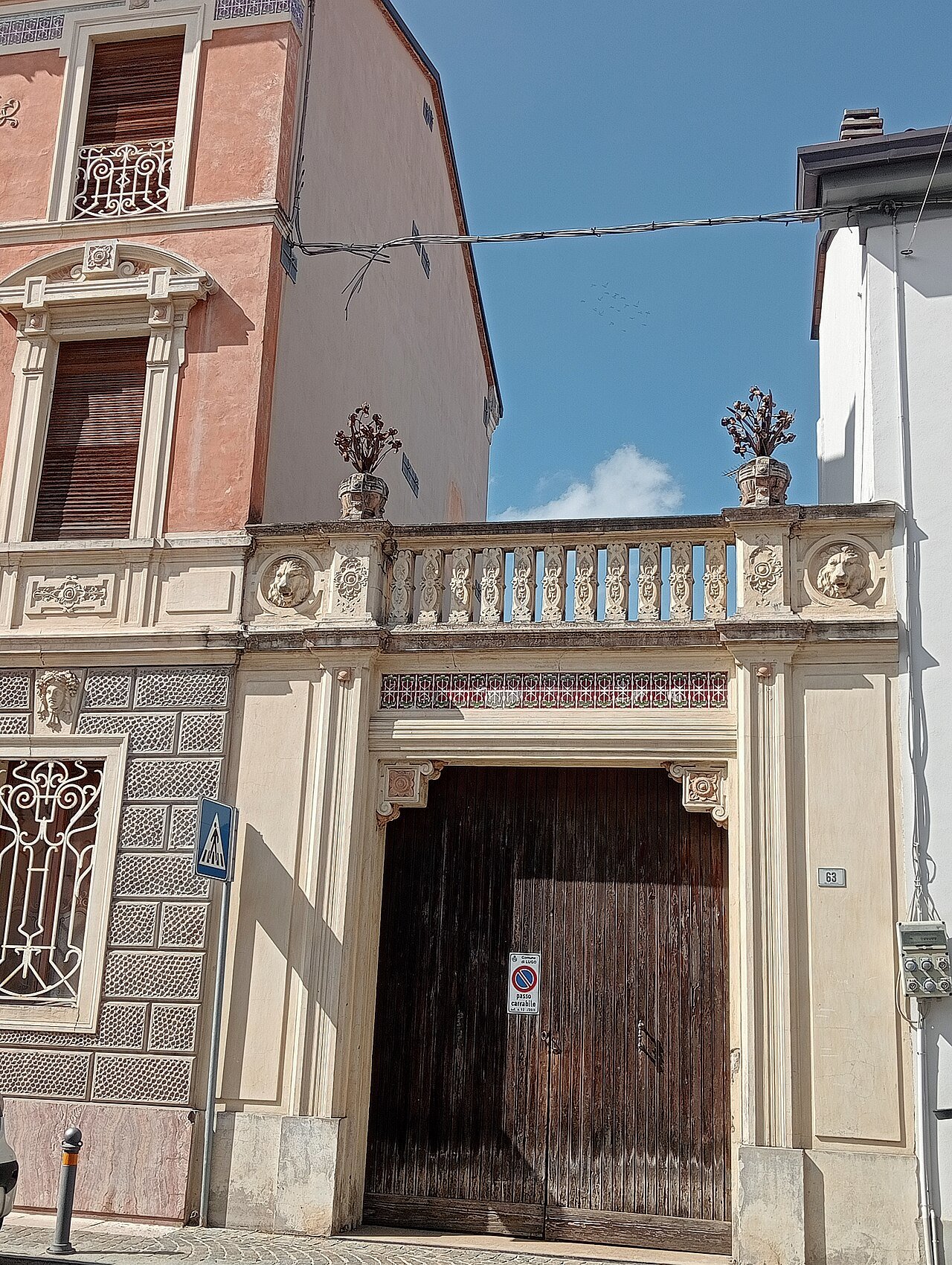
Every Ferrari built since 1932 carries a black horse on a yellow shield. The horse was painted on the side of a fighter aircraft by a pilot from Lugo, and it was his mother who suggested giving it to a young racing driver named Enzo Ferrari. This is the house where the pilot was born.
At a glance
The Museo Francesco Baracca occupies the house on viale Baracca where Italy’s highest-scoring fighter pilot of the First World War was born in 1888. It is one of the oldest aviation museums in Italy: the town council founded it in 1924 and it opened in 1926, in the rooms of Lugo’s Rocca estense. In 1993 it moved into the family home, which Baracca’s father had left to the town for exactly that purpose. Its centrepiece is an original SPAD VII fighter. In 2026 the museum turns one hundred, and admission is free while the building is being enlarged.
Key facts
- Founded: by resolution of the Lugo town council, 3 October 1924
- Opened: 16 June 1926, in the Rocca estense, in the presence of Crown Prince Umberto of Savoy
- Moved to the birthplace: 1993, under the will of Baracca’s father, Count Enrico
- Francesco Baracca: born in this house on 9 May 1888, killed on the Montello on 19 June 1918; 34 aerial victories; gold medal for military valour
- Star exhibit: the original SPAD VII S2489 of the 91st Fighter Squadron, which Baracca commanded, flown in late 1917 and early 1918
- Also held: the wreck of a German DFW C.V brought down in 1917; the Baldini collection of nearly 3,000 First World War propaganda postcards; decorations, uniforms and letters given by the family in 1951
- Address: viale Francesco Baracca 65, 48022 Lugo (RA) — 44.4173 N, 11.9092 E
History
Francesco Baracca was born in Lugo on 9 May 1888, the son of Count Enrico Baracca and Countess Paolina Biancoli. He went to the military academy at Modena, transferred to the new air arm, and by the end of the war was the most successful Italian fighter pilot, with thirty-four confirmed victories. He was shot down over the Montello on 19 June 1918, at the age of thirty.
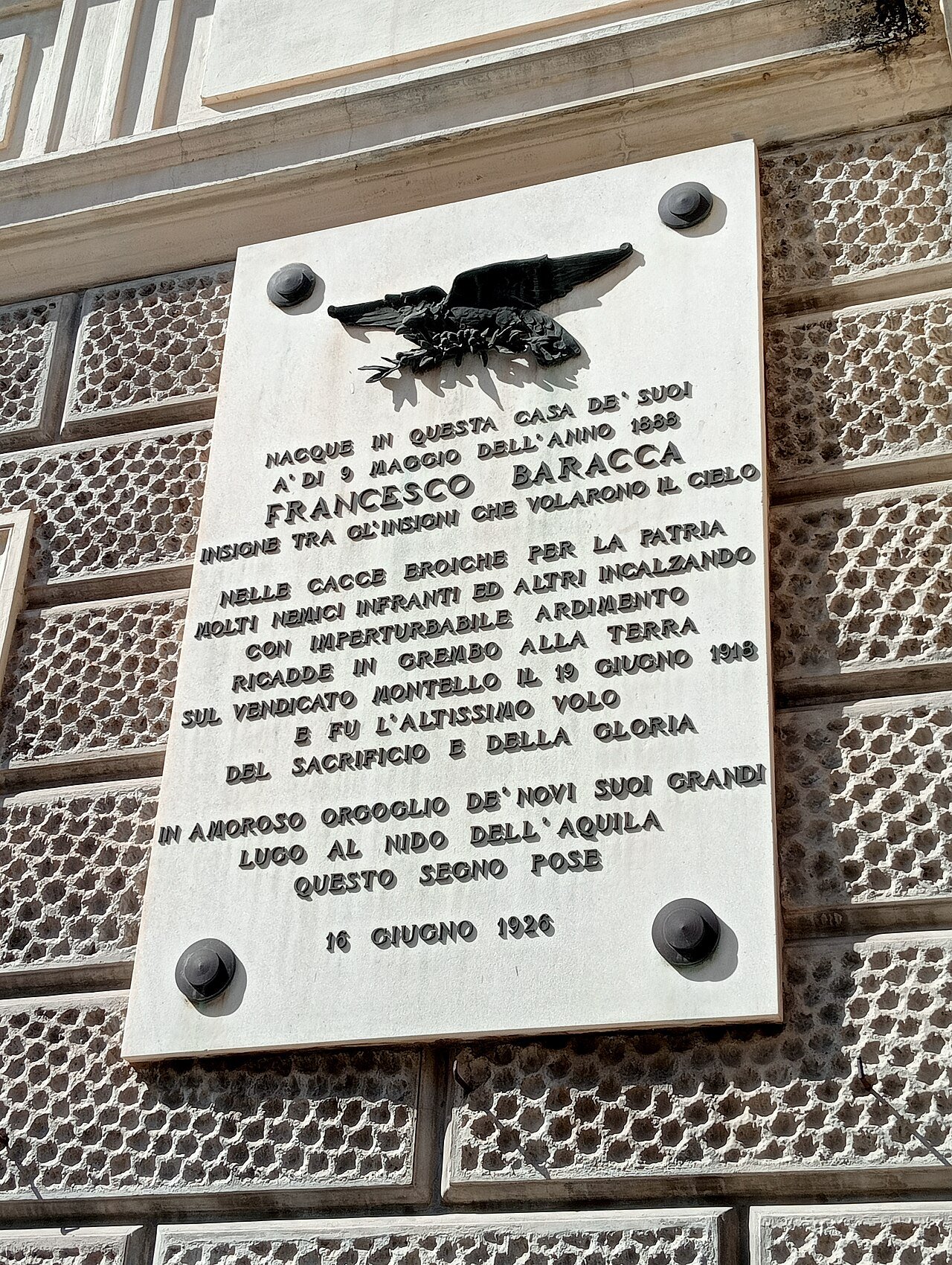
Lugo began building his memory almost at once. The town council voted to found a museum on 3 October 1924, and it opened on 16 June 1926 inside the Rocca estense, in a hall decorated for the occasion; the heir to the throne, Prince Umberto of Savoy, attended. On the same day a marble plaque went up on the front of the house where Baracca had been born, ending with the words Lugo al nido dell’aquila questo segno pose — Lugo set this sign on the eagle’s nest.
The family kept giving. In 1951 Baracca’s relatives handed over his decorations, diplomas, correspondence, uniforms and personal effects. His father had left instructions that the birthplace should one day hold the collection, and in 1993 the museum finally moved the few hundred metres from the fortress into the house on viale Baracca, where it has been ever since.
What you see
From the street the museum does not announce itself as a museum. It is a nineteenth-century town house with a stone doorway, a balustrade of small columns above the entrance and two lions’ heads carved at the corners; the plaque of 1926, with its bronze eagle, is fixed to the wall beside it. The rooms inside are domestic in scale, which is part of the effect: the objects of a national hero are laid out in the rooms of a provincial family.
The aircraft is the exception. The SPAD VII S2489 is an original machine of the 91st Squadron, the unit Baracca led, and it stands in the museum as an object rather than a replica — wood, wire and doped fabric, the technology that decided the air war of 1917. Beside it lie the remains of a German DFW C.V reconnaissance aircraft shot down in 1917. The Baldini collection of some three thousand propaganda postcards fills out the other half of the story: how the war was sold at home while it was being fought.
Cultural significance
Baracca painted a prancing black horse on the fuselage of his aircraft as his personal emblem. On 17 June 1923 a young driver named Enzo Ferrari, then racing for Alfa Romeo, won the Circuito del Savio near Ravenna and met Baracca’s parents; Countess Paolina Biancoli gave him leave to put her son’s horse on his cars, so that it would bring him luck. Ferrari kept the horse black and added a canary-yellow ground, the colour of Modena. The badge appeared on the cars of Scuderia Ferrari in 1932, and it has not moved since.
That is why this small municipal museum in the Romagna plain matters beyond Lugo. It holds the origin of one of the most recognised marks in the world, and it holds it in its first form: not a brand, but a fighter pilot’s private sign, in the house where he was born.
Practical information
- Opening days during the centenary works: Thursday and Friday 15.30-18.30; Saturday and Sunday 10.00-12.00 and 15.30-18.30.
- Admission is currently free while the museum is being enlarged. Outside this period the normal ticket is a low municipal charge, with the usual reductions.
- Hours change between the winter and summer timetables: check before travelling.
- Contact: museobaracca@comune.lugo.ra.it, +39 0545 299105.
- 2026 is the museum’s centenary year, with concerts, exhibitions and conferences running from May onwards.
Getting there
Lugo lies in the Bassa Romagna, between Ravenna and Imola. The town has a station on the Lavezzola-Faenza line, and the museum is a short walk from the centre; Ravenna is about half an hour away by road, Bologna a little over an hour. Coming by car, the A14 exits at Bagnacavallo-Lugo. The house stands on viale Baracca, on the ring of avenues around the old town.
Sources
- Comune di Lugo — Museo Francesco Baracca (foundation 1924, opening 1926, move to the birthplace in 1993, 1951 donation)
- Museo Baracca — official site (collections, SPAD VII, Baldini postcards, opening times)
- Motor Web Museum — the story of the prancing horse (Circuito del Savio, 17 June 1923; Countess Paolina; the yellow of Modena; 1932)
- Ferrari — the first appearance of the prancing horse on the Scuderia’s cars
- Ministero della Difesa — the prancing horse and Francesco Baracca
- Regione Emilia-Romagna, Patrimonio culturale — Cent’anni di Museo Baracca (2026 centenary)
- The dates of Baracca’s birth and death are those cut into the plaque of 16 June 1926 on the front of the house.
Find it on the map
See this place and what’s around it →Record researched and written by Luigi De Marchi for Cultural Heritage Online, 2026.
📷 Become a Cultural Heritage Online photographer
Share your photos of places: they stay published under your name as the author. The more they're seen, the more you get noticed — and soon a contest will reward the most appreciated photos.
Log in or sign up free to add a photoIs this page about you?
This page is read by travellers and heritage enthusiasts who find it on Google. Tell us how you are connected to this place and we will take it from there.