
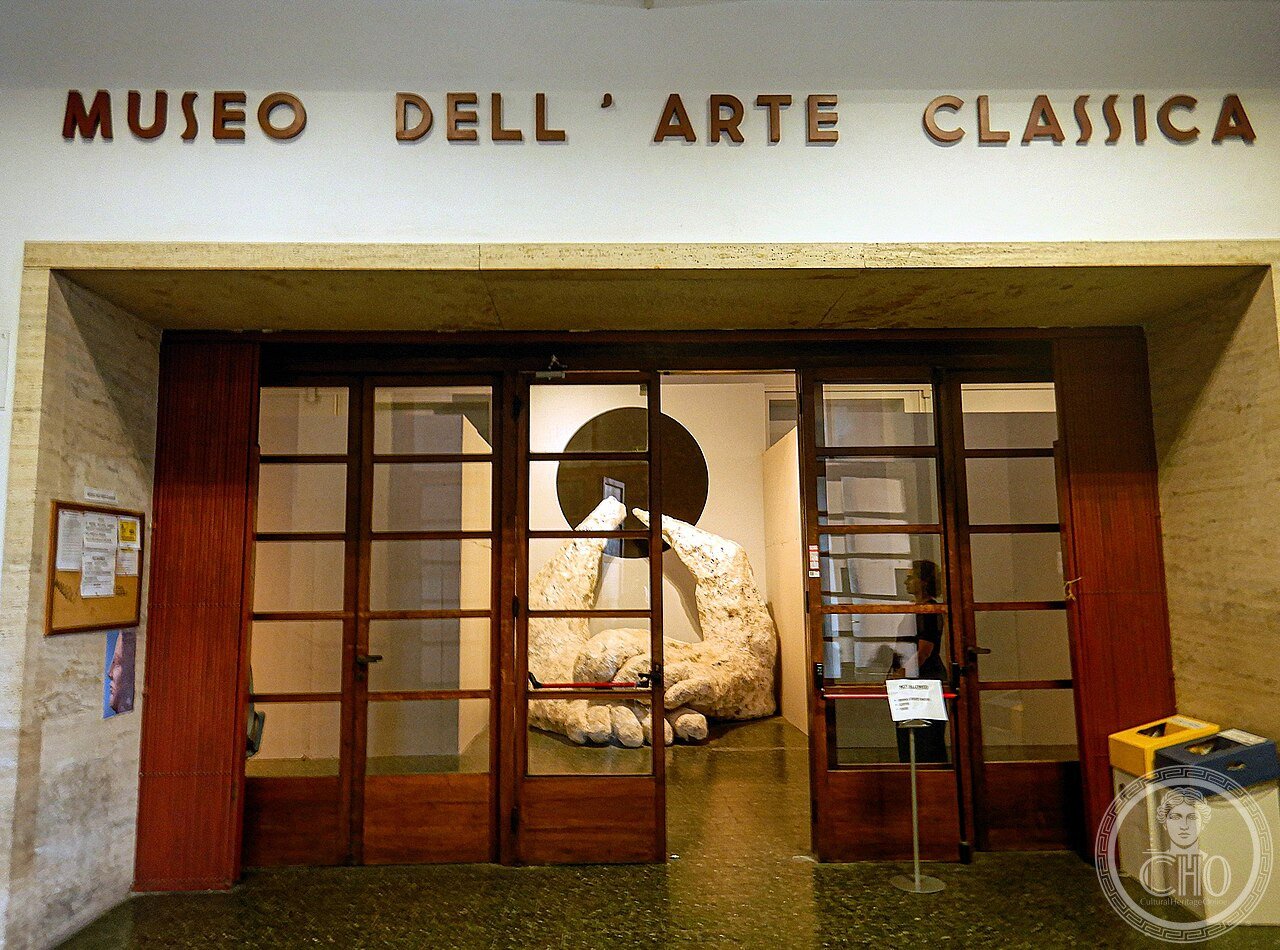
Over a thousand plaster casts of Greek and Roman sculpture, assembled by an Austrian archaeologist for students who could not travel to see the originals — and, in several cases, casts of copies whose originals are now lost.
At a glance
The Museo dell’Arte Classica — also known as the Museo dei Gessi, the plaster-cast museum — belongs to Sapienza University’s Department of Antiquity Sciences. It was founded in 1892 by the Austrian archaeologist Emanuel Löwy, who wanted his students to be able to study Greek and Roman sculpture directly, rather than from photographs, at a time when the originals were scattered across museums that few of them would ever visit.
Key facts
- Founded — 1892, by the archaeologist Emanuel Löwy
- Collection — more than 1,000 plaster casts, from the Archaic period to the late Hellenistic, plus a collection of gem impressions
- Location — the Faculty of Lettere e Filosofia, Città Universitaria, Sapienza
- Layout — 56 rooms, including space used for lectures, conferences and temporary exhibitions at the Odeion
- Type — a university teaching museum, not generally open on the walk-in basis of a public museum
History
Casting plaster copies of celebrated sculptures was standard practice in nineteenth-century European universities and academies, and Löwy’s museum belongs squarely to that tradition. What makes the Sapienza collection useful beyond teaching is that it sometimes holds several independent casts of the same lost original, made from different surviving Roman copies: set side by side, they let a viewer compare how faithfully — or not — each copyist rendered a Greek bronze or marble that no longer exists in any form.
What you see
The collection runs from the Archaic period through to the late Hellenistic, so it functions as a walkable timeline of Greek sculpture: the stiff frontal poses of early kouroi give way, room by room, to the classical balance of the fifth and fourth centuries BC and then to the more theatrical, twisting compositions of the Hellenistic age. Because these are casts rather than the marbles or bronzes themselves, surface texture and colour are lost, but proportion, pose and composition — the things a plaster cast actually preserves well — are easy to study up close, without the barriers and distance of a major museum.
Practical information
As a university teaching collection rather than a public museum, the Museo dell’Arte Classica does not keep the fixed opening hours of a state or municipal museum. Visits are generally by appointment, arranged directly with the Department of Antiquity Sciences (Dipartimento di Scienze dell’Antichità); the museum is also used for lectures, conferences and temporary exhibitions in its Odeion space.
Getting there
The museum is inside the Faculty of Lettere e Filosofia, in the Città Universitaria campus at Piazzale Aldo Moro 5, in the San Lorenzo district. The campus is a short walk from Roma Termini station and is served by several city bus and tram lines along Viale delle Scienze and Via dei Marsi.
Sources & resources
- Polo museale Sapienza — Wikipedia (IT), for the museum’s founding by Emanuel Löwy in 1892, the size and scope of the cast collection, the gem-impression holdings, and the 56-room layout at the Faculty of Lettere e Filosofia
Find it on the map
See this place and what’s around it →Historical events at this place (1)
📷 Become a Cultural Heritage Online photographer
Share your photos of places: they stay published under your name as the author. The more they're seen, the more you get noticed — and soon a contest will reward the most appreciated photos.
Log in or sign up free to add a photoIs this page about you?
This page is read by travellers and heritage enthusiasts who find it on Google. Tell us how you are connected to this place and we will take it from there.