

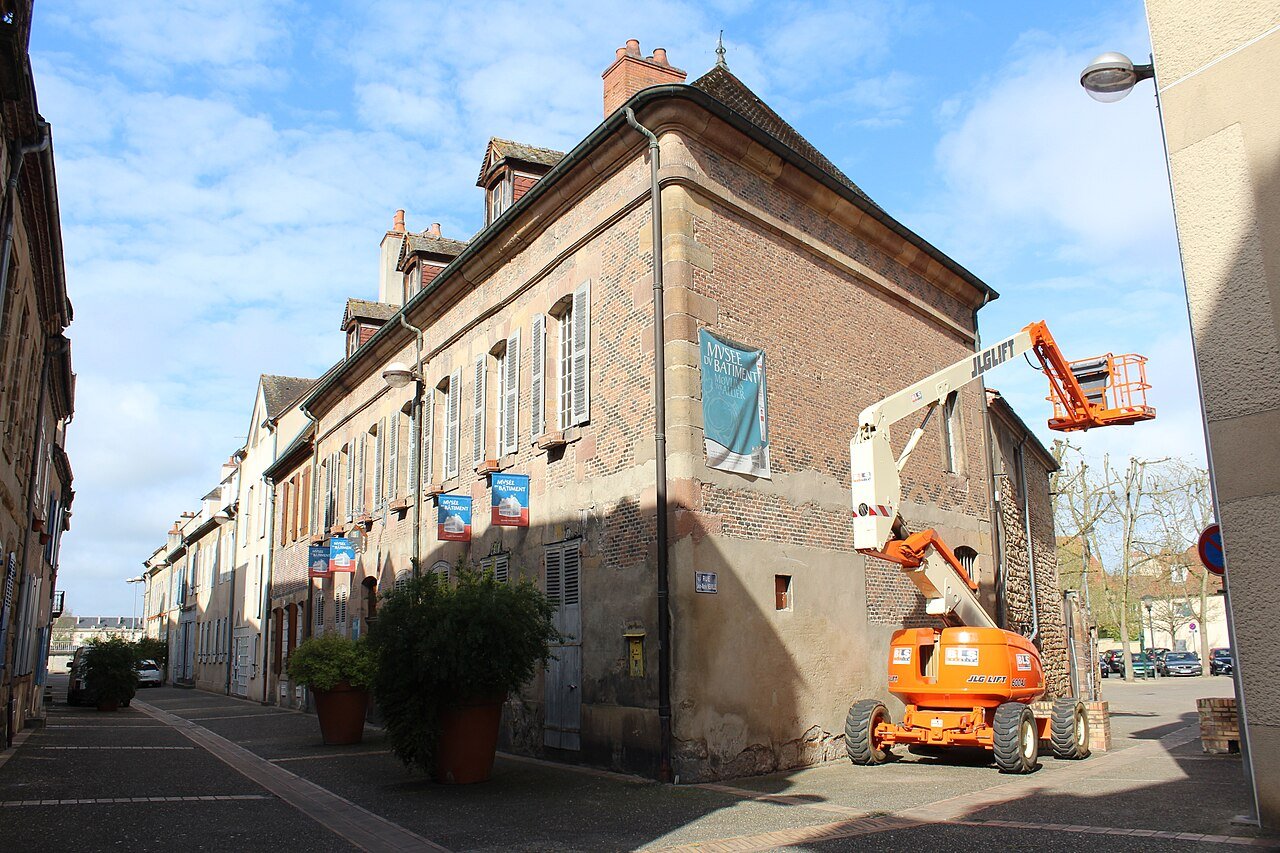

A museum about the people who build buildings, in a building they built. The tourist office calls it the only one of its kind in France.
At a glance
Most museums of architecture are about architects. This one is about everyone else: masons, carpenters, roofers, plasterers, glaziers, the trades that turn a drawing into a wall. It occupies an eighteenth-century town house on rue du Pont Ginguet, in the riverside Madeleine quarter of Moulins, a building that once housed the Compagnons du Devoir — the French craft guilds whose training system still exists. Admission is free. The collections are tools, scale models, plans, drawings and trade signs, and the museum opens for one season a year, roughly May to early October.
Key facts
- Building: eighteenth-century town house in stone and brick, described locally as a former mariners’ bank
- A note on the description: local tourist listings call it a half-timbered house. The street facade is stone and brick with dressed stone window surrounds; the only timber framing is in the roof dormers
- Earlier use: home to the Compagnons du Devoir, the French craft guild network
- Subject: the building trades — tools, techniques, models, plans and drawings
- Admission: free
- 2026 season: 7 May to 4 October, Wednesday to Sunday, 14:00–18:00
- Address: 18 rue du Pont Ginguet, 03000 Moulins, France
History
Moulins grew on the Allier, and the Madeleine quarter grew on the river trade. The house that now holds the museum belongs to that world: eighteenth century, and by local account a bank used by the river boatmen. Later it passed to the Compagnons du Devoir, the guild network that has trained French building craftsmen since long before the term heritage conservation existed. That lineage is why the collection ended up here rather than in a purpose-built hall.
The museum was formed around the trades rather than around a single donor or architect. Its object is the chantier — the building site — taken apart into the crafts that make it: how a wall is raised, how a roof is framed, how stone is cut and glass is set. The displays are organised by trade, with a documentary section covering vocabulary, technique and the anatomy of a building site.
Each year the museum mounts one temporary exhibition. In 2026 it turns to the interwar decade, and to a decorator whose work is still standing five minutes away.
What you see
The facade is the first exhibit, and it is a lesson in reading a wall. Rubble stone and brick, patched and re-patched over three centuries, with dressed stone surrounds around tall shuttered windows and a wide arched carriage door at no. 18. Look up and the roof carries small timber-framed dormers — the only wood in the elevation, and the detail that has led more than one guidebook to call the whole house half-timbered. The museum inside spends its rooms explaining exactly this kind of construction.
The collection is dense rather than monumental: plane and adze, plumb line and level, roof trusses in miniature, glaziers’ irons, the drawings by which a shape passes from one head to another. Scale models do the work that photographs cannot, showing a roof frame from underneath. It takes about an hour, and the pleasure is in recognising, at the end, the joints holding up the ceiling above you.
Practical information
- Open one season a year; in 2026, 7 May to 4 October, Wednesday to Sunday, 14:00–18:00
- Admission free; groups by appointment
- Ground floor partially accessible by wheelchair
- Allow about an hour
- Entry is included in the Moulins City Pass
Getting there
Moulins is on the Paris–Clermont-Ferrand railway, a little over two and a half hours from Paris Bercy, and the station is a walk from the centre. The museum stands in the Madeleine quarter near the Allier, about fifteen minutes on foot from place d’Allier. Clermont-Ferrand is the nearest airport, roughly an hour and a half by road. Coordinates: 46.5639, 3.3256 (Google Maps).
Nearby
- The Grand Café on place d’Allier, built from 1898 to a design by Louis Galfione and opened in 1899, with stucco pilasters, mirrors and a painted ceiling by Auguste Sauroy
- Moulins cathedral, whose anonymous master painter is one of the puzzles of French late-Gothic art
- The Centre National du Costume et de la Scène, in a converted cavalry barracks
Sources
- Musée du Bâtiment, official site
- Office de tourisme de Moulins, building history, season and access
- Grand café (Moulins), French Wikipedia, for the Galfione attribution and the 1898–1899 dates
- OpenStreetMap Nominatim, coordinate verification at 18 rue du Pont Ginguet
Find it on the map
See this place and what’s around it →Historical events at this place (1)
📷 Become a Cultural Heritage Online photographer
Share your photos of places: they stay published under your name as the author. The more they're seen, the more you get noticed — and soon a contest will reward the most appreciated photos.
Log in or sign up free to add a photoIs this page about you?
This page is read by travellers and heritage enthusiasts who find it on Google. Tell us how you are connected to this place and we will take it from there.