

.jpg)
A merchant’s country house on the edge of Marseille, built to outdo every other bastide in Provence, now the city’s museum of decorative arts, faience and fashion.
At a glance
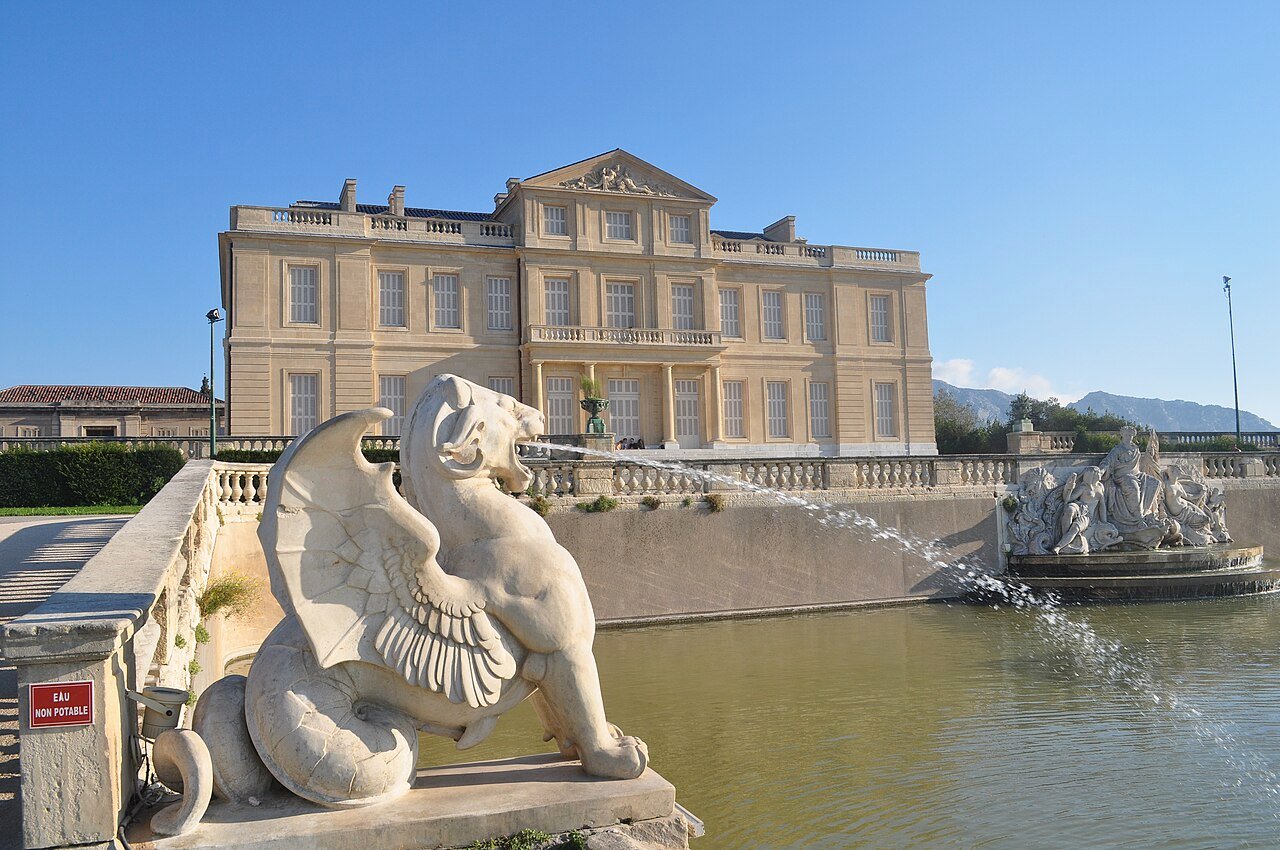
The building sits at the end of a long ornamental basin in the Parc Borély, three storeys of pale limestone with a sculpted pediment and a stone balustrade running the whole length of the roofline. Two pavilions frame the main block. Water from a winged lion fountain crosses the basin towards the facade, and on a clear morning the light off that water reaches the first-floor windows. Louis Borély, a Marseille merchant who made his fortune in trade with Egypt, commissioned it in 1767. He died the following year and never saw it finished. Since 2013 the interior has held the Musée des Arts décoratifs, de la Faïence et de la Mode.
Key facts
- Built: 1767–1778, for Louis Borély (1692–1768)
- Design: facade project by Charles-Louis Clérisseau (1721–1820), revised by Marie-Joseph Peyre (1730–1785); site works overseen by Esprit Brun
- Interior painting: Louis Chaïx, of Aubagne — trompe-l’œil, camaïeu panels and mythological ceilings
- Style: neoclassical, conceived as a Provençal bastide on an unusually large scale
- Protection: classified historic monument since 1936; the wider Borély estate registered by decree of 5 September 2024
- Today: Musée des Arts décoratifs, de la Faïence et de la Mode, City of Marseille
History
Clérisseau submitted his facade project on 1 September 1767. It was judged too Italian in feeling for a Marseille estate, and Peyre — then attached to the king’s buildings — kept the ground plan but raised the elevations and reworked the ornament into something recognisably French. That double authorship is why the building reads as neither a Roman villa nor a Paris hôtel, but as a Provençal country house given the proportions of a château.
Borély died in 1768, a year into the work. His heirs carried the project to completion in 1778. The estate passed to the City of Marseille in the nineteenth century, and from 1863 to 1989 the rooms held the city’s archaeology collections. A restoration begun in 2009 emptied and reworked the interiors; the decorative arts museum opened here for Marseille-Provence 2013.
What you see
From the basin the facade is symmetrical and almost severe: three registers of tall windows, a shallow central projection carrying the pediment, and figures standing along the balustrade against the sky. The stone is pale and dry-looking, closer to the local limestone of the Marseille hills than to anything imported. Nothing curves. The decoration is carried entirely by proportion and by the sculpted pediment.
Inside, the register changes completely. Chaïx painted the ceilings and panels in trompe-l’œil and camaïeu, and an oval private chapel survives in marble — the one room where the building drops the restraint of its exterior. The museum uses these rooms for faience, furniture and fashion, so the eighteenth-century decoration is read against the objects rather than on its own.
Practical information
- Open Tuesday to Sunday, 9am–6pm; closed Mondays
- Address: 132 avenue Clot Bey, 13008 Marseille
- Temporary exhibitions are ticketed; free entry on the first Sunday of each month
- Allow 90 minutes for the museum, longer if you walk the park
Getting there
The château stands in the Parc Borély, in the eighth arrondissement south of the Vieux-Port, about twenty minutes by bus from the city centre and a short walk from the Prado beaches. Marseille Saint-Charles is the main rail station; Marseille Provence airport is roughly 30 km north. Coordinates: 43.2573, 5.3820 — open in Google Maps.
Sources
Find it on the map
See this place and what’s around it →Events here — now on & upcoming
- Art nouveau – Art déco. Marseille au cœur des styles08 May 2026 — 25 Apr 2027See the event →
📷 Become a Cultural Heritage Online photographer
Share your photos of places: they stay published under your name as the author. The more they're seen, the more you get noticed — and soon a contest will reward the most appreciated photos.
Log in or sign up free to add a photoIs this page about you?
This page is read by travellers and heritage enthusiasts who find it on Google. Tell us how you are connected to this place and we will take it from there.