
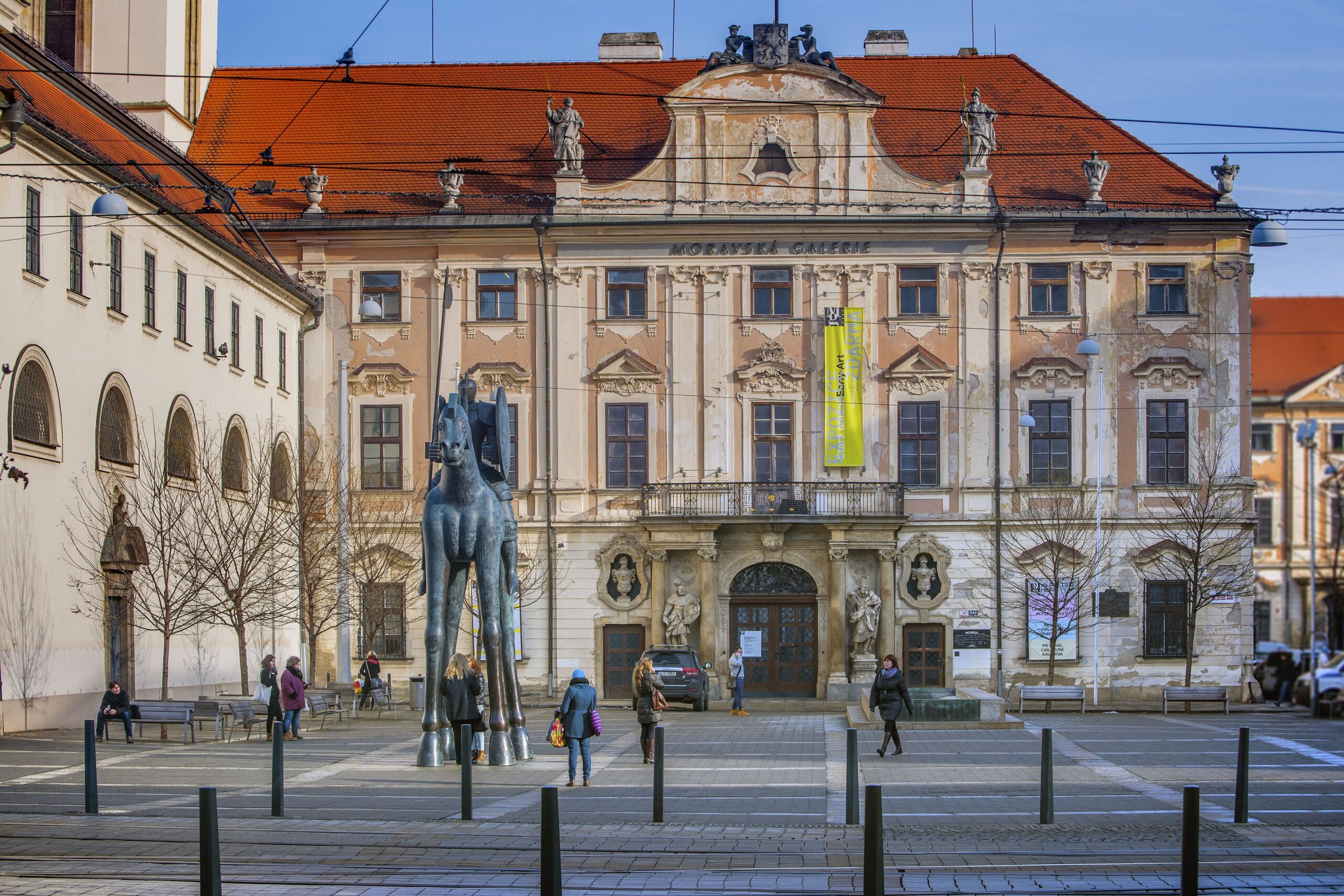
The second largest art museum in the Czech Republic, spread across five historic buildings and a vital hub for contemporary design discourse.
At a glance
The Moravian Gallery occupies five distinct structures throughout Brno: Pražák Palace, Governor’s Palace, the Museum of Applied Arts, Jurkovič House, and the Josef Hoffmann Museum. This distributed model allows the institution to present diverse collections while activating multiple important architectural landmarks across the city.
History
Established in 1961 through the merger of two older institutions, the Moravian Gallery brought together previously separate collections under unified stewardship. Since 1963, it has organized the International Biennial of Graphic Design Brno, establishing itself as a significant venue for contemporary visual culture and design innovation.
What you see
The gallery’s five-building structure means visitors encounter varied architectural styles and periods. Pražák Palace and the Governor’s Palace represent civic heritage, while Jurkovič House and the Josef Hoffmann Museum offer insights into early modern design philosophy through their buildings themselves. The Museum of Applied Arts anchors the collection’s focus on functional aesthetic traditions.
Cultural significance
As Czechia’s second largest art museum, the Moravian Gallery serves as both custodian and curator of Central European artistic practice. Its role as host of the biennial graphic design festival extends its influence beyond static exhibition into the realm of contemporary creative discourse and international artistic exchange.
Key facts
- Location: Brno, Czechia
- Established: 1961
- Coordinates: 49.1955, 16.6044
- Comprises five buildings with distinct collections
- Organizes the International Biennial of Graphic Design Brno since 1963
Practical information & getting there
The gallery’s multi-location structure requires planning your visit. Check opening hours for each building, as operating schedules may vary. Public transport in Brno connects to all five sites.
Sources & resources
Find it on the map
See this place and what’s around it →📷 Become a Cultural Heritage Online photographer
Share your photos of places: they stay published under your name as the author. The more they're seen, the more you get noticed — and soon a contest will reward the most appreciated photos.
Log in or sign up free to add a photoIs this page about you?
This page is read by travellers and heritage enthusiasts who find it on Google. Tell us how you are connected to this place and we will take it from there.