

A fishing town on the Ionian coast raised the money for its memorial by running a lottery, and put the result in the middle of a fountain. Many of the men listed on it are sailors. The square around it has been renamed twice.
At a glance
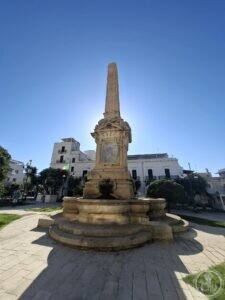
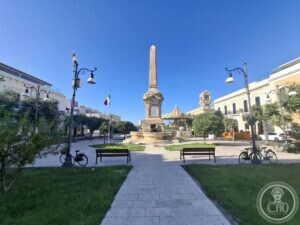
A tall obelisk in warm local limestone stands on a heavily carved pedestal — broken pediment, volutes, stone garlands — and the whole thing rises from a shallow circular basin fed by a lion-mask spout, set on a stepped platform. It is in the middle of a small square planted with olives and clipped trees, and on a normal afternoon there are bicycles against the benches and a carousel turning at the far end. It was designed by Franco Manfredi, a native of Gallipoli, and inaugurated on 23 March 1924.
Key facts
- What it is: the town war memorial to the fallen of the First World War, in the form of an obelisk set in a fountain
- Where: piazza Giacomo Matteotti, Gallipoli, province of Lecce, Puglia
- Inaugurated: 23 March 1924
- Architect: Franco Manfredi (Lecce 1883 – Naples 1968), born in Gallipoli
- Paid for by: a large public lottery
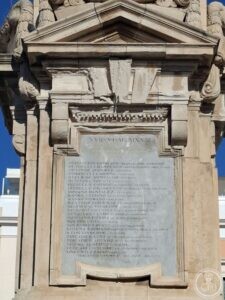
- Names: seventy-five men of Gallipoli fallen in the First World War, on three marble plaques; the fourth plaque carries the victory bulletin
History
The monument belongs to the first years of the Fascist period, but not to its architecture: it is a piece of late academic classicism, and its funding was a civic affair. The money came from a large lottery run for the purpose, which in a town of fishermen and small traders was the practical way to pay for a monument nobody could otherwise afford.
The square it stands in has changed names with the politics. It was first dedicated to Armando Casalini, a Fascist deputy killed in 1924. After the fall of the regime it was renamed after Giacomo Matteotti, the socialist deputy murdered by Fascist squadristi in the same year. Two men killed in the same twelve months, and a square that has commemorated first one and then the other.
What you see
The obelisk is plain and slightly tapered, with a rounded top. Everything decorative is concentrated in the pedestal below it: a broken pediment supported on paired pilasters, corner volutes carved as thick ropes or garlands, dentils under the cornice, and on each face a framed marble plaque. The basin beneath is a simple stone bowl in two lobes, with water running from a carved mask into the pool.
The plaques repay a slow read. They are set out in alphabetical order and each name carries a rank: soldato, marinaio, bersagliere zappatore, tenente, and twice a decoration — Petrelli Francesco, second lieutenant, gold medal; Spagna Corrado, second lieutenant, silver medal. Where two men shared a surname the stonecutter added the father’s name to tell them apart: Rizzello Giorgio di Emidio and Rizzello Francesco di Sebastiano. The proportion of marinai is the town itself, written on stone.
Practical information
- Open square, free, visible at any hour; the fountain runs.
- The plaques are at eye level and can be read in full from the platform.
- Our map point marks the monument in piazza Matteotti.
Getting there
Gallipoli is on the Ionian coast of the Salento, about 40 km south-west of Lecce, with a railway station on the Sud-Est line. The square lies in the modern town, a short walk from the bridge to the old island town.
Nearby
- The old town of Gallipoli on its island, and the Angevin castle.
- The cathedral of Sant’Agata.
- The Parco della Rimembranza, the memorial grove.


Look around it
Google Street View opens on the nearest panorama to this point: Piazza Matteotti in Street View.
Sources
- Local historical documentation of Gallipoli for the architect Franco Manfredi, a native of the town, the inauguration on 23 March 1924, the lottery that financed the work, the seventy-five names on three plaques and the victory bulletin on the fourth, and the renaming of the square from Armando Casalini to Giacomo Matteotti.
- National photographic heritage catalogue (ICCD), record of the Obelisco ai Caduti per la Patria, Gallipoli, architect Franco Manfredi.
- The plaque text quoted above is transcribed from the photographs supplied by Stefano Vigolo.
Find it on the map
See this place and what’s around it →Record researched and written by Stefano Vigolo for Cultural Heritage Online, 2026.
📷 Become a Cultural Heritage Online photographer
Share your photos of places: they stay published under your name as the author. The more they're seen, the more you get noticed — and soon a contest will reward the most appreciated photos.
Log in or sign up free to add a photoRequest to use these images
Each photograph is by the person named on it. Cultural Heritage Online is the seller: it runs the payment, handles tax and delivers the file, and the photographer receives 70% of the price net of tax. Buying gives you the right to use the image in your own project — a website, an article, a presentation — with the file and a written licence. Read the Terms of Sale.
What you receive. The file as it is held in our archive: the photographer's own original, without the Cultural Heritage Online watermark, unretouched and not enlarged. This is a working archive built over many years by many people, so the files differ — some were taken recently, others years ago with the equipment of their time. Older pictures are usually smaller: a camera from fifteen or twenty years ago simply recorded fewer pixels than a phone does today, so the resolution is lower and the print comes out smaller. We say so rather than hide it. The size, weight, format and year of each one are printed below it, and the print size is given at 300 dpi. Nothing is upscaled to make a number look better. Where the picture on this page has been cropped for the layout, the file you receive is the full frame, which may be wider or taller than what you see here.
Monumento ai Caduti
Photo: Stefano Vigolo
€3.00
1536 × 2048 px · JPG · 179.3 KB
prints 13 × 17 cm at 300 dpi
Monumento ai Caduti
Photo: Stefano Vigolo
€3.00
1536 × 2048 px · JPG · 223.7 KB
prints 13 × 17 cm at 300 dpi
Monumento ai Caduti
Photo: Stefano Vigolo
€3.00
2048 × 1536 px · JPG · 253.2 KB
prints 17 × 13 cm at 300 dpi
Is this page about you?
This page is read by travellers and heritage enthusiasts who find it on Google. Tell us how you are connected to this place and we will take it from there.