
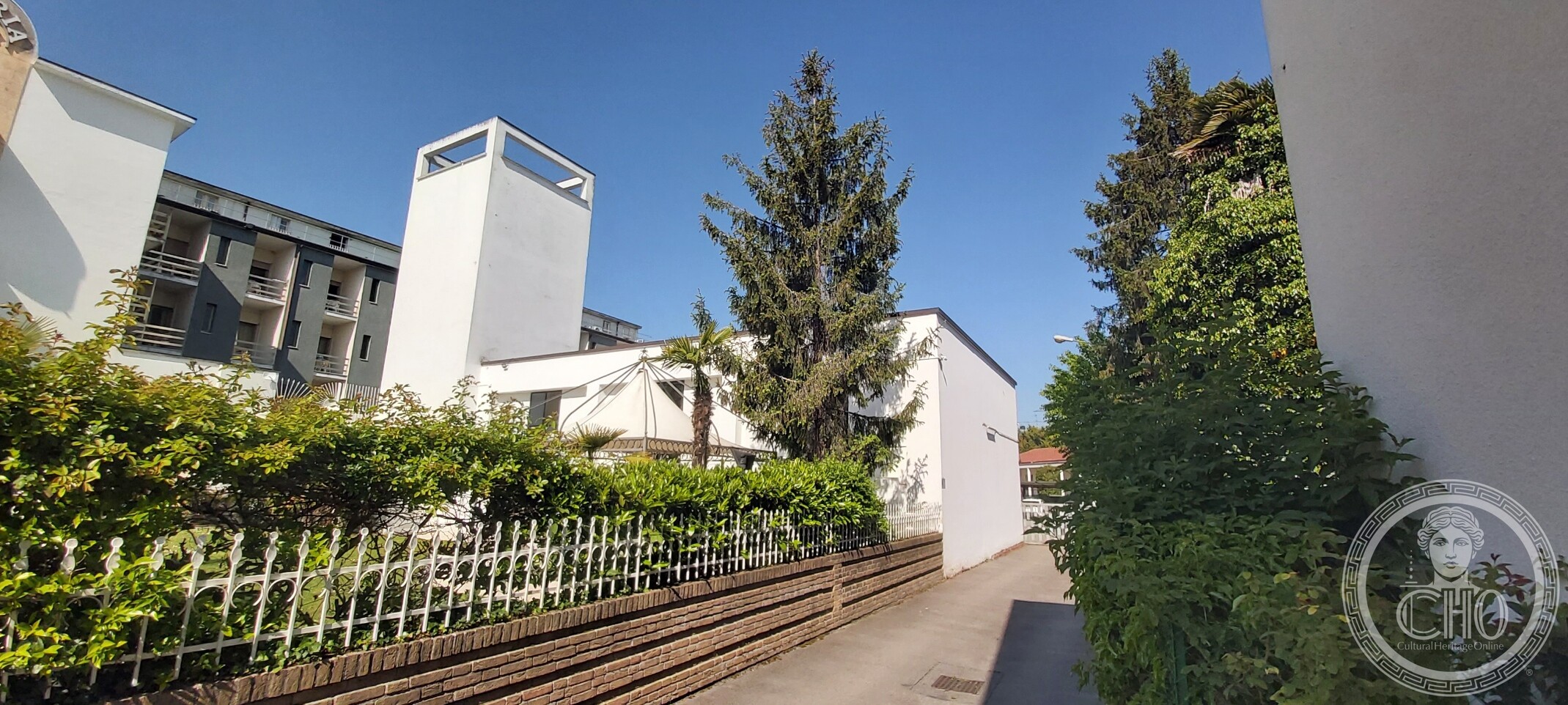
Daniele Calabi built eight party headquarters across the province of Padua while he was still in his twenties. In 1938 the racial laws took away his right to practise, and he left for Brazil. His tower still stands in Abano, in the garden of a spa hotel, among the palm trees.
At a glance
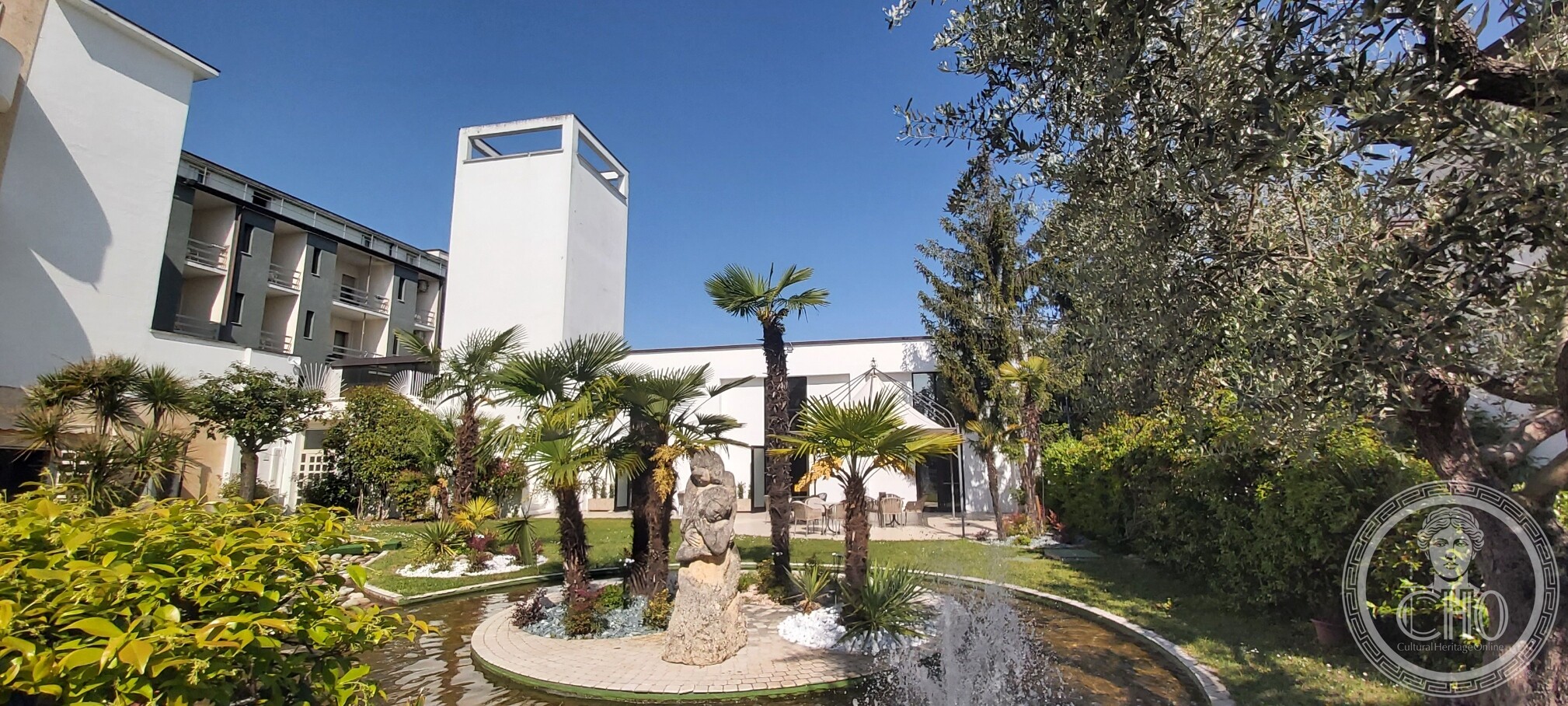
What survives is a white rendered tower, plain to the point of severity, with an open frame at the top where a belvedere or a flagstaff once stood, and a low white block attached to it. It sits inside the grounds of a hotel on viale delle Terme, and the setting has changed completely around it: lawn, palms, an olive tree, a fountain, garden chairs. Calabi designed it in 1934–35, when he was twenty-eight, for the local branch of the National Fascist Party.
Key facts
- What it is: the surviving tower and block of a Fascist party headquarters, now inside private hotel grounds
- Where: viale delle Terme, Abano Terme, province of Padua, Veneto
- Built: 1934–35
- Architect: Daniele Calabi (Verona 1906 – Venice 1964)
- Client: the Abano branch of the Partito Nazionale Fascista
- Access: private grounds; visible from the street and the adjoining lane
History
Between the early 1930s and 1938 Daniele Calabi, a young architect from Verona working out of Padua, built party headquarters for a string of towns in the province: Abano Terme, San Giorgio in Bosco, Mestrino, Codevigo, Camin, Urbana, Sant’Angelo di Piove and Vighizzolo d’Este. He also designed the astrophysical observatory at Asiago, inaugurated on 27 May 1942. It was a busy, promising practice.
Then, in 1938, the racial laws came. Calabi was Jewish. Persecution drove him to emigrate to São Paulo, where at first he could not even sign his own drawings and worked for a cousin’s construction firm before setting up on his own, largely for the Italian community in Brazil. He came back to Italy after the war and opened offices in Milan, Padua and the Venice Lido. His old people’s home at Gorizia won the international Andrea Palladio prize in 1960; his paediatric clinic in Padua took an IN/ARCH regional award in 1961; he restored the Tolentini convent in Venice and the Biblioteca Augusta in Perugia. He died in Venice in 1964.
What you see
The tower is a plain white shaft with no ornament at all, capped by an open rectangular frame — the void where the top storey opens through. Below and behind it runs a single-storey white volume with a flat roof, its window openings cut without surrounds. The whole thing is the stripped, cubic language a young rationalist could get past a provincial party committee in 1934: no columns, no fasces carved in stone, no inscription.
What has changed is everything around it. The building now stands in a hotel garden, with palms and yuccas planted against it, a circular pool with a fountain, a stone sculpture, tables and chairs on the grass. From certain angles the tower reads as a piece of garden architecture. That it survives at all is largely because it was absorbed rather than demolished.
Reading the building
Cultural Heritage Online documents buildings of the Fascist period because they are evidence, and this one carries an uncomfortable piece of evidence in particular. It was designed by a man the regime would expel from his own profession four years later. That is not an irony to be enjoyed; it is a fact about how the period actually worked, and about how many Italian Jews were inside Italian public life until the moment they were thrown out of it. Recording the architecture is not endorsing the politics.
Practical information
- The building is inside the grounds of a hotel on viale delle Terme. It is not a visitor site.
- The tower can be seen from the street and from the service lane alongside.
- Our map point marks viale delle Terme, not the exact position within the grounds.
Getting there
Abano Terme is about ten kilometres south-west of Padua, with frequent buses from the city and a station at Terme Euganee–Abano–Montegrotto. Viale delle Terme is the spine of the spa district.
Nearby
- Montegrotto Terme and the Euganean Hills regional park.
- The abbey of Praglia, 8 km west.
- Padua and its Scrovegni Chapel, 20 minutes by road.
Look around it
Google Street View opens on the nearest panorama to this point: Viale delle Terme in Street View.
Sources
- Biography of Daniele Calabi: dates, the party buildings in the province of Padua listed by town, the Asiago observatory, the effect of the 1938 racial laws, the emigration to São Paulo and the work after his return, including the 1960 Andrea Palladio prize and the 1961 IN/ARCH award.
- Local documentation places the Abano building at 1934–35 and within the grounds of the hotel on viale delle Terme.
- Photographs taken on site by Stefano Vigolo and supplied to Cultural Heritage Online.
Find it on the map
See this place and what’s around it →Record researched and written by Stefano Vigolo for Cultural Heritage Online, 2026.
📷 Become a Cultural Heritage Online photographer
Share your photos of places: they stay published under your name as the author. The more they're seen, the more you get noticed — and soon a contest will reward the most appreciated photos.
Log in or sign up free to add a photoRequest to use these images
Each photograph is by the person named on it. Cultural Heritage Online is the seller: it runs the payment, handles tax and delivers the file, and the photographer receives 70% of the price net of tax. Buying gives you the right to use the image in your own project — a website, an article, a presentation — with the file and a written licence. Read the Terms of Sale.
What you receive. The file as it is held in our archive: the photographer's own original, without the Cultural Heritage Online watermark, unretouched and not enlarged. This is a working archive built over many years by many people, so the files differ — some were taken recently, others years ago with the equipment of their time. Older pictures are usually smaller: a camera from fifteen or twenty years ago simply recorded fewer pixels than a phone does today, so the resolution is lower and the print comes out smaller. We say so rather than hide it. The size, weight, format and year of each one are printed below it, and the print size is given at 300 dpi. Nothing is upscaled to make a number look better. Where the picture on this page has been cropped for the layout, the file you receive is the full frame, which may be wider or taller than what you see here.
Former Casa del Fascio
Photo: Stefano Vigolo
€3.00
2139 × 962 px · JPG · 1,015.0 KB
prints 18 × 8 cm at 300 dpi · taken 2026
Former Casa del Fascio
Photo: Stefano Vigolo
€3.00
2018 × 908 px · JPG · 1.0 MB
prints 17 × 8 cm at 300 dpi · taken 2026
Is this page about you?
This page is read by travellers and heritage enthusiasts who find it on Google. Tell us how you are connected to this place and we will take it from there.