

A twelve-day winter festival of song, satire, and revelry rooted in ancient Greek traditions, Momoeria transforms villages across Kozani into spaces where ritual comedy and pranks celebrate the liminal days between Christmas and Epiphany.
In UNESCO’s words
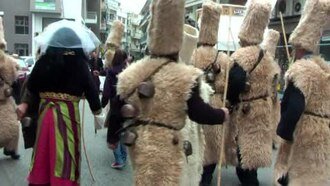
From December 25 to January 5 in Kozani (north-western Greece), dancers, actors and musicians can be seen performing in village streets and visiting people’s homes to celebrate the coming of the new year. The Momoeria dancers, a group made up of 30 male performers, are a special focus. They represent the priests of Momos (god of laughter and satire) or commanders of Alexander the Great wearing helmets, pleated skirts, traditional shoes and brandishing sticks dancing under their leader’s command to convince the powers of nature not to endanger the livelihood of villagers. Actors surround the dancers performing a well-known satirical play featuring characters like an old man and the devil (this can vary among villages) who the audience is invited to tease creating a fun atmopshere. Instruments like the bagpipe play in the background. The practice is mainly to wish the community prosperity in the year ahead, including healthy offspring and good harvests but now also encourages the sustainable management of natural resources. Festivities culminate in the town square with everyone singing and dancing around a fire until morning. Transmitted informally from older to younger generations, it symbolizes part of the community’s cultural identity and helps to build social integration.
Official description, UNESCO Intangible Cultural Heritage List — Momoeria, New Year's celebration in eight villages of Kozani area, West Macedonia, Greece
At a glance
Momoeria is a winter celebration held in Kozani from December 25 to January 5, featuring dancers, actors and musicians performing in streets and homes to welcome the new year. The Momoeria dancers—a group of 30 male performers—dress as priests of Momos, the god of laughter and satire, or as commanders of Alexander the Great, wearing helmets, pleated skirts and traditional shoes. They dance with sticks under their leader's command. Actors perform satirical plays with characters like an old man and the devil, inviting the audience to tease them. Bagpipes provide music throughout.
Origins & history
Momoeria traces its roots to pre-Christian traditions venerating Momus, god of satyr and mischief in ancient Greek religion. The festival survives in Pontic Greek communities, particularly in northern Greece, where it has persisted as a winter ritual marking the threshold between the old year and the new. A closely related custom, Ragoutsaria, is practised in neighbouring regions of Drama, Kozani, and Kastoria.
The practice
Dancers, actors and musicians visit homes and perform in village streets during the twelve-day period. The 30 male Momoeria dancers wear helmets, pleated skirts, traditional shoes and carry sticks, dancing under their leader's direction to persuade the forces of nature to protect the villagers' livelihood. Actors perform satirical plays featuring variable characters depending on the village. Bagpipes play in the background. The festivities end in the town square with everyone singing and dancing around a fire until morning.
Cultural significance
The tradition aims to bring the community prosperity in the coming year, including healthy offspring and good harvests, and now also promotes sustainable management of natural resources. Passed informally from older to younger generations, Momoeria represents part of the community's cultural identity and strengthens social integration.
Key facts
- Country: Greece
- Inscribed: 2016
- UNESCO list: Representative List of the Intangible Cultural Heritage of Humanity
- UNESCO reference: 01184
- UNESCO vocabulary: Dance; New year; Prosperity ritual
- Map: Kozani — the locality named in UNESCO’s official description of this element
Where to experience it
From December 25 to January 5, Momoeria fills the streets and homes of Kozani and its surrounding villages in north-western Greece. During these twelve days, visitors encounter male dancers in traditional costumes performing satirical plays, musicians playing bagpipes, and actors engaging the audience with folk characters. The festivities culminate in the town square where the community gathers around a fire to sing and dance through the night. Local cultural offices can provide details on participating villages and specific performance schedules during the winter season.
Sources & resources
- UNESCO — official element page: Momoeria, New Year's celebration in eight villages of Kozani area, West Macedonia, Greece
- UNESCO — open data record: Intangible Heritage List, reference 01184
- UNESCO — official photograph: Momoeri dance in a village house yard, with the 'bride' they 'protect' in the middle of their circle, where is also lurking 'the devil', Tetralofos village — Kostas Alexandridis, 2014
- Reference — Wikipedia (secondary): Momoeria — consulted as a secondary reference, not as confirmation
- Cultural Heritage Online: Our archive and city guides

Find it on the map
See this place and what’s around it →📷 Become a Cultural Heritage Online photographer
Share your photos of places: they stay published under your name as the author. The more they're seen, the more you get noticed — and soon a contest will reward the most appreciated photos.
Log in or sign up free to add a photo