
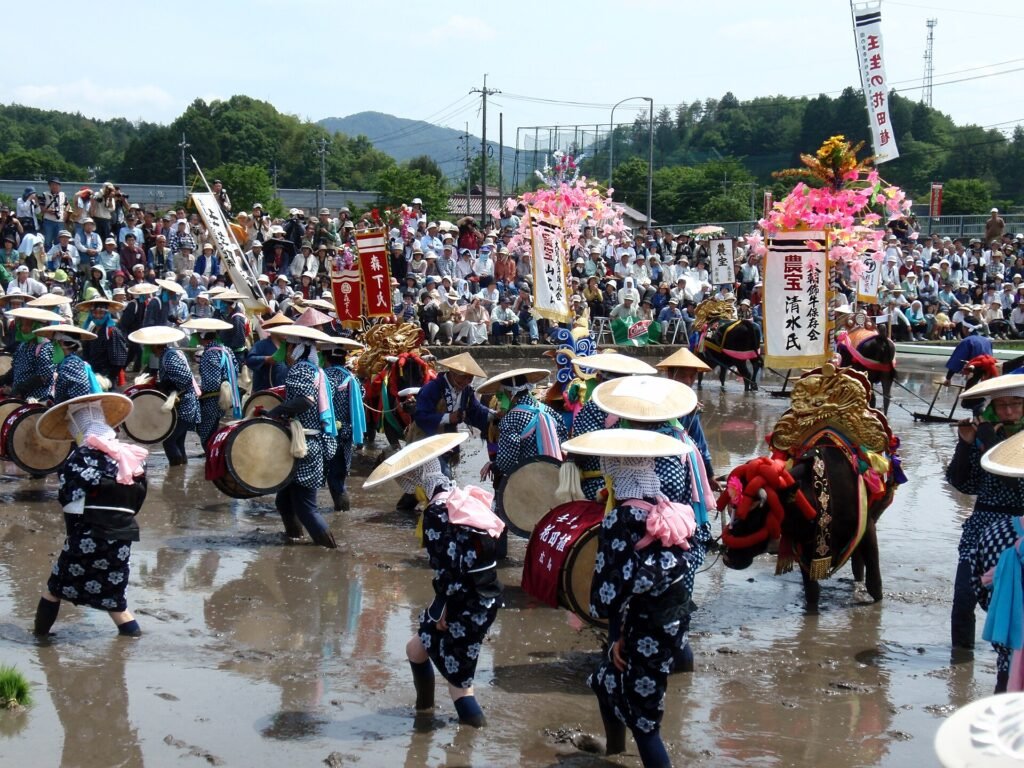
Each June, in the rice paddies of Kitahiroshima, a centuries-old ritual of transplanting seedlings unfolds with music, dance, and collective labor—a ceremony performed not merely to plant crops, but to invoke the blessings of a good harvest.
In UNESCO’s words
Mibu no Hana Taue is a Japanese agricultural ritual carried out by the Mibu and Kawahigashi communities in Kitahiroshima Town, Hiroshima Prefecture to assure an abundant rice harvest by celebrating the rice deity. On the first Sunday of June, after the actual rice transplanting has ended, the ritual enacts the stages of planting and transplanting. Villagers bring cattle to Mibu Shrine to be dressed with elaborately decorated saddles and colourful necklaces. An elder carrying a sacred stick then leads them to a rice field specially kept in reserve for the ritual. After the cattle have ploughed the field, colourfully dressed girls place seedlings inside a case while singing a song under the direction of an elder. Then the rice field is levelled with an implement ''(eburi),'' said to contain the deity of rice fields. The girls then transplant the seedlings one by one, walking backwards, followed by the ''eburi''-user and the person carrying the seedlings, who level the field as they pass. Ritual songs are sung accompanied by drums, flutes and small gongs. Once this ritual transplantation is completed, the ''eburi'' is placed upside down in water with three bunches of rice seedlings. Transmission is ensured by the elders, who know the songs and music for rice planting and oversee the ritual’s smooth execution.
Official description, UNESCO Intangible Cultural Heritage List — Mibu no Hana Taue, ritual of transplanting rice in Mibu, Hiroshima
At a glance
Mibu no Hana Taue is a Japanese agricultural ritual performed by the Mibu and Kawahigashi communities to ensure an abundant rice harvest by honouring the rice deity. Held on the first Sunday of June after the actual rice transplanting ends, the ceremony recreates the stages of planting and transplanting through coordinated performance, music, and labour. The ritual transforms everyday agricultural work into a collective celebration that brings the community together around the crucial act of setting seedlings into the paddy.
Origins & history
The ritual emerges from Japan's long agrarian tradition, where rice transplanting has held deep communal significance as the moment when the crop's fortune is determined. Rice planting marked a crucial threshold in the farming year, and communities developed rituals that combined agricultural necessity with prayer and social cohesion. The practice reflects a worldview in which labour, celebration, and spiritual intention are intertwined.
The practice
On the ritual day, villagers bring cattle to Mibu Shrine, where they are dressed with elaborately decorated saddles and colourful necklaces. An elder carrying a sacred stick leads them to a reserved rice field. After the cattle plough, girls in colourful dress place seedlings in a case while singing under an elder's direction. Girls then transplant seedlings one by one, walking backwards, while others using the eburi implement level the field. Ritual songs accompany the work, performed with drums, flutes, and small gongs. After transplanting, the eburi is placed upside down in water with three bunches of seedlings.
Cultural significance
The ritual celebrates the rice deity and expresses hope for abundance, central to the community's relationship with the harvest. Elders preserve the tradition by teaching the songs, music, and correct execution of the ceremony to younger generations, ensuring transmission of this essential cultural knowledge. The practice strengthens social bonds and maintains the community's spiritual and agricultural heritage.
Key facts
- Country: Japan
- Inscribed: 2011
- UNESCO list: Representative List of the Intangible Cultural Heritage of Humanity
- UNESCO reference: 00411
- UNESCO vocabulary: Agricultural ritual
- Map: Mibu — the locality named in UNESCO’s official description of this element
- Related World Heritage site: Hiroshima Peace Memorial (Genbaku Dome) (a different UNESCO designation, not the place of the tradition)
Where to experience it
Mibu no Hana Taue takes place in the Mibu and Kawahigashi communities of Hiroshima Prefecture each June, when the Mibu Shrine and its surrounding rice fields become the centre of this agricultural celebration. On the first Sunday of the month, visitors can witness villagers bringing decorated cattle to the shrine, then observe the ritual transplanting in the reserved rice field where girls in colourful dress sing traditional songs while planting seedlings. The ceremony combines music—drums, flutes, and small gongs—with the symbolic ploughing and levelling of the field, concluding with the ritual placement of the eburi in water.
Sources & resources
- UNESCO — official element page: Mibu no Hana Taue, ritual of transplanting rice in Mibu, Hiroshima
- UNESCO — open data record: Intangible Heritage List, reference 00411
- UNESCO — official photograph: Photograph of this element — Takeshita Masahiko (Kitahiroshima-cho) — 2009 by Kitahiroshima-cho
- Reference — Wikipedia (secondary): Mibu no Hana Taue — consulted as a secondary reference, not as confirmation
- Cultural Heritage Online: Our archive and city guides

Find it on the map
See this place and what’s around it →📷 Become a Cultural Heritage Online photographer
Share your photos of places: they stay published under your name as the author. The more they're seen, the more you get noticed — and soon a contest will reward the most appreciated photos.
Log in or sign up free to add a photo