
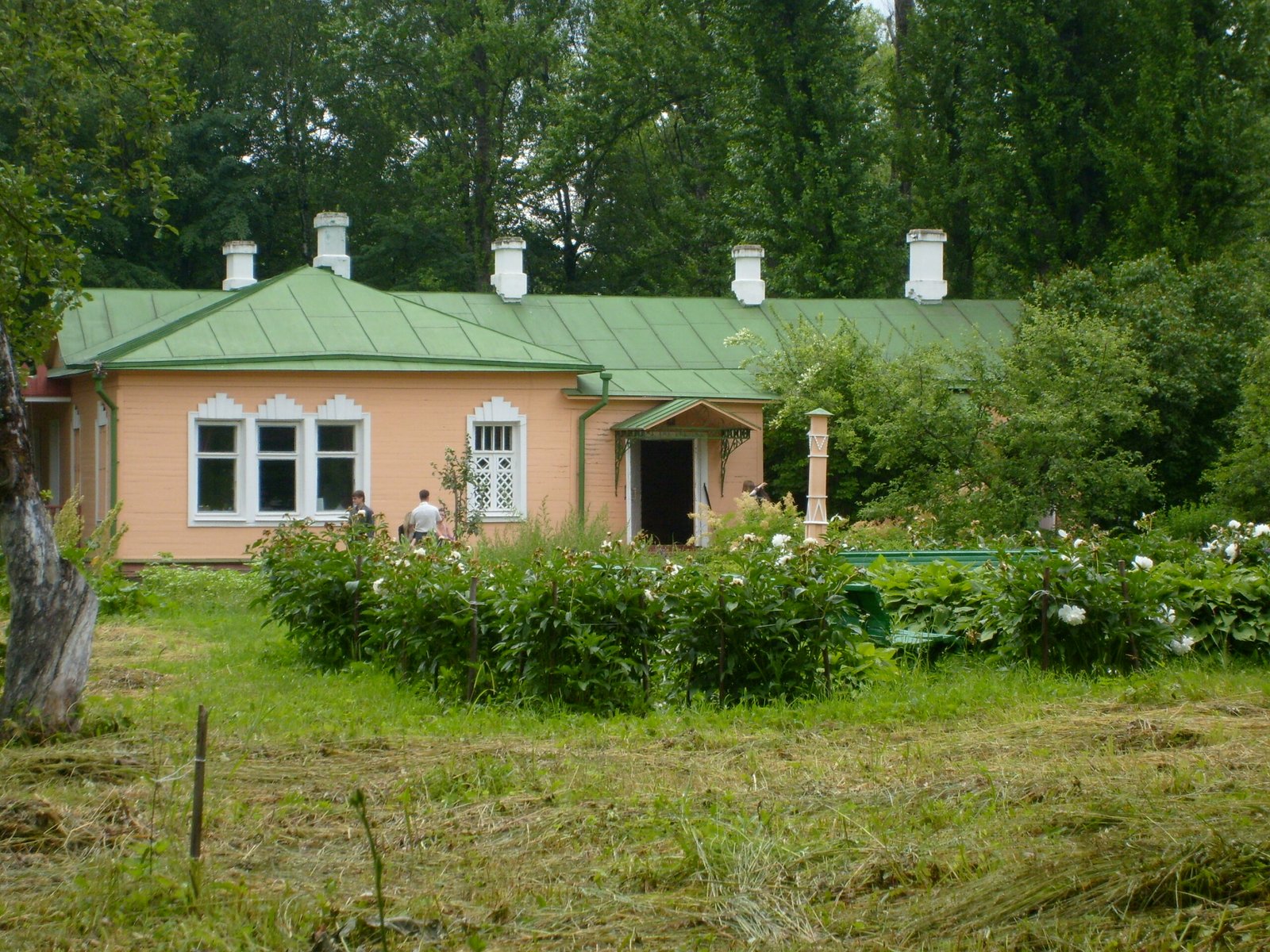
Forty miles south of Moscow, a modest country estate preserves the house where Anton Chekhov practiced medicine by morning and wrote The Seagull by night.
At a glance
Melikhovo is the former country estate of Anton Chekhov, purchased in February 1892 and occupied by his family from March that year until 1899. The wooden main house, built in the 1840s in a Russian neoclassical style, once stood alongside a small garden and a two-story guest cottage. Today the site functions as a writer’s house museum, opened in its current form in 1944.
History
Chekhov bought the property from Nikolai Sorokhtin, a Moscow theater set decorator who had remodeled the house and then run short of money. The family moved in within weeks. Chekhov combined medical practice with writing here, treating patients from his study each morning, sometimes managing care for twenty-six villages during the 1892–93 cholera epidemic. In 1894 he added a two-story cottage; its upper room, quiet and set apart from the house, is where he finished The Seagull in 1895 and Uncle Vanya the following year. Baron Nikolai Stuart owned the estate after 1899. He was later arrested and shot following the Revolution. The Bolsheviks nationalized Melikhovo in 1918, but neglect followed. Farm buildings rose near the house, which was eventually destroyed; only a plaque marked its site. Restoration began in 1940, and a museum opened in January 1941, closing months later after Germany invaded the Soviet Union. Work resumed even during the war, and the rebuilt museum reopened on 25 September 1944.
What you see
The main house is a single-story wooden building of Russian neoclassical form, its plan simple, its rooms compact. Chekhov’s study looked onto the garden through a window near his desk, where portraits of Tolstoy, Turgenev, Tchaikovsky, and others once hung. Nearby stands the reconstructed guest cottage, its lower floor a former medical reception room, its upper floor a writing retreat with a terrace facing the garden. The garden itself, replanted after fire and hard winters destroyed the original fruit trees, still holds a few surviving linden and birch trees. One Berlin poplar remains from Chekhov’s own time.
Cultural significance
Melikhovo shaped some of Chekhov’s most enduring work. The Seagull and Uncle Vanya were completed here, and the 1898 trilogy of stories written after his return from Nice bears the marks of village life he observed nearby. A local schoolteacher he met in Talezh likely inspired the character Medvedenko. Even the garden left its trace on the plays; Chekhov’s own description of heliotrope scent reappears almost verbatim in Trigorin’s dialogue in The Seagull. The estate’s 1899 visit by actress Olga Knipper, who later married Chekhov, adds a personal thread to its literary history.
Key facts
- Location: Melikhovo, near Chekhov, about 40 miles south of Moscow, Russia
- Original house built: 1840s, Russian neoclassical style
- Chekhov residence: March 1892 – August 1899
- Museum inception: 1940; reopened 1944 after wartime closure
- Heritage status: officially protected cultural monument
- Notable works completed here: The Seagull, Uncle Vanya, and a 1898 trilogy of stories
Practical information & getting there
Melikhovo sits within reach of Moscow by road or rail toward the town of Chekhov. You should check current opening times and any seasonal closures before visiting, since the museum’s schedule has shifted historically around restoration and events. The grounds include the reconstructed house, the writing cottage, and the garden Chekhov and his sister planted together.
Sources & resources
Find it on the map
See this place and what’s around it →📷 Become a Cultural Heritage Online photographer
Share your photos of places: they stay published under your name as the author. The more they're seen, the more you get noticed — and soon a contest will reward the most appreciated photos.
Log in or sign up free to add a photoIs this page about you?
This page is read by travellers and heritage enthusiasts who find it on Google. Tell us how you are connected to this place and we will take it from there.