
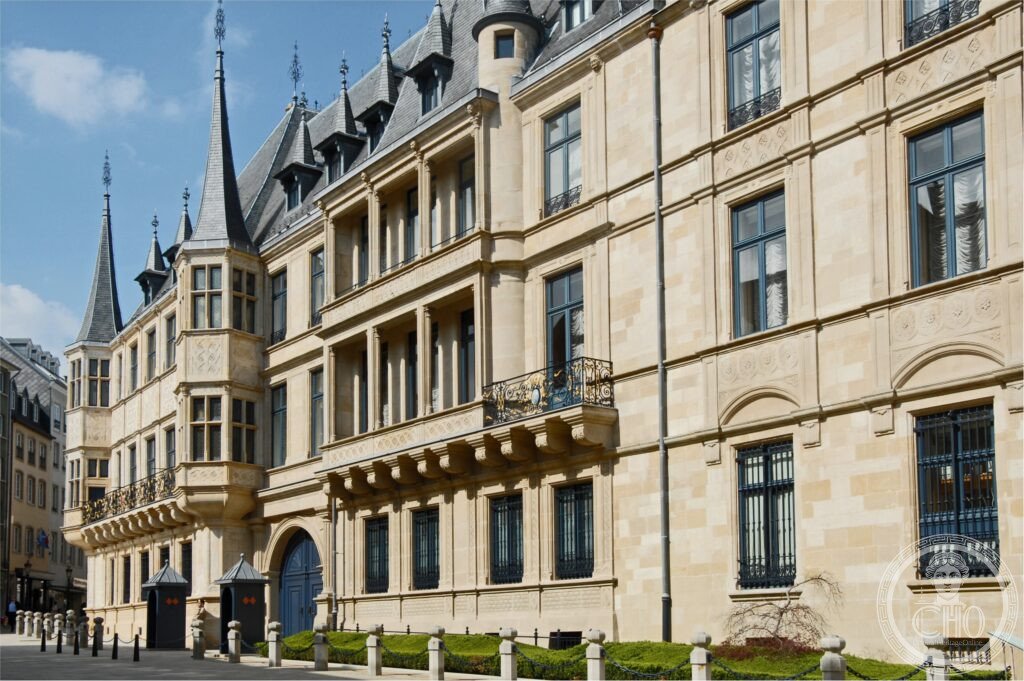
Built on a rocky promontory above two river gorges, Luxembourg City grew from a single fortress into one of Europe’s most heavily defended positions, nicknamed the Gibraltar of the North. Though its ramparts were dismantled in the nineteenth century, seventeen kilometres of tunnels cut into the sandstone still run beneath the old town.
At a glance
In 963 CE, Count Sigefroi of the Ardennes acquired a rocky promontory above the Alzette and named his fortress Lucilinburhuc, little fortress, from which Luxembourg takes its name. Surrounded on three sides by steep river gorges, the position was so formidable that the city became known as the Gibraltar of the North. The Treaty of London of 1867 required the demolition of Luxembourg’s fortifications as a condition of the Grand Duchy’s neutrality and independence, and the work of dismantling the ramparts took sixteen years. The underground galleries carved into solid rock, however, survived and remain open to visitors today.
Key facts
- Casemates du Bock: a network of underground passages and chambers, seventeen kilometres in all, cut from the sandstone beneath the city over several centuries; during the Second World War and the Cold War they served as a shelter, reputedly able to hold tens of thousands of troops.
- The Grund: the lower town, sitting some seventy metres below the plateau of the upper city and counted among the deepest urban valleys in Europe; the Alzette runs through it, with the towers and ramparts of the upper city visible above.
- Neumünster Abbey: a seventeenth-century abbey in the Grund, now one of the city’s principal cultural centres.
- Pont Adolphe: completed in 1903, an arched stone bridge spanning the Pétrusse valley that was, at the time of its construction, the largest stone arch bridge in the world.
- Coordinates: 49.6116° N, 6.1319° E.
History
In the winter of 1944 to 1945, Luxembourg City served as the headquarters of General George S. Patton during the Battle of the Bulge. Patton is buried in the American Military Cemetery in Hamm, a short distance from the city. Today Luxembourg City hosts several institutions of the European Union, including the European Court of Justice, the European Court of Auditors, the Eurostat office and the European Investment Bank.
The Grand Ducal Palace, built in 1572 in Renaissance style, stands at the centre of the old city and remains the official residence of the Grand Duke. The old quarters and fortifications of Luxembourg City were inscribed as a UNESCO World Heritage Site in 1994.
What you see
The Chemin de la Corniche runs along the edge of the upper city plateau, looking down over the Grund and the Alzette valley; it has been described by travel writers as one of Europe’s most scenic urban walkways. Notre-Dame Cathedral, built between 1613 and 1621 by the Jesuits in a transitional Gothic-Renaissance style, is the only cathedral in Luxembourg. It holds the Renaissance tomb of the Count of Nassau, dated 1530, and is the focus of an annual pilgrimage to a statue of the Madonna.
Practical information
- Getting around: the old city, the Grund, the Casemates and the Corniche can all be covered on foot within a compact area.
- Public transport: buses, trams and trains within Luxembourg have been free of charge since 2020, a policy that applies to visitors as well as residents; check current conditions with the national transport authority.
- Casemates du Bock: open seasonally; consult the site’s official channel for current hours and admission.
Getting there
Luxembourg City has its own international airport, and high-speed trains connect it to Paris Gare de l’Est. The historic centre is compact enough to explore largely on foot.
Nearby
- Vianden Castle — around 45 km north; one of the largest feudal castles in Western Europe, built between the eleventh and fifteenth centuries above the Our valley, where Victor Hugo lived in exile in 1871.
- Metz, France — around 60 km southwest; home to the Cathedral of Saint-Étienne, said to hold the largest area of stained glass in the world, including windows added by Chagall between 1958 and 1968.
- Trier, Germany — around 50 km northeast; founded by the Romans in 17 BCE and inscribed as a UNESCO World Heritage Site in 1986, with the Porta Nigra, regarded as the best-preserved Roman city gate north of the Alps, and a Roman amphitheatre. Karl Marx was born there in 1818.
Sources
- Wikipedia
- UNESCO
Find it on the map
See this place and what’s around it →📷 Become a Cultural Heritage Online photographer
Share your photos of places: they stay published under your name as the author. The more they're seen, the more you get noticed — and soon a contest will reward the most appreciated photos.
Log in or sign up free to add a photo