
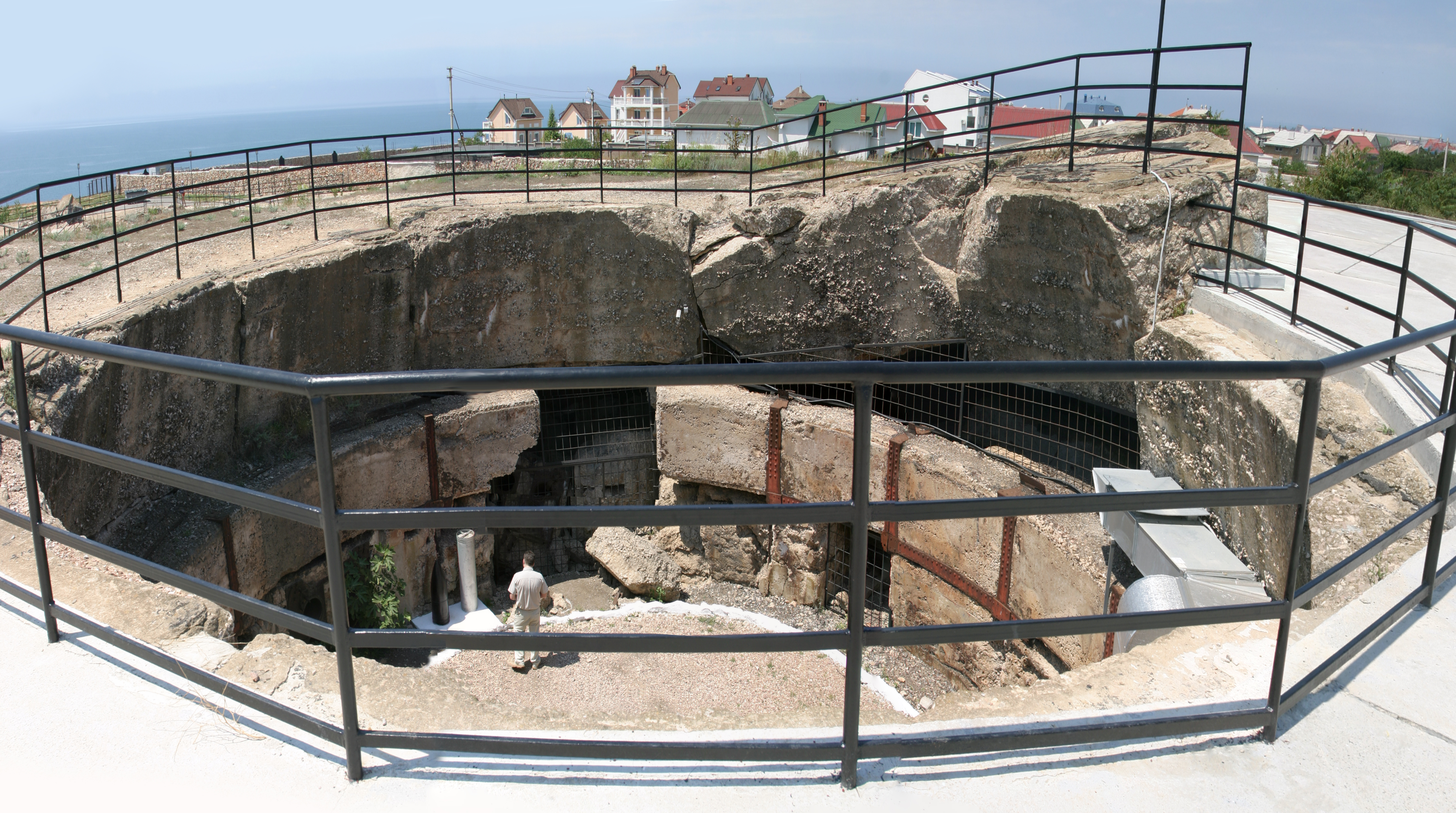
Two armoured coastal batteries guarding Sevastopol’s harbor, named by their German attackers after the Soviet writer, and tested by some of the heaviest artillery ever built.
At a glance
Battery-30 and Battery-35, begun in 1929, mounted twin battleship-style turrets firing 30.5 cm guns. German troops called them Maxim Gorky I and II. Both fell in 1942 during the siege of Sevastopol, then re-entered service after the war.
History
Battery-30 stood north of Severnaya Bay, above the harbor it was built to defend. After German forces broke through the Perekop Isthmus in October 1941, they pushed toward Sevastopol and ran straight into its guns. To silence it, they brought up the 80 cm railway gun Schwerer Gustav and Karl-Gerät siege mortars. On 6 June 1942 direct hits wrecked one turret and damaged the other. The battery kept firing. It took German assault engineers until 17 June to finish the job, after Soviet accounts say the crew exhausted their ammunition and blew up the fort themselves. Battery-35, on the cliffs southwest of the city, held out longer. It fell on 4 July, once Soviet positions at Sapun had been overrun, making it the last major pre-war fortress to fight in the campaign.
What you see
Each battery paired two twin gun turrets, taken from warship design and set into reinforced concrete emplacements sunk into the terrain. Steel armour and thick concrete were meant to absorb naval and aerial bombardment alike. Battery-30 was later rebuilt with triple 305 mm turrets salvaged from the battleship Frunze, lifting its armament from four guns to six and adding a modern fire-control system. Battery-35’s surviving galleries and gun pits, by contrast, show decades of stripping and neglect, softened only recently by restoration work aimed at the public.
Cultural significance
The forts became a symbol of Sevastopol’s resistance during one of the war’s longest sieges. Their destruction required some of the largest artillery pieces Germany ever deployed, an unusual tribute to a coastal battery’s stubbornness. Battery-30 stayed combat-ready into the 1990s, its guns fired for the last time in 1968 for the Soviet film “Sea on Fire.” Battery-35, badly damaged by looters and grave robbers in the 1980s and 1990s, was reborn in 2007 as a museum honoring its defenders, funded largely through private donations from businessman Aleksei Chaly.
Key facts
- Construction began in 1929.
- Battery-30 armed with four, later six, 305 mm naval guns.
- Destroyed by German forces in June–July 1942, then rebuilt after the war.
- Battery-30 mothballed in 1997; reportedly reactivable within 72 hours.
- Battery-35 converted into a museum in 2007.
Practical information & getting there
Battery-35’s museum complex sits on the cliffs southwest of Sevastopol and is the more accessible of the two sites for visitors. Battery-30 remains a former military installation and is not set up for casual sightseeing. Check current access conditions before planning a visit, given the region’s shifting security situation.
Sources & resources
Find it on the map
See this place and what’s around it →📷 Become a Cultural Heritage Online photographer
Share your photos of places: they stay published under your name as the author. The more they're seen, the more you get noticed — and soon a contest will reward the most appreciated photos.
Log in or sign up free to add a photoIs this page about you?
This page is read by travellers and heritage enthusiasts who find it on Google. Tell us how you are connected to this place and we will take it from there.