
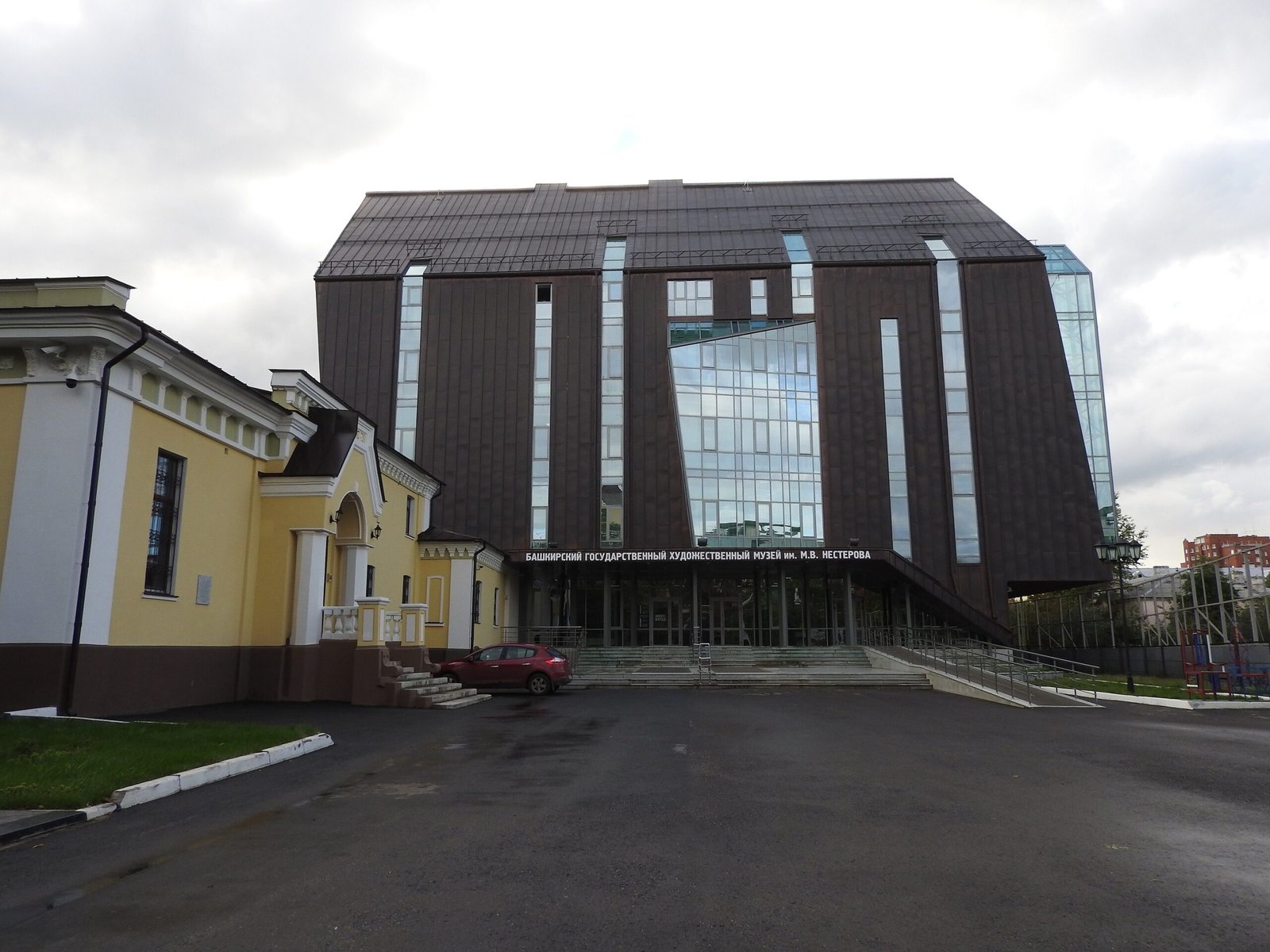
A merchant’s house on Gogol Street holds one painter’s gift to his native city, a collection that survived war, revolution, and a change of name six times over.
At a glance
Founded in 1920, the museum grew from a personal donation into one of the major regional art collections in Russia. It occupies a former merchant’s house in central Ufa. More than 10,000 objects are held in storage, with roughly 4,000 works of fine art on permanent display across an exhibition area of 391 square metres.
History
In 1913 Mikhail Nesterov, born in Ufa, offered his home city a substantial collection of Russian painting from the late 19th and early 20th centuries, along with about thirty of his own canvases. War intervened. The building meant to house it, the Aksakov People’s House, stalled amid the First World War and the revolutions of 1917. The paintings sat in Moscow for years. Only after Ufa was retaken from Kolchak’s forces in late 1919 did the local Revolutionary Committee establish an art museum by decree, placing it in the house of timber merchant M. A. Laptev. Architect Ilya Bondarenko, a friend of Nesterov and fellow Ufa native, was entrusted with moving the collection across a country torn by civil war. He then ran the museum himself. It opened to visitors in January 1920. By May of that year Bondarenko had expanded the holdings to 1,500 exhibits and built a library of 2,500 volumes. Acquisitions from Moscow and Petrograd museum funds continued through the 1920s and 1930s, bringing in Konstantin Korovin, Mikhail Vrubel, Valentin Serov, and others. A gift of icons arrived in 1921 from restorer Grigory Chirikov, deepening the museum’s holdings of early Russian religious art. The institution’s name shifted repeatedly, from the October Revolution Artistic Proletarian Museum in 1919 to the Bashkir State Art Museum by 1929, gaining Nesterov’s name permanently in 1954.
What you see
The museum building itself began as a private residence, not a purpose-built gallery. Its rooms now hold a wide chronological sweep. Icons from the late 16th century, including two from a Deesis row depicting the Virgin and John the Baptist, sit alongside 19th-century landscape and portrait painting. Nesterov’s own early works form a core section. Elsewhere, canvases by Ilya Repin, Ivan Aivazovsky, Isaac Levitan, and Boris Kustodiev’s drawings extend the range. Bashkir artists such as Kassim Davletkildeev and Alexander Tyulkin occupy dedicated space, alongside sculpture and theatrical design work by regional masters.
Cultural significance
The museum anchors Bashkortostan’s cultural identity around a single artist’s generosity. Nesterov gave the city sixty of his own paintings, a gesture that shaped the entire institution. Its collection bridges Russian imperial-era painting, Soviet-period acquisitions, and Bashkir regional art in one place. Branch galleries in Meleuz, Neftekamsk, Sterlitamak, and elsewhere extend its reach beyond Ufa.
Key facts
- Established: 1920, in Ufa, Bashkortostan
- Named after: Mikhail Nesterov, Russian painter and Ufa native
- Original donation: circa 30 works by Nesterov plus works by other Russian masters, offered in 1913
- Key early figure: architect Ilya Bondarenko, who transported the collection and ran the museum from 1920
- Holdings: more than 10,000 exhibits; around 4,000 fine art works; library of over 10,000 volumes
- Exhibition area: 391 square metres
- Address: Gogol Street 27, Ufa, Republic of Bashkortostan
Practical information & getting there
The museum stands on Gogol Street in central Ufa, reachable on foot from the city’s main squares. Check the official website before visiting for current opening hours and ticket prices, since these are not fixed public knowledge. Branch galleries in Meleuz, Neftekamsk, and Sterlitamak operate separately and may keep their own schedules.
Sources & resources
Find it on the map
See this place and what’s around it →📷 Become a Cultural Heritage Online photographer
Share your photos of places: they stay published under your name as the author. The more they're seen, the more you get noticed — and soon a contest will reward the most appreciated photos.
Log in or sign up free to add a photoIs this page about you?
This page is read by travellers and heritage enthusiasts who find it on Google. Tell us how you are connected to this place and we will take it from there.