

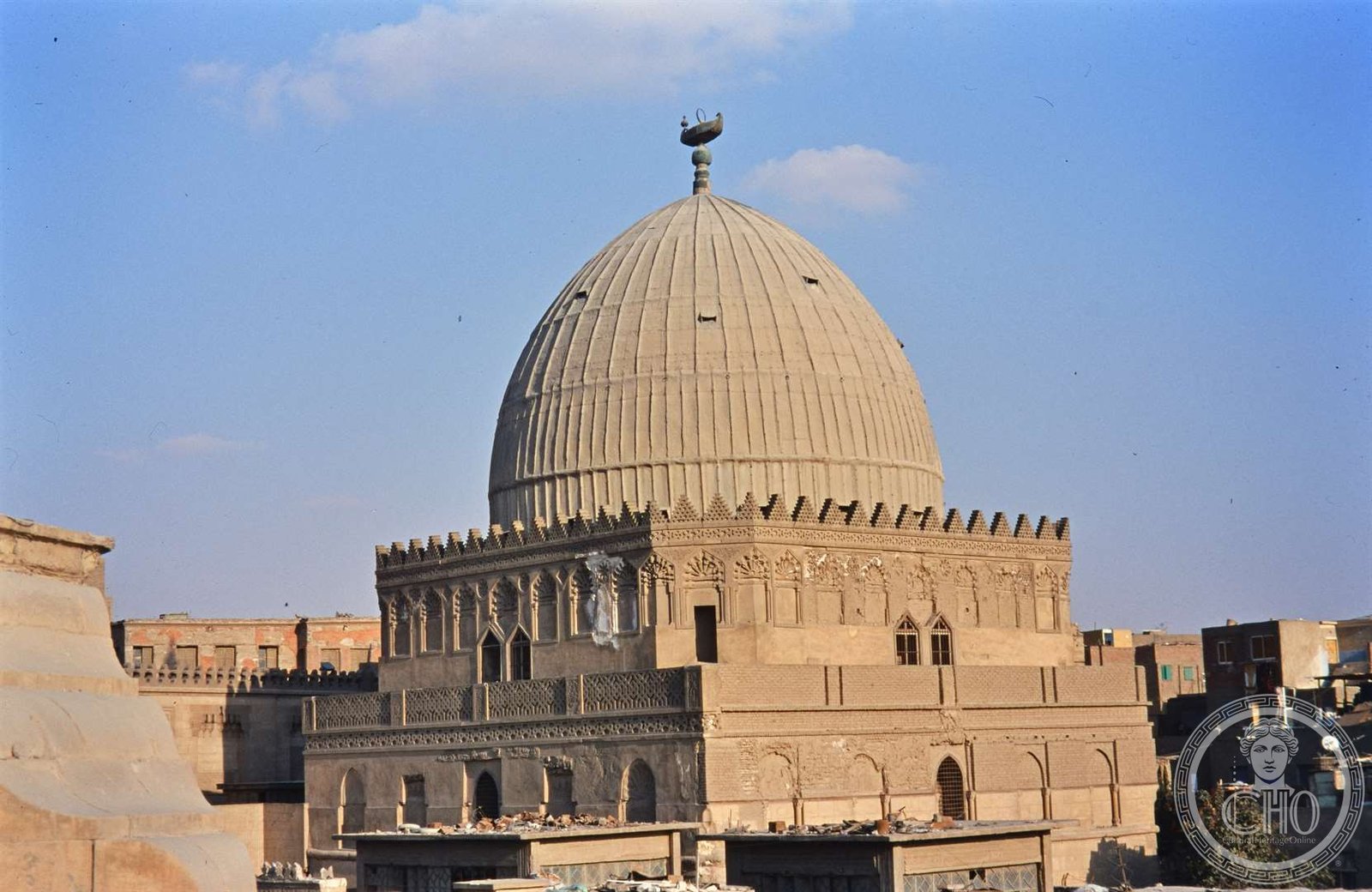
A landmark shrine in Cairo’s City of the Dead honouring the founder of Sunni Islam’s Shafi’i school of jurisprudence, this mausoleum evolved from a simple grave into an architectural masterpiece spanning five centuries of Islamic design.
At a glance
The mausoleum stands in the City of the Dead on Imam Shafi’i Street, a sacred space in Cairo’s medieval cemetery quarter. Built across multiple dynasties—Ayyubid, Mamluk, and Ottoman—it represents the layered traditions of Islamic patronage and devotion to scholarship.
History
Imam al-Shafi’i arrived in Cairo in 813 and taught at the Mosque of Amr ibn al-As until his death six years later. His son Ibn Abdulhakim buried him in the cemetery district known as the turbah.
In 1176, Ayyubid sultan Salah ad-Din commissioned the first formal structure over the grave—a turbah and madrasa. Four years later, craftsman Abid al-Najar created an ornate wooden coffin adorned with geometric patterns and Qur’anic inscriptions in Kufic and Ayyubic scripts.
The mausoleum’s defining phase came in 1211, when Sultan al-Kamil built a dome and encompassing structure to honour his mother’s grave while simultaneously enlarging the shrine around al-Shafi’i’s tomb. Mamluk Sultan Qaitbay enriched it with muqarnas and marble in 1480. Later Ottoman and Mamluk restorers—including wali Ali Bey al-Kabir in 1772—added coloured interior walls and enhanced the dome.
What you see
The mausoleum exemplifies Ayyubid style, though its present form reflects centuries of embellishment. A wooden dome, later reinforced with muqarnas work, crowns the structure. Interior walls display coloured decoration and geometric muqarnas detailing.
The coffin itself remains a masterwork of medieval Islamic craftsmanship, its surface dense with calligraphic and ornamental detail.
Cultural significance
Al-Shafi’i (767–820) was a jurist and theologian whose school of Islamic law became one of the four major Sunni madhabs, profoundly shaping Islamic jurisprudence across centuries and geographies. His mausoleum reflects the reverence accorded to him by rulers spanning dynasties.
The site is integral to the City of the Dead’s spiritual and architectural landscape, demonstrating how medieval Cairo honoured intellectual and spiritual legacies through monumental devotion.
Key facts
- Country: Egypt
- City: Cairo
- Coordinates: 30.0117°N, 31.2581°E
- Founded: 1176 (Ayyubid); expanded 1211; enhanced 1480 and 1772
- Original turbah built by: Salah ad-Din
- Coffin commissioned: 1178; decorated by Abid al-Najar
Practical information & getting there
The mausoleum is located in Cairo’s City of the Dead, a vast medieval necropolis east of Islamic Cairo’s historic centre. It remains an active site of pilgrimage and scholarly interest. Visitors should dress respectfully and be mindful of prayer times. Local guides are recommended for navigating the cemetery quarter.
Sources & resources
Find it on the map
See this place and what’s around it →📷 Become a Cultural Heritage Online photographer
Share your photos of places: they stay published under your name as the author. The more they're seen, the more you get noticed — and soon a contest will reward the most appreciated photos.
Log in or sign up free to add a photoIs this page about you?
This page is read by travellers and heritage enthusiasts who find it on Google. Tell us how you are connected to this place and we will take it from there.