

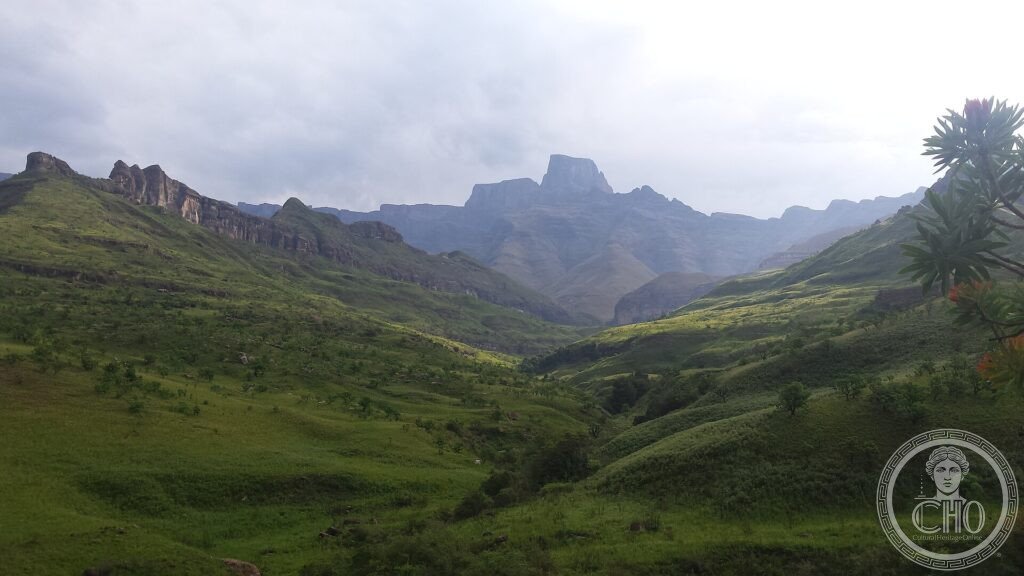
Along the border between Lesotho and South Africa rises the great basalt wall of the Drakensberg, the “dragon mountain”: spectacular cliffs, summits, waterfalls and high-altitude grassland. On its rocks the San left the richest collection of rock painting in sub-Saharan Africa, thousands of images of an ancient spirituality.
At a glance
The Maloti-Drakensberg Park, straddling the border between Lesotho and South Africa, protects the dramatic basalt escarpment of the Drakensberg — the “dragon mountains” — with their soaring crags, pinnacles, waterfalls and high grasslands, and the gentler Maloti highlands of Lesotho. It is both a natural wonder, rich in endemic plants and animals, and a cultural treasure: its caves and overhangs hold the largest and most concentrated group of San (Bushman) rock paintings in sub-Saharan Africa. This mixed site was inscribed by UNESCO in 2000 and extended in 2013.
Key facts
- UNESCO: World Heritage since 2000 (extended 2013), a mixed cultural and natural site
- Transboundary: shared by Lesotho and South Africa
- Basalt escarpment: dramatic peaks, crags and the Amphitheatre
- San rock art: the richest collection in sub-Saharan Africa
- Endemic life: many unique mountain plants and animals
- High grasslands: alpine moorland feeding great rivers
History
For thousands of years the Drakensberg was home to the San, hunter-gatherers who painted the walls of caves and rock shelters with thousands of images of people, animals (above all the eland) and scenes from their spiritual world — an art now understood as deeply connected to trance and ritual. These paintings, made over millennia, are among the finest expressions of San culture.
In more recent centuries the Basotho and other peoples settled the highlands, and the mountains became the heartland of the kingdom of Lesotho. Protected on both sides of the border and joined into a single transboundary park, the Maloti-Drakensberg was inscribed by UNESCO in 2000 for both its mountain nature and its irreplaceable rock art.
What you see
On the South African side, viewpoints and trails reveal the great wall of the escarpment — the Amphitheatre, Cathedral Peak, the Tugela Falls — while guided visits lead to rock-shelters such as Game Pass with their San paintings. On the Lesotho side, the high Maloti moorlands, Sehlabathebe’s rock formations and remote villages offer a different, austere beauty.
The union of the dragon mountains and the ancient painted caves is the meaning of the Maloti-Drakensberg.
Practical information
- Park: many gateways in KwaZulu-Natal (South Africa) and Lesotho
- Best time: spring to autumn; winters are cold with snow on the peaks
- Time needed: one to several days
- Note: view rock art with guides to help protect it
Getting there
The Maloti-Drakensberg Park lies along the Lesotho–South Africa border. The South African (uKhahlamba-Drakensberg) gateways are reached from Durban; Sehlabathebe is in eastern Lesotho. GPS: 29.50° S, 29.30° E.
Nearby
- The Amphitheatre — the great basalt wall and Tugela Falls
- Sehlabathebe — the Lesotho national park within the site
- Durban — the coastal city and usual gateway
Sources
- UNESCO World Heritage Centre — “Maloti-Drakensberg Park” (ref. 985)
- Lesotho / Ezemvelo KZN Wildlife — official bodies
- Encyclopaedia Britannica — Drakensberg; San
Find it on the map
See this place and what’s around it →📷 Become a Cultural Heritage Online photographer
Share your photos of places: they stay published under your name as the author. The more they're seen, the more you get noticed — and soon a contest will reward the most appreciated photos.
Log in or sign up free to add a photo