
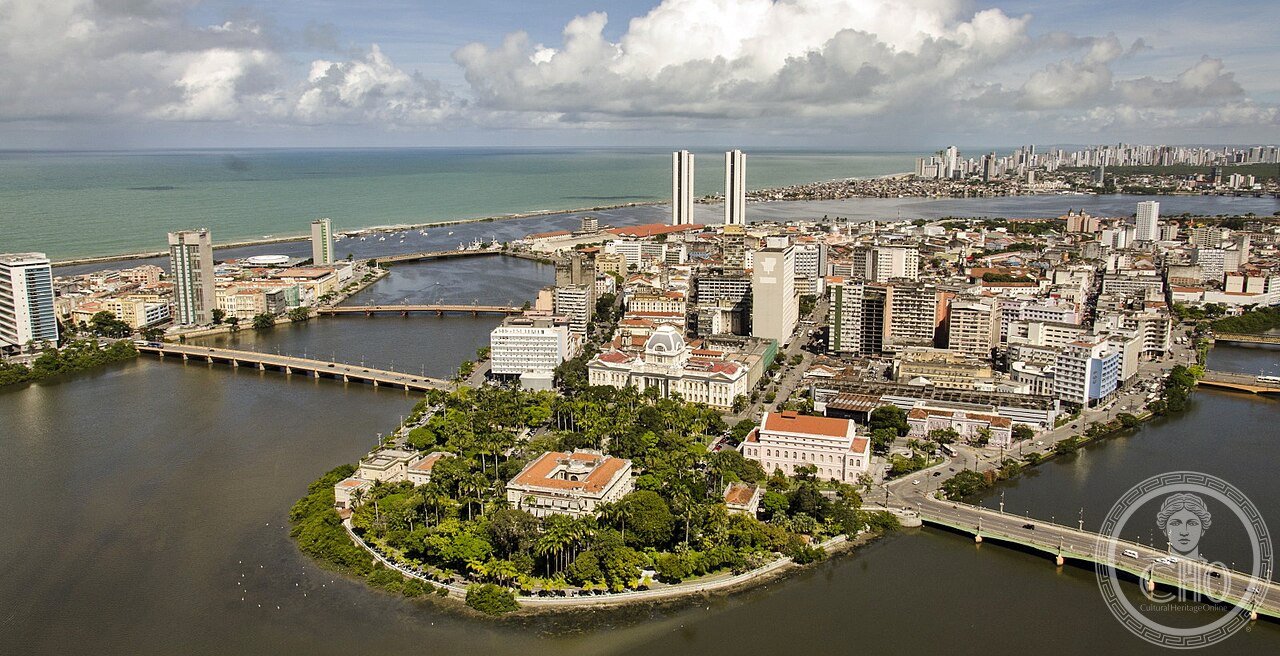
The Moorish gate of the navy yard named for a Crimean fort – Recife’s observatory arch where the old port’s culture now gathers.
At a glance
- Type
- Monumental gate and observatory, now cultural centre
- Period
- 1853-1855
- Style
- Neo-Moorish
- Location
- Recife Antigo, Pernambuco, Brazil
- Coordinates
- -8.0614, -34.8714
- Builder
- Imperial Navy arsenal
Overview
The Torre Malakoff rises in striped Moorish arches at the tip of Recife Antigo – built 1853-55 as the naval arsenal’s monumental gate and observatory, and nicknamed at once for Sevastopol’s Malakoff redoubt then filling the newspapers of the Crimean War. The name stuck through law; the tower became the old port island’s beloved odd landmark.
History
Recife’s port – Dutch Mauritsstad’s heir, the sugar northeast’s gate – worked around the arch for a century; the observatory timed ships’ chronometers by its dome. Decommission and decay ended with restoration as the Torre Malakoff cultural centre: the dome’s telescope reopened to the public, exhibitions below, and the Marco Zero square’s carnival cycles – the world’s largest, Galo da Madrugada – surging past its arches.
Architecture and Design
Horseshoe arches in banded masonry pierce the block beneath the octagonal observatory drum; the rooftop reads harbour, reef line (the recife that names the city), and the sculpture-dotted Marco Zero plaza. Moorish revival here saluted naval modernity, not nostalgia – the empire’s engineers borrowing fashionably.
Cultural significance
The tower keys Recife Antigo’s revival – innovation district by day, frevo and maracatu’s stage in season – linking imperial port history to the northeast’s contemporary creative surge.
Visiting today
Open Tuesday to Sunday with free or token entry; astronomy nights use the dome. The sculpture park on the reef and the Paco do Frevo museum adjoin Marco Zero.
Getting there
Recife Antigo connects by short bridge-walks from the center; cabs and buses reach Marco Zero’s square directly.
Sources and resources
Find it on the map
See this place and what’s around it →Record researched and written by Luigi De Marchi for Cultural Heritage Online, 2026.
📷 Become a Cultural Heritage Online photographer
Share your photos of places: they stay published under your name as the author. The more they're seen, the more you get noticed — and soon a contest will reward the most appreciated photos.
Log in or sign up free to add a photoIs this page about you?
This page is read by travellers and heritage enthusiasts who find it on Google. Tell us how you are connected to this place and we will take it from there.