
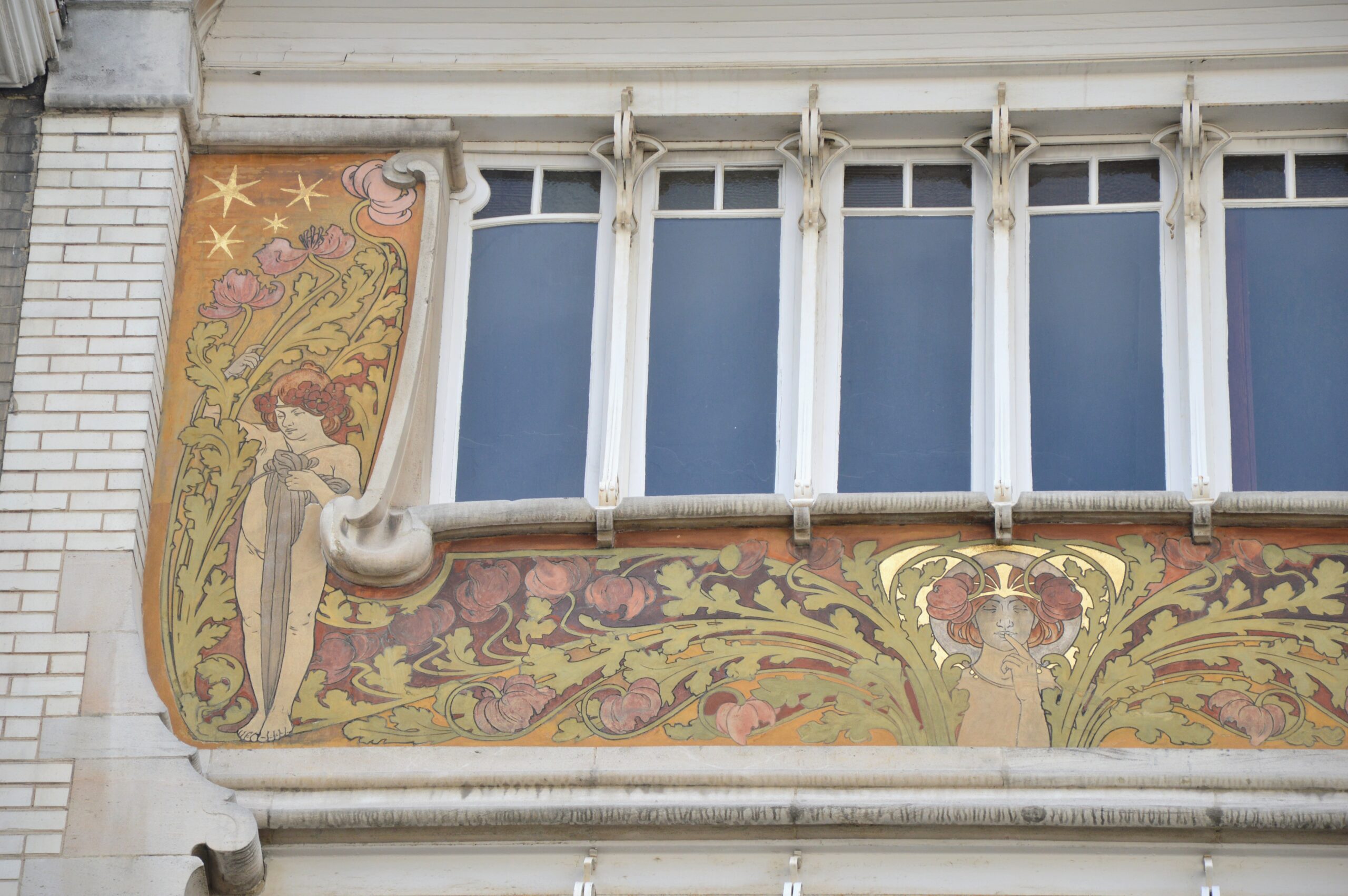

A woman holds a finger to her lips among poppies and stars. The sgraffito that Henri Privat-Livemont painted across this facade in 1900 is about night and sleep, and it survived eighty years of neglect on a house that was nearly lost.
At a glance
Number 83 rue Faider, in Ixelles, is the house Albert Roosenboom (1871–1943) built in 1900 — his masterpiece in Art Nouveau, and one of the facades most often named alongside Horta’s when the style is discussed in Brussels. It has been a listed monument since 1981. In 2018 it was declared uninhabitable, at risk of fire and collapse; a buyer took it on in June 2020 and the restoration followed. It is a private house, not a museum, and can be seen inside only on the guided visits its owners allow.
Key facts
- What it is: a private town house of 1900, Art Nouveau
- Architect: Albert Roosenboom (1871–1943)
- Sgraffito: Henri Privat-Livemont
- Protection: listed monument since 1981
- Where: rue Faider 83 / Faiderstraat 83, 1050 Ixelles, Brussels
- Also known as: Maison Beeckman, the name under which it appears in the regional heritage inventory
- Access: private residence; interiors only by booked guided visit
History
Roosenboom designed the house in 1900, at the height of the Brussels Art Nouveau decade, and it stands a few streets from the other set pieces of that moment. He was, by the account of the visits held here, a painter as well as an architect, and the facade is composed like a picture: stone below, glazed white brick above, the ornament concentrated in one horizontal band.
Its twentieth century was hard. By 2018 the building had decayed to the point that the authorities declared it uninhabitable, citing the risk of fire and of collapse, and demolition was a real prospect. It was bought in June 2020 and an extensive restoration began: the facade’s original colours were recovered, and inside the mosaics, the panelling and the painted ceilings were brought back to their historic appearance.
What you see
The ground floor is blue stone and white stone. Above it, a slightly convex bow window runs in five lights divided by wrought-iron mullions; the floor over that has three bays and a black wrought-iron balcony of unusual design. The top storeys mix white glazed brick with stone, and it is there that the sgraffito runs.
Privat-Livemont’s subject is nocturnal silence: a female bust at the centre, a finger raised to the lips, two naked children behind a cloth, and poppies throughout — the flower of sleep. It is held to be among the finest sgraffiti in the city.
Practical information
- The house is lived in. The facade can be seen from the street at any time; the interior only on organised visits.
- Guided visits are run by Korei Guided Tours, in English, Dutch and French, with a maximum of twelve people and house rules that include no photography indoors.
- A lift is available, but the building is not wheelchair accessible.
Getting there
Rue Faider crosses Ixelles and Saint-Gilles, between the Chaussée de Charleroi and the avenue Louise. Trams along avenue Louise stop within a few minutes’ walk.
Nearby
- Brussels and the Art Nouveau of Victor Horta — the houses in the same quarter.
- The Horta Museum in Saint-Gilles, ten minutes on foot.
- Avenue Louise and the Art Nouveau streets around the Châtelain.
Sources
- French Wikipedia, Maison Roosenboom — Roosenboom’s dates, the 1900 design, the facade materials, the bow window and the iron balcony, Privat-Livemont’s sgraffito and its subject, the listing of 1981, the 2018 declaration of unfitness and the purchase in June 2020.
- Inventory of the architectural heritage of the Brussels-Capital Region, rue Faider 83, Ixelles — the building’s record.
- Korei Guided Tours — the conditions of the guided visits and the state of the interiors after restoration.
Find it on the map
See this place and what’s around it →Events here — now on & upcoming
- Maison Roosenboom: inside a restored Brussels Art Nouveau house06 Sep 2026 — 08 Nov 2026See the event →
📷 Become a Cultural Heritage Online photographer
Share your photos of places: they stay published under your name as the author. The more they're seen, the more you get noticed — and soon a contest will reward the most appreciated photos.
Log in or sign up free to add a photoIs this page about you?
This page is read by travellers and heritage enthusiasts who find it on Google. Tell us how you are connected to this place and we will take it from there.