
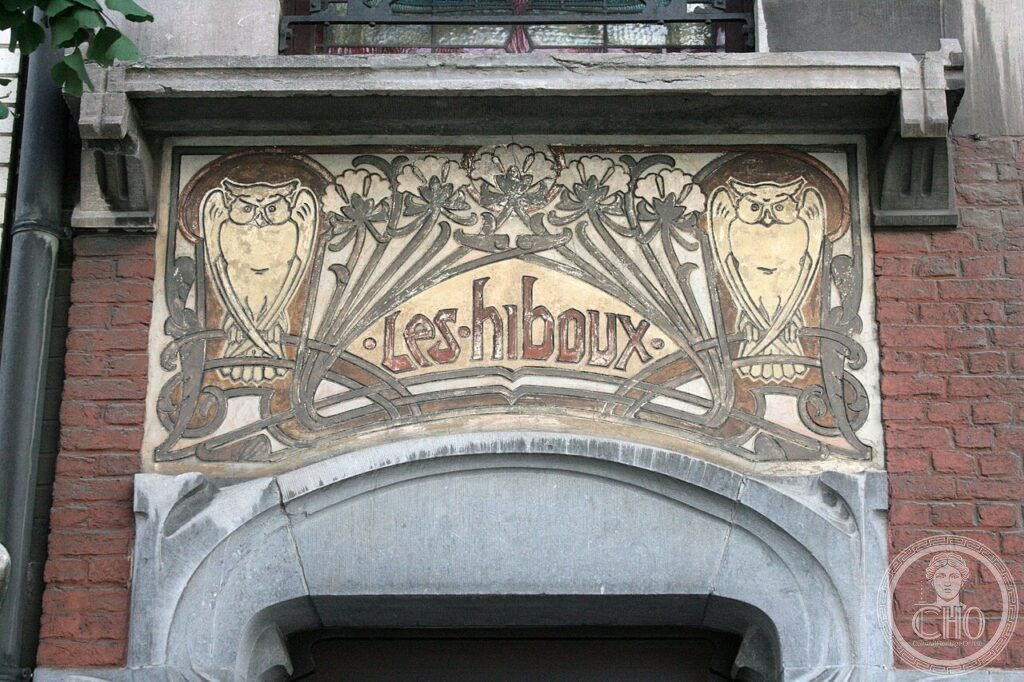

Two stylized owls perch in the sgraffito above a small low door on Avenue Brugmann, giving this 1899 house by Édouard Pelseneer its name — and one of the most quietly loved facades in Art Nouveau Brussels.
At a glance
Les Hiboux — “The Owls” — stands at Avenue Brugmann 55 in Saint-Gilles, built in 1899 by Édouard Pelseneer, the architect the symbolist painter Fernand Khnopff would entrust with his own house. It is a compact essay in what Brussels calls geometric Art Nouveau: polychromy built from red brick, white stone and blue stone, sharpened by sgraffiti in white, yellow, orange, beige and green. The house sits between no. 53, also by Pelseneer, and the celebrated Hôtel Hannon — three facades that make this corner one of the densest Art Nouveau spots south of the centre.
Key facts
- Built: 1899
- Architect: Édouard Pelseneer
- Style: Geometric Art Nouveau
- Materials: Red brick, white stone, blue stone; multicoloured sgraffiti
- Signature feature: Sgraffito above the entrance with the inscription “Les Hiboux”, two stylized owls and white lilies
- Address: Avenue Brugmann 55, Saint-Gilles, Brussels
- GPS: 50.8209264, 4.3523166 — View on Google Maps
- Protected: Classified monument since 27 October 1983
History
Édouard Pelseneer built Les Hiboux in 1899, in the years when the avenues of Saint-Gilles were filling with the experimental houses of Brussels’ bourgeoisie. Pelseneer never achieved Horta’s fame, but his credentials among artists were impeccable — Fernand Khnopff, the most enigmatic of Belgian symbolists, chose him to design his own house-atelier. At Les Hiboux, Pelseneer worked in the geometric register of the style: where Horta curved, he composed in planes and edges, letting colour and sgraffito carry the poetry. The house was classified as a monument in October 1983, among the earlier Art Nouveau protections in the capital, and remains privately inhabited.
What you see
The facade stacks a play of materials — warm red brick against bands of white stone over a blue stone base — under a roofline that steps with the street. The sgraffiti do the talking: multicoloured panels in white, yellow, orange, beige and green thread through the composition, and above the deliberately small, low entrance door sits the panel that names the house, “Les Hiboux” framed by two owls with stylized silhouettes and crowned with white lilies. It is a facade calibrated for the pedestrian: everything worth seeing sits within a few metres of your eye.
Practical information
- Private house — viewed from the pavement of Avenue Brugmann
- The owl sgraffito is directly above the entrance door: step back across the street for the full composition
- See it together with the Hôtel Hannon next door — ten metres apart, two different worlds of Art Nouveau
Getting there
Avenue Brugmann 55 stands at the Ma Campagne end of the avenue, on the border of Saint-Gilles and Ixelles. Trams along the Chaussée de Charleroi and Avenue Brugmann stop within two minutes on foot. The Horta Museum is a ten-minute walk downhill.
Nearby
- Hôtel Hannon — immediately next door; Jules Brunfaut’s 1902 house with its famous fresco staircase
- Horta Museum — ten minutes on foot; the master’s own house
- Hôtel Max Hallet — Horta’s mature masterpiece on Avenue Louise, 15 minutes away
- Brussels — Victor Horta and Art Nouveau — the CHO city guide
Sources
- admirable-facades.brussels / admirable-artnouveau.brussels (official regional programme) — date, architect, materials, sgraffito description, protection
- Brussels regional heritage inventory (monument.heritage.brussels), Îlot Hannon file — setting between no. 53 and the Hôtel Hannon
- OpenStreetMap Nominatim — coordinates of Avenue Brugmann 55
Find it on the map
See this place and what’s around it →Record researched and written by Luigi De Marchi for Cultural Heritage Online, 2026.
📷 Become a Cultural Heritage Online photographer
Share your photos of places: they stay published under your name as the author. The more they're seen, the more you get noticed — and soon a contest will reward the most appreciated photos.
Log in or sign up free to add a photoIs this page about you?
This page is read by travellers and heritage enthusiasts who find it on Google. Tell us how you are connected to this place and we will take it from there.