
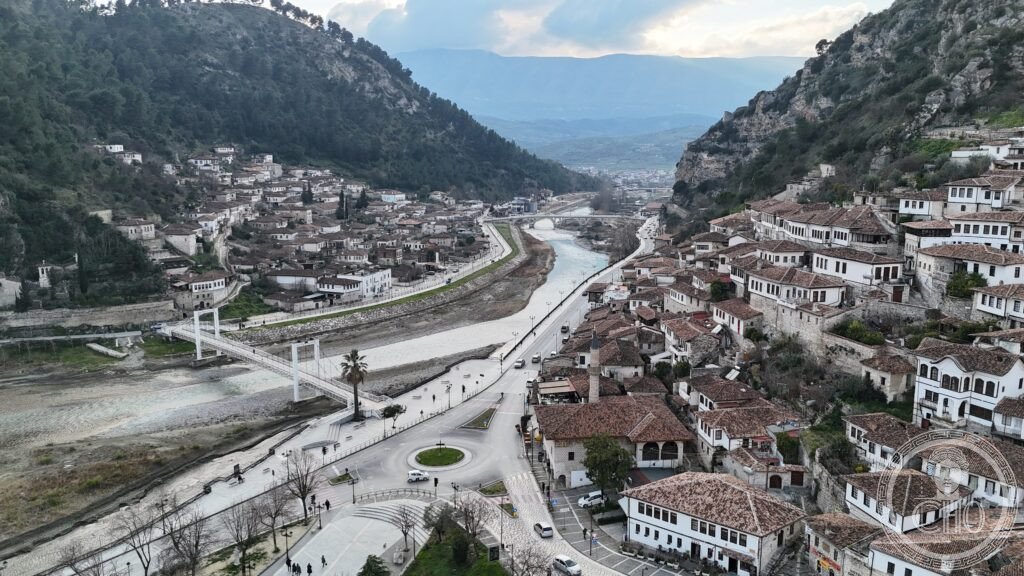
Berat’s whitewashed houses climb the hillside above the Osum River in tight rows of oversized, south-facing windows, a pattern so dense it gave the town its nickname. Above them, a castle inhabited without interruption since the 2nd century BCE still shelters churches, mosques and a handful of resident families.
At a glance
Berat was founded by Illyrians and Greeks as Antipatrea in the 3rd century BCE; the present name descends from the medieval Albanian Beligrad, meaning white city. The Osum River cuts a limestone gorge beneath the town, and the reflection of its pale stone houses in the water is one of the most photographed views in Albania.
The houses of the Mangalem quarter were built with several large windows per room, all facing south to catch what winter sun there is. Seen from across the river, the tiers of glass give the hillside the look of a thousand watching eyes, hence the city’s epithet.
Key facts
- Berat Castle (Kalaja): occupied continuously since the 2nd century BCE, with curtain walls dating mainly from the 10th to 13th century Byzantine period; it contains six Byzantine churches, two mosques and a small resident community living within the walls.
- Onufri: the leading Balkan icon painter of the 16th century, active around 1554 to 1578, celebrated for a vivid red pigment made from natural vermilion that has not faded.
- Three quarters: Mangalem, historically Muslim; Gorica, historically Orthodox Christian; and Kalaja, the mixed castle quarter, sit within walking distance of one another on the same hillside.
- Coordinates: 40.7058° N, 19.9522° E.
History
Under Enver Hoxha, Albania declared itself the world’s first atheist state in 1967, and the churches and mosques of Berat were secularised and converted to warehouses or cultural centres. After the fall of communism in 1991 the religious buildings were restored and returned to their communities. Hoxha’s regime also scattered concrete bunkers across the country, and a number of these still stand in the landscape around the town.
Berat’s historic centre was inscribed on the UNESCO World Heritage List in 2005 alongside Gjirokastra, with the listing extended to include Berat in 2008.
What you see
The Bachelor’s Mosque, built in 1827 for unmarried craftsmen, is one of the few mosques in Berat still partly in use. Inside the castle, the 13th-century Church of the Holy Trinity holds the town’s best-preserved Byzantine frescoes, painted in the 14th century. The Onufri National Museum, housed in the castle church of St Mary of Blachernae, brings together the finest collection of Onufri’s icons, including his Virgin Hodegetria.
Below the castle, the 18th-century Gorica Bridge, a single stone arch, links the Mangalem and Gorica quarters across the Osum and is among the most photographed spots in the city, particularly at sunset.
Practical information
- Access to the castle: free of charge; the climb is steep and follows cobbled paths, so sturdy footwear is worth wearing.
- Onufri National Museum: a paying entry applies; check current terms with the museum directly.
- Best time to visit: spring or early autumn, when the weather is mild.
Getting there
Berat is reached from Tirana by bus or minibus, or by car from Tirana International Airport, roughly 120 kilometres to the north. The town centre itself is compact and easily explored on foot, though the approach to the castle is uphill throughout.
Nearby
- Gjirokastra — about 120 kilometres south; the other Albanian town on the same UNESCO listing, known for its slate-roofed Ottoman houses, its castle housing a military museum, and as the birthplace of Enver Hoxha and the writer Ismail Kadare.
- Apollonia — about 50 kilometres west; an ancient Greek colony founded in 588 BCE, with a Roman-era odeon and the 13th-century Byzantine Monastery of St Mary built over the ruins. Julius Caesar used the site as a staging base in 48 BCE.
Sources
- Wikipedia, Berat
- Wikipedia, Onufri
- Wikipedia, Berat Castle
- UNESCO, Historic Centres of Berat and Gjirokastra
Find it on the map
See this place and what’s around it →📷 Become a Cultural Heritage Online photographer
Share your photos of places: they stay published under your name as the author. The more they're seen, the more you get noticed — and soon a contest will reward the most appreciated photos.
Log in or sign up free to add a photo