
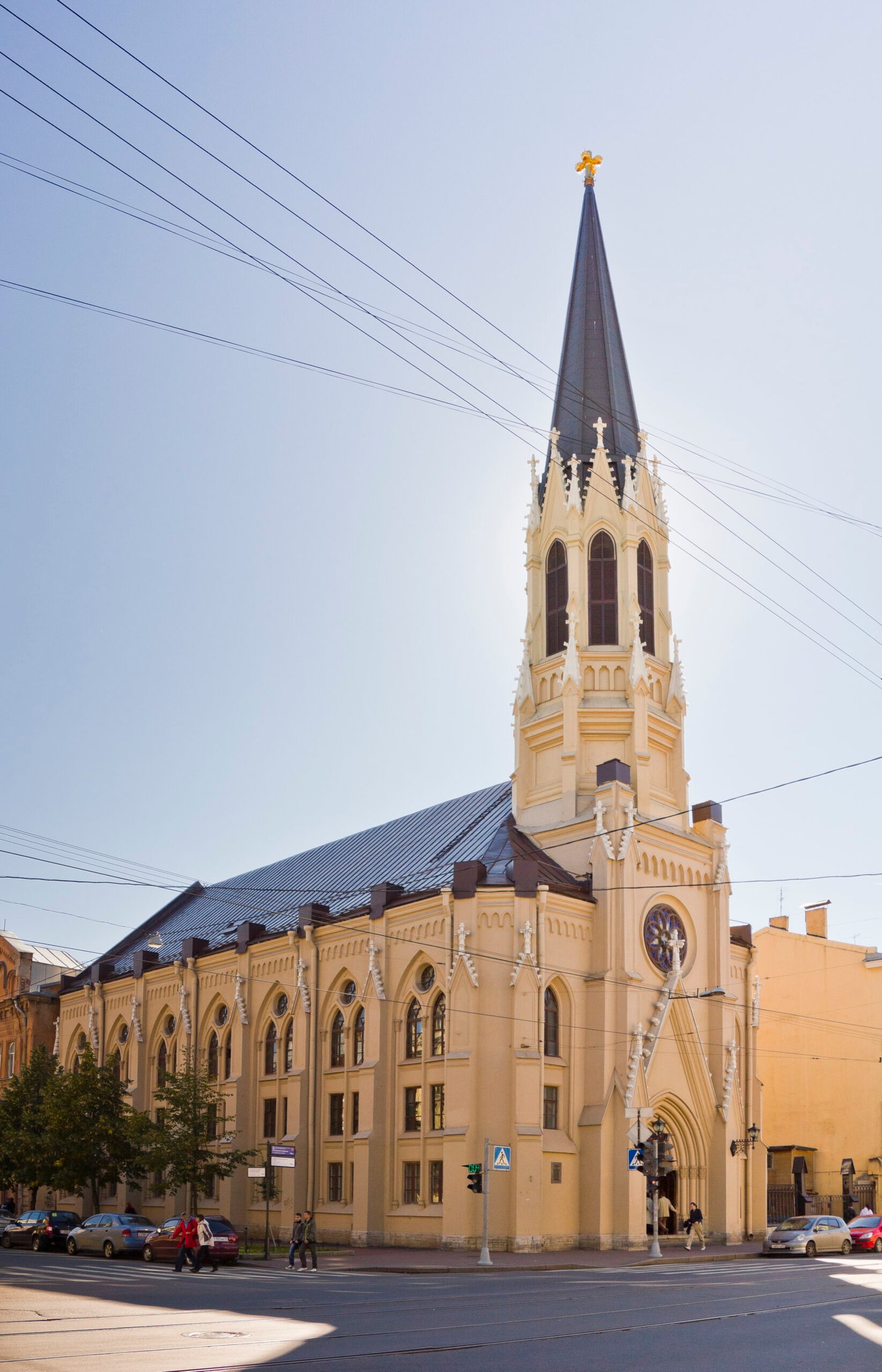
On Sredny Avenue, Vasilyevsky Island, a neo-Gothic church built for one of the city’s poorer German parishes has outlived decades as a sports hall and tobacco warehouse to hold Lutheran services again.
At a glance
Consecrated in 1876, the church seats 800 beneath a pointed tent roof and pinnacle turrets. It belongs to the Church of Ingria, an Evangelical Lutheran body active in Russia since 1992, and is heritage-listed.
History
The parish traces back to 1731, inside the First Cadet Corps. Nicholas I ordered the community moved to a private building in 1841, splitting German and Estonian congregations. The German parish, some 2,000 strong, consecrated its own church on Vasilyevsky Island in August 1842. That building soon proved too small. Funds for a permanent church accumulated slowly. Construction finally began in October 1874, and the new building was consecrated on 19 December 1876. It ran a school, an orphanage, and a widow’s shelter. Soviet authorities merged it with a Russian Lutheran congregation in 1929, then closed it outright in 1935. A sports base moved in. Later came a tobacco-factory warehouse, then a workshop. The main hall was carved into three floors of ceilings. Nothing about the interior survived that use unaltered.
What you see
Colonel Karl Bulmerincq, a military engineer, designed the stone church raised between 1871 and 1876. Rudolf Bernhard reworked the facade in 1886. Sandstone cladding, lancet windows, and pinnacle turrets mark it as Gothic Revival. The roofline was meant to carry cast-iron finials and Gothic grilles; many were lost or removed as unsafe under Soviet neglect, and the parapet still awaits restoration funds. Stained glass, absent in the 19th century because the parish could not afford it, was added only during the 2002–2010 restoration. A Sauer organ served the church from 1877 until 1935. Its replacement came from Helsinki’s Lutheran Church of St. Paul, a 1956 Rieger Orgelbau instrument installed in 2012 and consecrated in January 2016.
Cultural significance
The building’s survival through Soviet repurposing gives it particular weight for St. Petersburg’s Lutheran community. Since 1992 it has functioned as a predominantly Russian-speaking parish, an unusual identity for a church built by German congregants. Its shared premises now host Methodists, Adventists, and other Protestant groups. Rector Sergei Preyman shaped its postwar revival before his sudden death in 2003.
Key facts
- Location: Vasilyevsky Island, St. Petersburg, Russia
- Style: Gothic Revival
- Built: 1871–1876; facade reworked 1886
- Architect: Karl Bulmerincq (facade: Rudolf Bernhard)
- Capacity: 800 seats
- Restoration: 2002–2010
- Current use: Parish of the Church of Ingria, active since 1992
- Heritage status: listed
Practical information & getting there
The church stands on Sredny Avenue, Vasilyevsky Island, reachable from central St. Petersburg by metro and tram to the island’s grid of numbered “lines.” Check the parish’s own site for current service times before visiting, since schedules shift with its shared use by several Protestant congregations.
Sources & resources
Find it on the map
See this place and what’s around it →📷 Become a Cultural Heritage Online photographer
Share your photos of places: they stay published under your name as the author. The more they're seen, the more you get noticed — and soon a contest will reward the most appreciated photos.
Log in or sign up free to add a photoIs this page about you?
This page is read by travellers and heritage enthusiasts who find it on Google. Tell us how you are connected to this place and we will take it from there.