
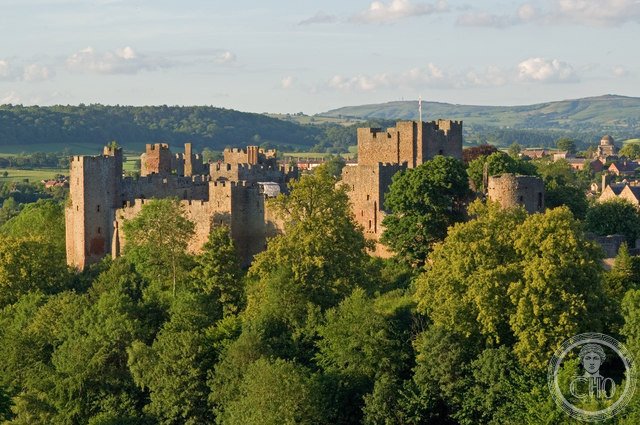
A ruined medieval fortress overlooking the River Teme, Ludlow Castle evolved from Norman stronghold to seat of the Council of Wales, hosting cultural grandeur before civil war and centuries of romantic decay.
At a glance
Ludlow Castle stands as one of England’s earliest stone fortifications, founded probably by Walter de Lacy after 1066. The castle sprawls across nearly 5 acres, its inner and outer baileys separated by a stone-cut trench. Today it remains privately owned by the Earl of Powis and welcomes visitors year-round.
History
Walter de Lacy likely established the castle shortly after the Norman Conquest, making it among the first stone castles built in England. During the 12th-century civil war, it changed hands repeatedly between the de Lacys and rival claimants, who added a Great Tower and enlarged the outer bailey.
Geoffrey de Geneville received Ludlow in the mid-13th century and rebuilt sections of the inner bailey. Roger Mortimer acquired it in 1301 and expanded the internal buildings further. Richard, Duke of York, inherited the fortress in 1425; when his son Edward IV became king in 1461, the castle passed to the Crown and became a symbol of Yorkist power during the Wars of the Roses.
In the 16th century, Ludlow served as the seat of the Council of Wales and the Marches, effectively Wales’s administrative capital. Extensive renovations made it luxuriously appointed; John Milton’s masque Comus premiered here. Parliamentarians besieged and captured the castle in 1646 during the English Civil War, after which it declined for decades.
The Earl of Powis leased the property in 1772 and later purchased it outright in 1811. The estate landscaped the ruins romantically and built a mansion in the outer bailey, while leaving the medieval structures largely untouched. Early 20th-century restoration cleared vegetation and stabilized the stonework.
What you see
The castle measures approximately 500 by 435 feet, its stonework spanning Norman, medieval, and Renaissance periods. The inner bailey houses a Great Tower, Solar block, Great Hall, and Great Chamber block, alongside 16th-century additions. A rare circular chapel, modeled on the shrine of the Church of the Holy Sepulchre in Jerusalem, stands among its most distinctive features.
The Castle House in the outer bailey now serves the Powis Estate as offices. The stone trench separating the two baileys remains a defining defensive element.
Cultural significance
Ludlow Castle embodies centuries of English political ambition and cultural life. As seat of the Council of Wales and the Marches, it administered an entire principality. Its 16th-century role as a venue for courtly entertainment—hosting the premiere of Milton’s major masque—demonstrates its importance to Tudor and Stuart cultural circles.
The castle’s romantic decay attracted artists throughout the 19th and 20th centuries, making it an enduring subject for painters and poets drawn to picturesque ruins.
Key facts
- Founded: Probably by Walter de Lacy after 1066
- Location: Ludlow, Shropshire, England
- Coordinates: 52.3672°N, 2.723°W
- Size: Approximately 5 acres (2.0 hectares)
- Current status: Owned and operated by the Earl of Powis as a heritage site
Practical information & getting there
Ludlow Castle is located in the market town of Ludlow in Shropshire, on a promontory above the River Teme. The castle is open to visitors and operated as a tourist attraction. For current opening hours, admission fees, and guided tour availability, consult the official site or contact the Powis Estate directly.
Sources & resources
Find it on the map
See this place and what’s around it →📷 Become a Cultural Heritage Online photographer
Share your photos of places: they stay published under your name as the author. The more they're seen, the more you get noticed — and soon a contest will reward the most appreciated photos.
Log in or sign up free to add a photoIs this page about you?
This page is read by travellers and heritage enthusiasts who find it on Google. Tell us how you are connected to this place and we will take it from there.