
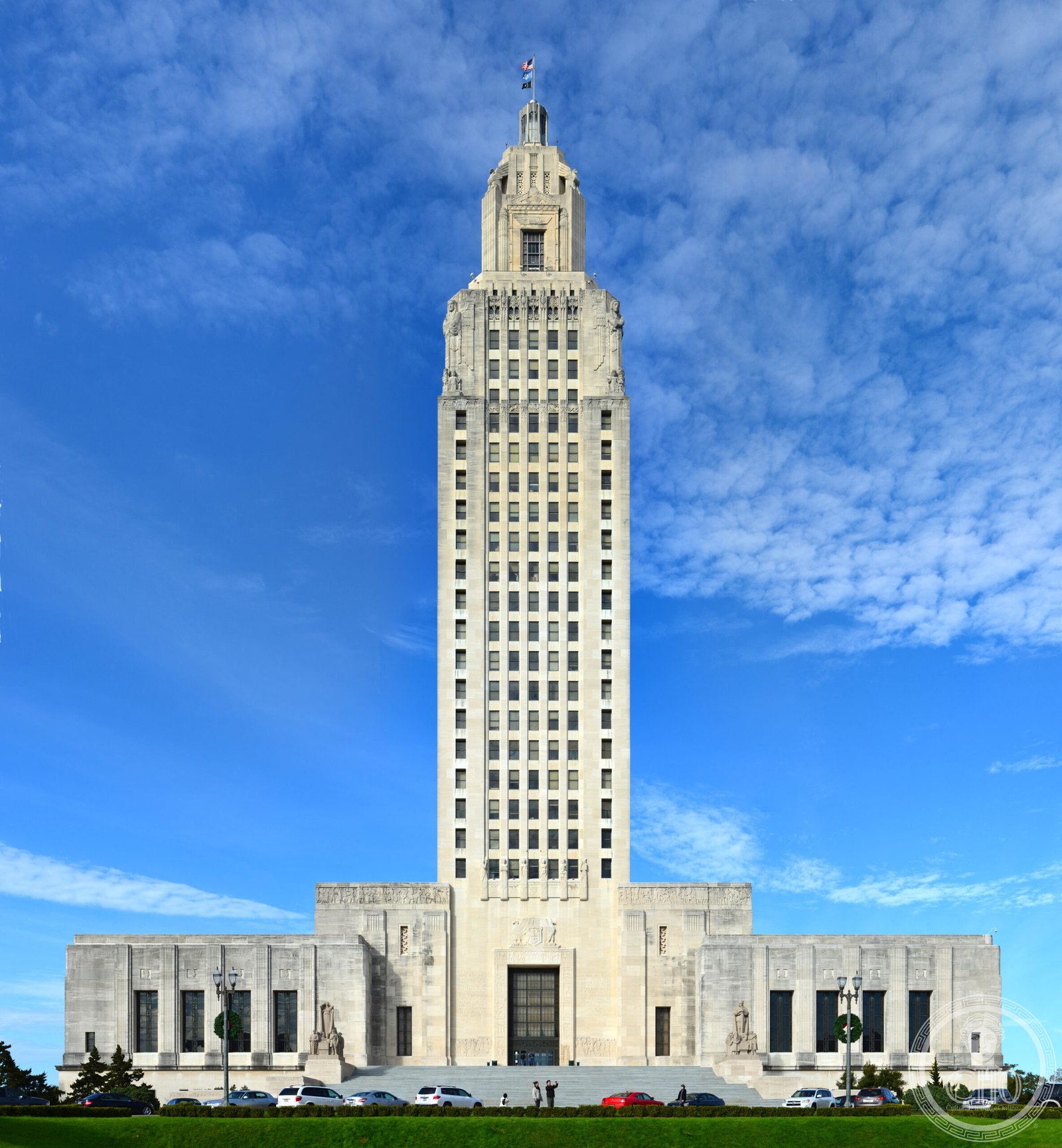
At 450 feet, the Louisiana State Capitol is the tallest state capitol building in the United States — a limestone Art Deco tower that Governor Huey P. Long drove from groundbreaking to completion in under two years, and that still bears the marks of his assassination in 1935.
At a glance
The Louisiana State Capitol rises thirty-four floors above Baton Rouge in a form unlike any other government building in America. Where most state capitols look to classical domes and colonnades, Louisiana’s 1932 building adopts the vocabulary of Art Deco — setback massing, vertical limestone piers, and bas-relief panels depicting the state’s industries, flora, and history — to produce a skyscraper that reads simultaneously as civic monument and commercial tower. Governor Huey P. Long initiated the project and personally oversaw its design and construction; the building was completed in an extraordinary fourteen months. Long was assassinated in a corridor of the building on 8 September 1935, and his body is interred in the memorial garden at the building’s base.
Key facts
- Address: 900 N. Third Street, Baton Rouge, LA 70802
- Architects: Weiss, Dreyfous & Seiferth (New Orleans)
- Completed: 1932
- Height: 450 feet (137 m), 34 floors
- Style: Art Deco — skyscraper form, limestone cladding, bas-relief sculpture
- Designation: National Register of Historic Places
- Distinction: Tallest state capitol building in the United States
History
When Huey P. Long became governor of Louisiana in 1928, the existing state capitol was a nineteenth-century Italianate building widely regarded as inadequate for the ambitions of a state he was determined to transform. Long secured funding for a replacement and pushed the project through design and construction at a pace that surprised even his contemporaries: the new capitol was designed by the New Orleans firm Weiss, Dreyfous & Seiferth, and construction ran from 1931 to 1932. The cost, at a time of acute economic depression, drew criticism; Long characterised the building as a monument to Louisiana’s potential rather than its present condition.
The exterior bas-relief programme is among the most extensive on any American public building of the period: panels carved in shallow relief depict sugar cane, cotton, pelicans, cypress trees, and scenes from Louisiana’s agricultural and commercial life, framing the entrance and rising up the lower floors. Inside, the Memorial Hall — the building’s principal public space — is finished in imported marble and richly carved bronze.
Long was shot in the building on 8 September 1935 by Dr. Carl Weiss and died two days later. He is buried in the sunken garden immediately south of the building, beneath a bronze statue. The assassination site in the first-floor corridor is marked, and the building’s own history has become inseparable from Long’s controversial legacy as one of the most powerful political figures in twentieth-century American state politics.
What you see
The tower steps back in the Art Deco manner as it rises, each setback reducing the floor plan and drawing the vertical limestone piers upward toward a flat crown. At street level, the main entrance is flanked by bronze doors and framed by bas-relief panels; the stonework here is the most densely decorated part of the exterior, with figures, foliage, and emblems compressed into shallow carving that catches the Louisiana sun in strong shadows. The thirty-four floors above read as a stack of receding blocks, each clad in the same pale limestone that gives the building its white silhouette against the Louisiana sky.
A public observation terrace near the building’s summit is open to visitors and provides a panoramic view across the Mississippi River plain, the downtown Baton Rouge riverfront, and the industrial corridor stretching toward New Orleans. Memorial Hall on the ground floor — accessible on a self-guided tour — is finished in marble columns and bronze metalwork, with the state seal inlaid in the floor and portraits of governors lining the walls. The building is still the active seat of the Louisiana Legislature.
Practical information
- Hours: Open daily to visitors; observation deck and Memorial Hall accessible on self-guided tours — check current hours with the Louisiana State Capitol office
- Admission: Free
- Observation deck: Near the building’s upper floors; elevator access from main lobby
- Accessibility: The building is fully accessible by lift; contact the Capitol office for guided access arrangements
Getting there
The Louisiana State Capitol stands on N. Third Street in the Capitol Park district of Baton Rouge, approximately half a mile north of the downtown riverfront. Baton Rouge Metropolitan Airport is approximately eight miles (thirteen kilometres) to the north-east. The Capitol Area Transit System (CATS) serves the Capitol Park corridor from downtown Baton Rouge; the building is also accessible by the Baton Rouge riverfront, which connects to the Old State Capitol and the Shaw Center for the Arts. A large public car park serves the Capitol grounds.
Nearby
- Old Louisiana State Capitol — the nineteenth-century Gothic Revival capitol building, now a museum of political history, approximately half a mile south on River Road
- Louisiana Governor’s Mansion — the official residence, on the same Capitol Park grounds
- Shaw Center for the Arts — performing arts centre on Third Street, approximately four blocks south
- USS Kidd Veterans Museum — World War II destroyer museum on the Mississippi riverfront, approximately one mile south
Sources
- National Register of Historic Places nomination, Louisiana State Capitol
- Louisiana Secretary of State — Capitol history and visitor information
- T. Harry Williams, Huey Long (Knopf, 1969) — political and construction history
- Weiss, Dreyfous & Seiferth — architectural records, Louisiana State Archives
- Historic American Buildings Survey (HABS) — measured drawings and photographic record
Find it on the map
See this place and what’s around it →📷 Diventa un fotografo di Cultural Heritage Online
Condividi le tue foto dei luoghi: restano pubblicate con la tua firma come autore. Più vengono viste, più ti fai conoscere — e presto un concorso premierà le foto più apprezzate.
Accedi o registrati gratis per aggiungere una fotoDo you manage this place?
This page is read by travellers and heritage enthusiasts who find it on Google. Keep it accurate — and make it work for you. Free for non-profit heritage institutions.