
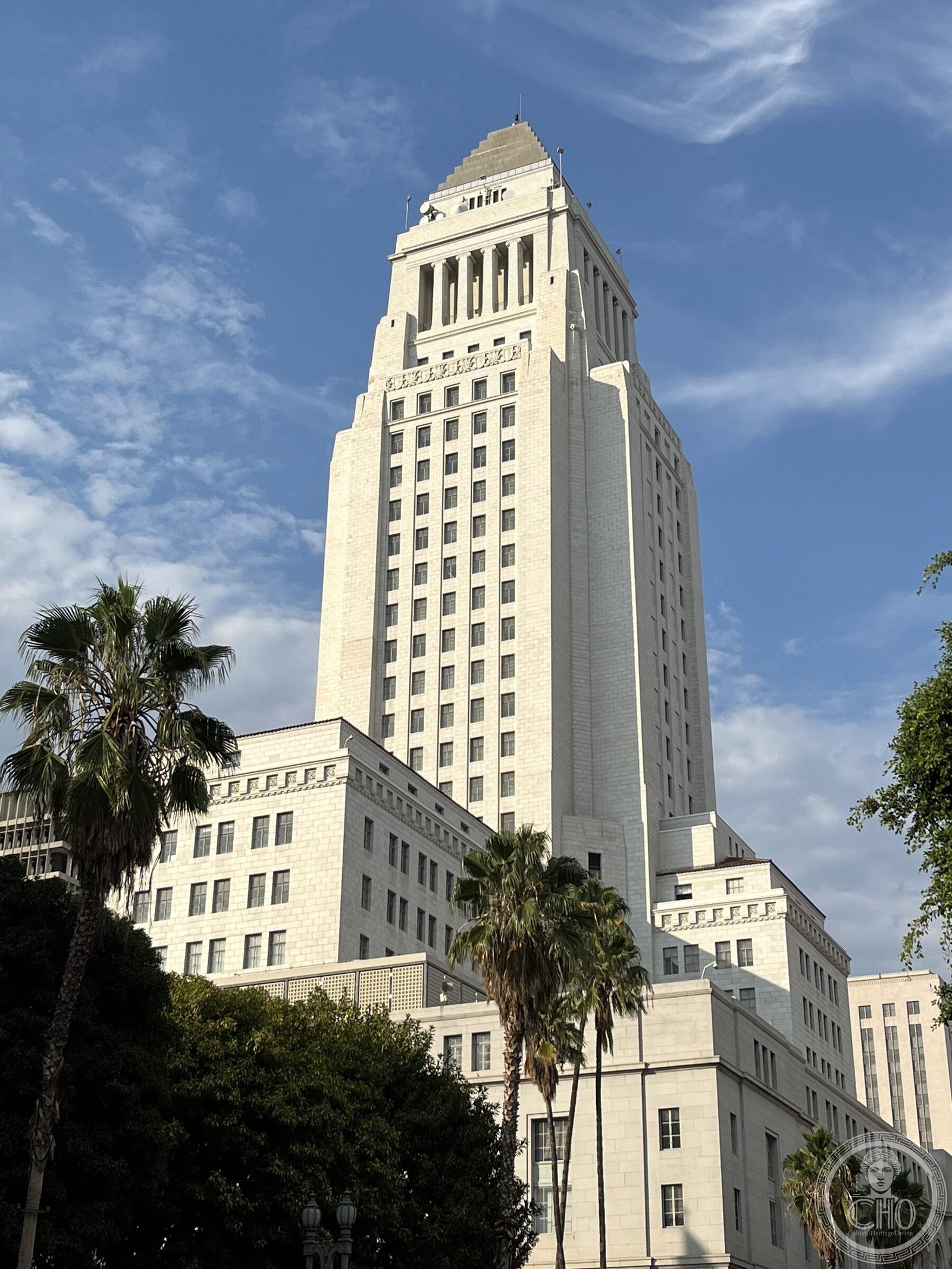
For nearly four decades, the 454-foot tower of Los Angeles City Hall was not just the tallest building in the city but the only skyscraper the law permitted — a deliberate civic statement that the public institution should visibly dominate a city that had not yet decided whether to be vertical or horizontal.
At a glance
Los Angeles City Hall at 200 North Spring Street was dedicated in 1928 and served as the tallest building in Los Angeles for nearly four decades, its 32-story tower rising to 454 feet in a city where private construction was restricted to a much lower limit. Designed by the team of John Parkinson, John C. Austin, and Albert C. Martin, the building works in a Classical Moderne idiom — a synthesis of Beaux-Arts classicism and the emerging Art Deco vocabulary of the 1920s — that gives it a formal civic presence suitable to the seat of government of the nation’s fastest-growing major city. The building is listed on the National Register of Historic Places.
Key facts
- Address: 200 North Spring Street, Civic Center, Los Angeles, California
- Dedicated: 1928
- Architects: John Parkinson, John C. Austin, and Albert C. Martin
- Style: Classical Moderne (Beaux-Arts with Art Deco elements)
- Height: 454 feet (138 meters), 32 stories
- Historic designation: National Register of Historic Places; Los Angeles Historic-Cultural Monument
History
The building of Los Angeles City Hall in the late 1920s was a civic act of considerable ambition. The city had grown explosively in the preceding decades — from roughly 100,000 residents in 1900 to nearly a million by the mid-1920s — and the construction of a monumental city hall was one statement among many that Los Angeles was establishing itself as a major American metropolis. The architects were instructed to produce a building of lasting dignity, and they responded with a design that drew on the full vocabulary of civic monumentalism: the colonnaded base, the tiered tower, the crowning pyramid, and the white cladding of granite and terracotta that makes the building visible from miles across the flat Los Angeles Basin.
At the time of its construction, a municipal ordinance limited the height of privately owned buildings in Los Angeles to 150 feet, a restriction established after fears of earthquake risk. City Hall was built under an exemption from this limit, and its tower stood alone above the city’s low-rise grid for nearly four decades. The ordinance was effectively lifted in the late 1950s, and the Bunker Hill district of downtown Los Angeles began its transformation into the high-rise financial center it is today. For the generation that grew up in Los Angeles between the 1930s and the 1960s, City Hall was simply the tallest thing in the city; its silhouette appeared in the opening sequence of the television series Dragnet and in dozens of films that needed an instantly recognizable visual signature for Los Angeles.
The building underwent a major seismic retrofit in the late 1990s and early 2000s, during which the original structure was comprehensively strengthened to modern earthquake resistance standards. The exterior and the ornamental interior, including the rotunda and the council chambers, were preserved and restored as part of the project. The renovation allowed City Hall to continue serving as a working government building while meeting the safety requirements that California law now demands of publicly occupied structures.
What you see
Los Angeles City Hall is most impressive from a distance, where the complete tower profile is visible: the broad base, the setback middle section, the narrowing upper stories, and the pyramidal crown give the building a silhouette that echoes the temple towers of ancient civilizations as much as it does the skyscrapers of the 1920s. The building is clad in white granite at the base and white granite above, giving it a brightness in the California sun that distinguishes it from the darker glass and steel of the post-1960s towers of Bunker Hill. The colonnade at the entrance level and the carved ornament of the exterior program maintain the Beaux-Arts character of the lower sections, while the upper tower and crown move toward the more austere monumentality of the period’s classicizing Modern.
Inside, the rotunda beneath the tower contains one of the finest civic interior spaces in California: a vaulted room decorated with a mosaic floor depicting the city’s early history, surrounded by the ornamental arches and columns that support the structure above. The observation deck on the 27th floor, open to the public, provides a 360-degree view of the Los Angeles Basin, the San Gabriel Mountains to the east, and the Pacific Ocean on clear days. It is one of the few free public observation decks in Los Angeles.
Practical information
- Status: Active municipal government building; lobby, rotunda, and observation deck open to the public on weekdays
- Observation deck: 27th floor; free admission; open Monday–Friday, hours vary — check the City of Los Angeles website for current access information
- Historic designation: National Register of Historic Places; Los Angeles Historic-Cultural Monument
Getting there
Los Angeles City Hall is at 200 North Spring Street in the Civic Center district of downtown Los Angeles. The nearest Metro station is Civic Center/Grand Park (B Line/Red Line, D Line/Purple Line), immediately adjacent to the building at First and Hill Streets. From Union Station, the walk west along First Street through the Civic Center takes approximately 10 minutes. Pershing Square station (B, D Lines) is also within walking distance, about six blocks south. The building is at the north end of Grand Park, the civic open space that runs from City Hall south to the Department of Water and Power building.
Nearby
- Grand Park — the 12-acre civic park immediately south of City Hall, from Spring Street to the Music Center, offering a green public space in the heart of downtown Los Angeles
- Union Station (1939) — the last great American rail terminal, a Mission Revival/Spanish Colonial/Art Deco hybrid at 800 North Alameda Street, about seven blocks east; opened the same year as the New York World’s Fair
- The Broad (2015) — the contemporary art museum at 221 South Grand Avenue, in the Bunker Hill cultural district about six blocks southwest, housing the Broad’s collection of post-1958 art
- The Museum of Contemporary Art (MOCA, 1986) — Arata Isozaki’s downtown contemporary art museum at 250 South Grand Avenue, about eight blocks southwest
Sources
- Wikipedia: Los Angeles City Hall
- National Register of Historic Places nomination documentation
- Los Angeles Conservancy building records
- Gebhard, David & Winter, Robert, An Architectural Guidebook to Los Angeles (5th ed., Gibbs Smith, 2003)
Find it on the map
See this place and what’s around it →Record researched and written by Luigi De Marchi for Cultural Heritage Online, 2026.
📷 Become a Cultural Heritage Online photographer
Share your photos of places: they stay published under your name as the author. The more they're seen, the more you get noticed — and soon a contest will reward the most appreciated photos.
Log in or sign up free to add a photoIs this page about you?
This page is read by travellers and heritage enthusiasts who find it on Google. Tell us how you are connected to this place and we will take it from there.