
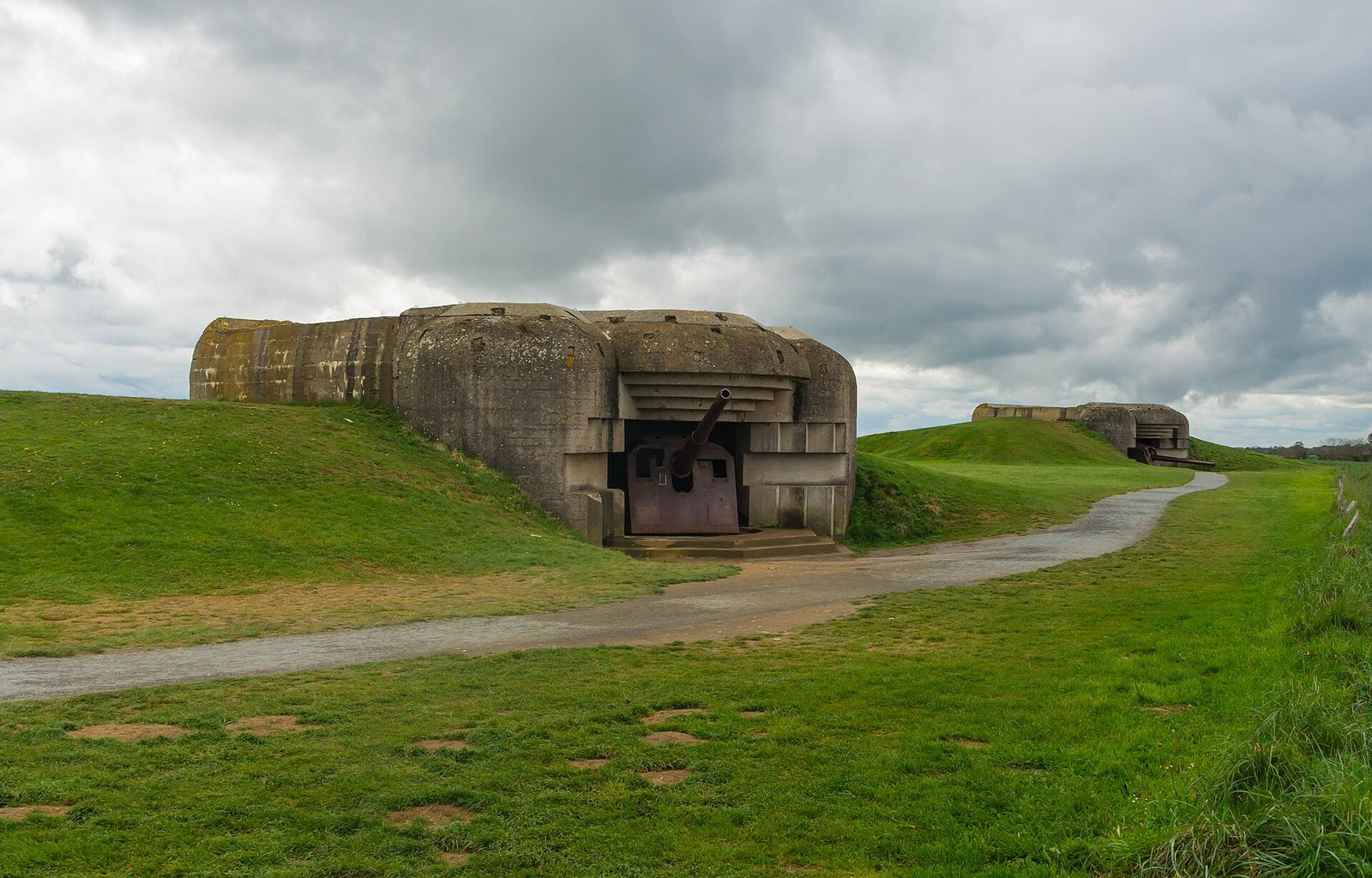
Four concrete casemates on a cliff between Omaha and Gold, and the only coastal battery in Normandy that still holds its original guns. What happened here on 6 June 1944 is told in at least three different ways — and the documents that complicate the best-known version are Allied documents.
At a glance
The battery sits on a chalk cliff about 60 metres above the Baie de la Seine, midway between the sectors the Allies would name Omaha and Gold. Four casemates housed four naval guns with a reach of roughly 20 kilometres, which put both landing sectors inside their arc. Three hundred metres seaward, on the cliff edge, a two-storey observation and fire-control post directed the shooting.
It is protected today because of what survived rather than what happened. Three of the four casemates still contain their guns; the fourth is a ruin. No other coastal battery in Normandy kept its armament, which makes Longues-sur-Mer the reference site for anyone studying how these works were actually designed, and how well they actually worked.
Key facts
- Built: begun September 1943, complete by April 1944, by the Organisation Todt
- Structures: four Regelbau M272 gun casemates, walls and roofs over 2 m thick; one Regelbau M262A fire-control post on the cliff edge, 300 m forward of the guns
- Guns: 15 cm TbtsK C/36 naval guns, made by the German-controlled Škoda works at Plzeň; range about 20 km; six to eight rounds a minute
- Garrison: 184 officers and men
- Rounds fired on 6 June 1944: more than 100, by the battery’s own count of the day
- Surrendered: midday, 7 June 1944, to C Company, 2nd Battalion, Devonshire Regiment
- Protection: listed 1994, classified monument historique 25 October 2001 (Mérimée PA00132892); owned by the Conservatoire du littoral
- Coordinates: 49.3435° N, 0.6950° W
How it was built
Longues-sur-Mer belongs to the last and heaviest phase of the Atlantic Wall. The Canadian War Museum puts the whole programme at over 17 million cubic metres of concrete and 1.2 million metric tons of steel between 1942 and 1944, spread across some 15,000 bunkers and installations from Norway to the Spanish border. Most of that concrete was poured by the Organisation Todt, which the same source describes as a labour system «notorious for its use of forced and slave labour». The men who mixed and placed the concrete at Longues-sur-Mer were, for the most part, not German and not there by choice.
The casemates are a catalogue design, not an architect’s project. Regelbau means «standard build»: a numbered type, drawn once in Berlin and repeated along 5,000 kilometres of coast, so that a crew trained in one casemate could fight in any other. The M272 gave each gun a concrete box with walls and roof above two metres thick, an embrasure narrow enough to be hard to hit and wide enough to traverse across the bay, and a rear corridor for ammunition. What the type could not give was a view: the gun sees a slice of sea, and someone else has to tell it where to shoot. That job belonged to the M262A post on the cliff edge, and the 300 metres between the observers and the guns are the reason the site reads the way it does today.
The guns themselves came from a factory the Germans did not build. The 15 cm TbtsK C/36 were destroyer guns manufactured at the Škoda works in Plzeň, in occupied Czechoslovakia. The wall was assembled, in other words, out of other countries’ industry and other countries’ labour — a fact more legible in the objects than in most accounts of them.
6 June 1944, hour by hour
The sequence is documented closely enough to be given in clock time. HMS Ajax opened fire on the battery at 05:37. The battery answered at 06:05. At 06:20 it took HMS Bulolo under fire — the headquarters ship of Force G, with the Gold Beach command staff aboard — and Bulolo shifted position. At 08:00 Ajax engaged again together with HMS Argonaut. The French cruisers Georges Leygues and Montcalm and the American battleship USS Arkansas also fired on the position; one casemate was put out of action and two were damaged.
By the end of the day the battery had fired more than 100 rounds and one gun was still able to work. It hit nothing of consequence. On the following day, at midday, the 184 men of the garrison surrendered to a single company of the Devonshire Regiment, without fighting.
Who tells it, and where the accounts diverge
The best-known version of this morning is British and it is short: Ajax silenced the battery with hits through the embrasures. It is the version that fits the site, because a visitor standing in front of the wrecked casemate can see a hole. It is also the version that leaves least room for the French and American cruisers that were firing at the same target in the same hours, and which appear in other accounts as the ships that did the damage. The disagreement is not about whether the battery was hit. It is about whose shells did it, and no reconstruction settles it: several ships were shooting at one small target through smoke, and the shells did not sign their work.
The larger divergence is over the word «silenced». The British Admiralty examined its own bombardment afterwards and reached a careful formulation, quoted by the naval historian Tim Benbow: the coastal batteries «were either silenced or reduced to short periods of spasmodic and ineffectual fire», and the shelling «succeeded in rendering the enemy temporarily incapable of strong resistance». Benbow’s summary of the evidence is blunter still — casemated batteries were suppressed and neutralised rather than destroyed, because «strongly protected and cleverly cited shore batteries are extremely difficult targets for warships to hit». Read against that, the hundred-odd rounds fired from Longues-sur-Mer after it was reported silenced are not an anomaly. They are what the Admiralty said to expect.
The German account of the wall does not survive contact with the site either, and the sharpest witness against it is German. In 1943 the commander in the Pas de Calais described the Atlantic Wall to his own superiors as, at best, «a thin, in many places fragile, length of cord with a few small knots at isolated points». Longues-sur-Mer is one of the small knots. Two metres of concrete kept the crews alive under naval gunfire and kept them shooting; it could not make 184 men and four guns into a defence, and on 7 June it did not.
Both propaganda machines needed the same building to be impregnable — one to promise safety, the other to make the breach heroic. The concrete was neither. It was a good box, poured by conscripted labour, holding old naval guns aimed by men who could not see the sea.
What you see today
- Three intact casemates with their 15 cm guns in place, and a fourth reduced to broken concrete — the damage of 6 June is part of what is legally protected.
- The M262A fire-control post on the cliff edge, two storeys, with the observation slit that framed the bay. It is the one place on the site where you see what the battery was actually looking at.
- The cliff path between the post and the guns, which makes the 300-metre separation physical rather than theoretical.
- The site is open ground on the coast: wind, no shade, uneven concrete. Sturdy shoes, and an hour if you want to walk between all five structures.
Getting there
The battery is about 6 km north-west of Bayeux and 8 km west of Arromanches, signposted from the D514 coast road. Bayeux is the practical base: it has the train station on the Paris–Cherbourg line, and the Musée Mémorial de la Bataille de Normandie. The land belongs to the Conservatoire du littoral and the outdoor site is freely accessible.
Nearby
- Arromanches and the remains of the Mulberry harbour, 8 km east
- Bayeux, its cathedral and the Bayeux Tapestry, 6 km south
- Port-en-Bessin, the fishing harbour at the boundary of the British and American sectors, 6 km west
Sources
- Ministère de la Culture, base Mérimée, notice PA00132892, Batterie d’artillerie de Longues — protection dates, extent of the classification, ownership.
- Tim Benbow, «Battleships, D-Day and naval strategy», War in History 29:3 (2022) — Admiralty assessment of counter-battery fire; suppression versus destruction.
- Serge Durflinger and Bill McAndrew, «Fortress Europe: German Coastal Defences and the Canadian Role in Liberating the Channel Ports», Canadian War Museum — Atlantic Wall materials, Organisation Todt labour, the Pas-de-Calais commander’s assessment.
- Wikipedia, Longues-sur-Mer battery — construction sequence, Regelbau types, armament, timings of 6 June, garrison and surrender. Used as a starting point and cross-checked against the sources above.
Find it on the map
See this place and what’s around it →Events here — now on & upcoming
- Anniversary: D-Day Seen from the Longues-sur-Mer Battery — June 6, 194406 Jun 2027See the event →
📷 Become a Cultural Heritage Online photographer
Share your photos of places: they stay published under your name as the author. The more they're seen, the more you get noticed — and soon a contest will reward the most appreciated photos.
Log in or sign up free to add a photo