

Bangkok, Thailand · reign of Rama III · Buddhist monastery
At a glance
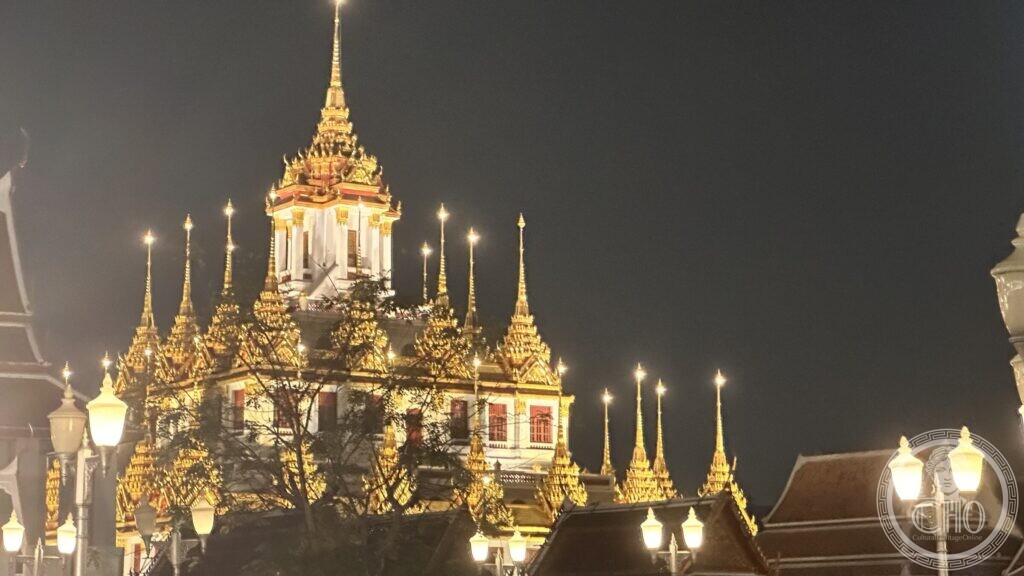
A tiered building bristling with metal spires, lit at night above the roofs of the old city. King Rama III — the king remembered in Thailand as the temple builder — ordered it in B.E. 2389, 1846, for his granddaughter Princess Somanas Wattanawadi, and it is the principal structure of Wat Ratchanatdaram, one of the nineteen temples founded in his reign. Its name, Loha Prasat, means metal castle: seven storeys, thirty-seven spires, and a spiral stair of sixty-seven steps up the middle. Two earlier buildings on the same idea, one in India and one in Sri Lanka, are gone; this is the only one left standing. In front of it there is now a wide empty plaza with a monument to that king in the middle of it — and the emptiness is deliberate: the square was cleared to give the building a view.
Key facts
- Temple: Wat Ratchanatdaram Worawihan (วัดราชนัดดารามวรวิหาร)
- Built during the reign of King Rama III (born 1788; crowned 1 August 1824; died 2 April 1851)
- One of the 19 new temples built in that reign, in which more than 60 others were repaired or added to
- Loha Prasat (โลหะปราสาท): the metal castle, the temple’s principal structure
- Ordered: B.E. 2389, 1846, by King Nangklao, Rama III
- For: Princess Somanas Wattanawadi, the king’s granddaughter
- Seven storeys; 37 spires, for the thirty-seven factors of enlightenment; an internal spiral stair of 67 steps
- Relics of the Buddha enshrined at the summit by King Rama IX in B.E. 2538, 1995
- The only surviving loha prasat: the two earlier ones, in India and in Sri Lanka, no longer exist
- Listed on Thailand’s national heritage register
- ⚠️ It is not a UNESCO World Heritage site, and no UNESCO record of it was found — a claim that circulates on travel sites
- In front of it: the Maha Chetsadabodin Royal Pavilion plaza, with the monument to King Rama III
- The plaza was created as open ground, without tall trees, to open the view of the Loha Prasat
- Coordinates: 13.754840, 100.504250
What you see
At night the building is the brightest thing on this stretch of Ratchadamnoen. It rises in stages — a white storey with red-framed windows, then a forest of gilded finials, then more white wall, then more finials, and finally a single tall spire in the middle. The spires are not decoration scattered on a roof: they are arranged on a grid, tier above tier, twenty-four low down, twelve above them and one at the summit, so that the whole thing reads as a building made of pinnacles. They are gold now. Several published accounts describe them as dark metal and credit the gilding to a restoration with the Fine Arts Department, but no official record of that work could be found, and the dates that circulate are not repeated here. From the plaza you see it over a low white wall and through the crowns of trees, which is exactly what the plaza was designed to let you do.
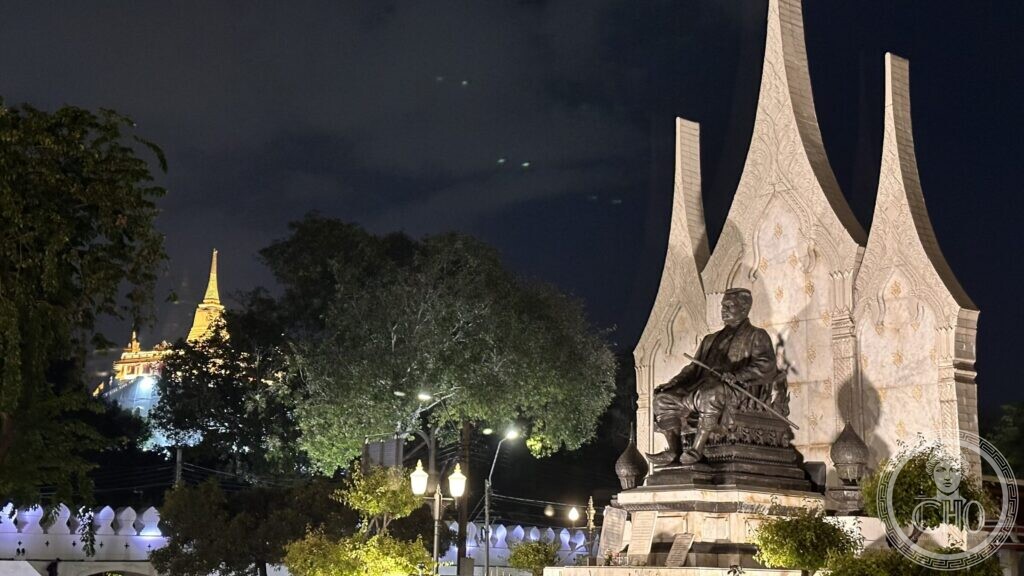
The plaza itself is worth reading. It is a large paved square with the seated bronze of Rama III at one end, backed by a white screen with three flame-shaped finials, and very little else: no big trees, no shade, almost nothing to sit on. The Thai architectural historian Chatri Prakitnonthakan has argued that this is not an accident of design but its purpose — that a series of open spaces on Rattanakosin Island were cleared less to give the city greenery than to give royal monuments an unobstructed setting. Standing there after dark, with the Loha Prasat on one side and the lit stupa of Wat Saket floating above the trees on the other, it is hard to disagree.
The metal castle today

Practical information
- The temple is on Maha Chai Road, at the Phan Fa end of Ratchadamnoen Klang, in Phra Nakhon district.
- A working monastery. Shoulders and knees covered; shoes off where indicated.
- Check opening times and any charge for climbing the Loha Prasat with the temple before travelling.
Do you know more?
On this page we have published what can be seen and what we were able to verify. About the restoration that gilded the spires — no official record of its dates, the agencies involved or the extent of the work we could not find a reliable source. If you know something — a name, a date, the architect, the family who lived there, an old photograph, a document, a book that mentions it — write to Sofia, who looks after these pages.
Write to Sofia
or send a message on WhatsApp
Please start your message with the title of this page, so it reaches the right file. Every contribution is checked against independent sources before it goes on the page, and we always say where a piece of information came from.
Sources
- The Siam Society under Royal Patronage — A Visit to Temples Built During the Reign of King Rama III: Wat Ratchanadda among the important temples of the reign; Rama III’s dates; the 19 new temples and the more than 60 repaired
- Chatri Prakitnonthakan, “The Rattanakosin Charter: The Thai Cultural Charter for Conservation”, Journal of the Siam Society, vol. 100 (2012): the Maha Chetsadabodin Royal Pavilion plaza, the Rama III memorial, and the argument that the open space without tall trees exists to give a view of the Loha Prasat
- Office of Natural Resources and Environmental Policy and Planning (ONEP), World Heritage Site database, record 5 — Wat Ratchanatdaram Worawihan: the commission by Rama III in B.E. 2389 for Princess Somanas Wattanawadi, the seven storeys and thirty-seven spires, the spiral stair of sixty-seven steps, the relics enshrined by Rama IX in B.E. 2538, the two earlier buildings of the type in India and Sri Lanka that no longer exist, and the temple’s place on the national heritage register
- Princess Maha Chakri Sirindhorn Anthropology Centre (SAC), database of archaeological sites in Thailand: the temple and its setting on the eastern moat, beside Pom Mahakan
- Silpa Bhirasri, Thai Buddhist Art (Architecture), Thai Culture New Series no. 4, published by the Fine Arts Department, Bangkok: the prasat as a building type
- OpenStreetMap: coordinates of the temple
Record researched and written by Luigi De Marchi for Cultural Heritage Online, 2026.
Find it on the map
See this place and what’s around it →📷 Become a Cultural Heritage Online photographer
Share your photos of places: they stay published under your name as the author. The more they're seen, the more you get noticed — and soon a contest will reward the most appreciated photos.
Log in or sign up free to add a photo