
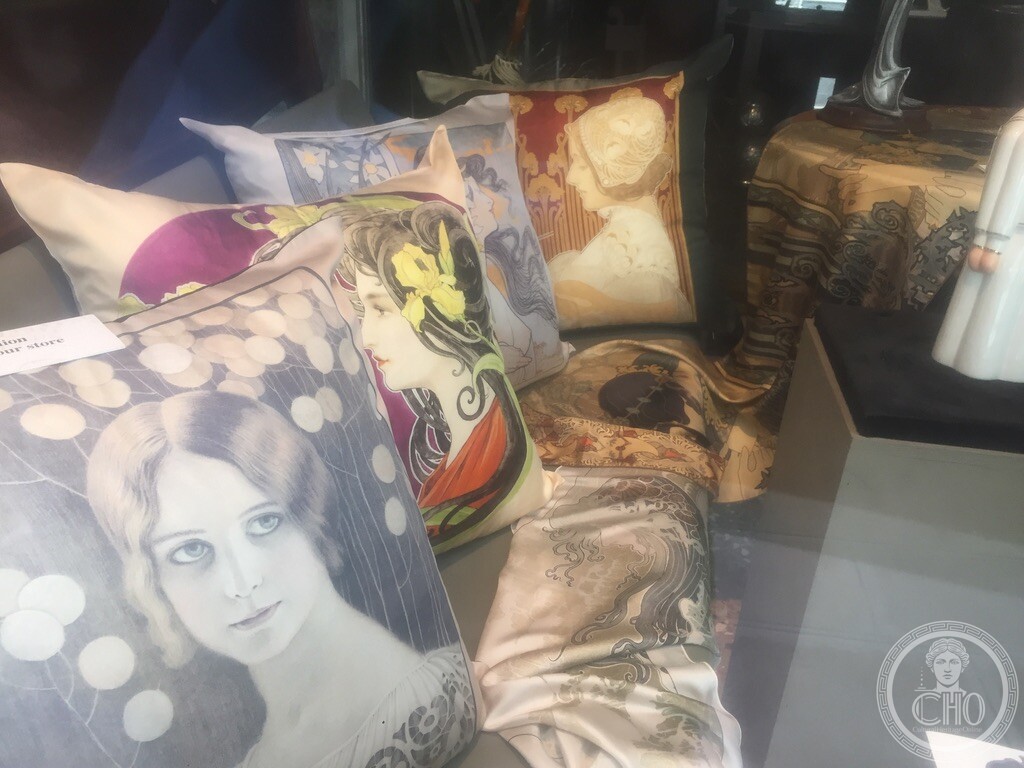
Overlooking the sunlit expanse of Campo Santo Stefano, artisanal boutique vitrines continue Venice’s rich legacy of luxury textiles, showcasing fine silk and velvet cushions adorned with Art Nouveau and Stile Liberty iconography inspired by Alphonse Mucha and Gustav Klimt.
At a glance
- Location
- Campo Santo Stefano (Campo Francesco Morosini), Sestiere di San Marco, Venice
- Artistic style
- Stile Liberty (Italian Art Nouveau) and Viennese Secession textile prints
- Craftsmanship
- Printed silk, damask velvet, and bespoke decorative home furnishings
- Featured motifs
- Flowing floral allegories of Alphonse Mucha, Byzantine-patterned gowns, and fin-de-siècle female portraiture
- Venetian context
- The continuation of Venice’s five-century tradition of master weaving, damask production, and decorative luxury arts
- Coordinates
- 45.43332° N, 12.33023° E · Open in Google Maps
Venetian Weaving and the Liberty Renaissance
Since the fourteenth century, Venice was the textile capital of the Western world. Venetian velvet, damask, brocade, and lampas were coveted by courts across Europe. At the turn of the twentieth century, the decorative arts underwent a dazzling modern rebirth in Venice: the historic workshops of Mariano Fortuny on the Giudecca and Vittorio Zecchin on Murano fused traditional Venetian luxury weaving with the sinuous, nature-inspired aesthetics of the Stile Liberty (Art Nouveau).
At Campo Santo Stefano, one of the most elegant cultural salons of the city, independent ateliers and textile studios continue to celebrate this heritage. Modern artisanal creations draw inspiration from the masterworks of Czech painter Alphonse Mucha and the golden mosaics of Gustav Klimt, whose formative visit to the Byzantine basilicas of Venice and Ravenna in 1903 revolutionized modern European decorative art.
The Vitrine at Campo Santo Stefano
The window display captured in Campo Santo Stefano presents a harmonious ensemble of fine cushions crafted in lustrous silk satin and printed velvet. Centred among the pieces is a reproduction of Alphonse Mucha’s celebrated 1898 lithographic series The Arts, showing sensual female profiles crowned with golden irises and flowing sinuous hair. Adjacent cushions pay homage to the geometric, floral patterns of the Viennese Secession, alongside draped silks that evoke the flowing gowns of the Belle Époque.
Nearby
- The Cloister of Santo Stefano — Peaceful historic monastery cloister, 80 m south
- Palazzo Franchetti — Magnificent Neo-Gothic palace and cultural institute on the Grand Canal, 120 m southwest
- Ponte dell’Accademia — Iconic wooden bridge crossing to Dorsoduro, 150 m south
Find it on the map
See this place and what’s around it →Record researched and written by Carla Szathvary for Cultural Heritage Online, 2026.
📷 Become a Cultural Heritage Online photographer
Share your photos of places: they stay published under your name as the author. The more they're seen, the more you get noticed — and soon a contest will reward the most appreciated photos.
Log in or sign up free to add a photoIs this page about you?
This page is read by travellers and heritage enthusiasts who find it on Google. Tell us how you are connected to this place and we will take it from there.