

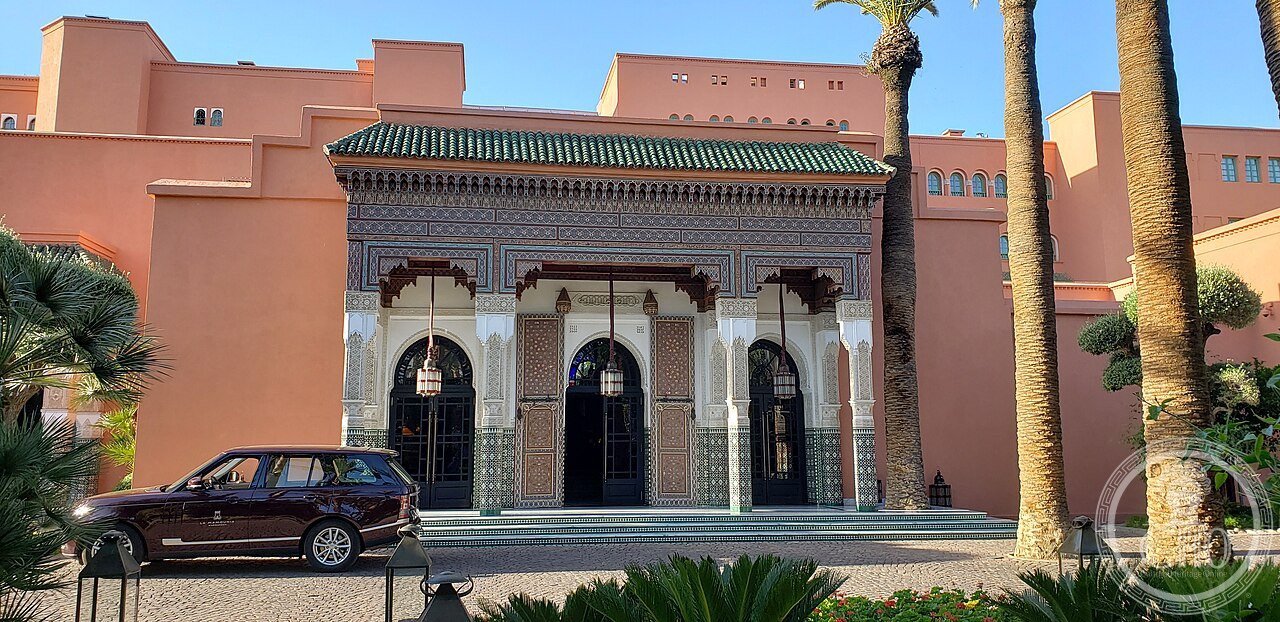
Winston Churchill called it “a wonderful place” and returned winter after winter to paint in the Moroccan sun. The gardens have been growing since the 18th century.
At a glance
La Mamounia stands opposite the Kutubiyya Mosque on the western edge of Marrakech’s medina, its 8-hectare gardens shading a building that architects Henri Prost (1874–1959) and Antoine Marchisio conceived in 1923 and completed in 1929. The design fuses the proportions of Moroccan palace architecture — horseshoe arches, colonnaded courtyards, zellij-tiled fountains — with the clean geometry and lacquered furniture of Art Deco. Three major renovations (1946, 2006–2009, 2020) have modernised the 135 rooms and 71 suites without erasing the building’s ceremonial scale. It remains one of the most architecturally coherent luxury hotels in the Arab world.
Key facts
- Built: 1923–1929, designed by Henri Prost and Antoine Marchisio
- Style: Moroccan palace architecture with Art Deco elements
- Status: Five-star luxury hotel; member of The Leading Hotels of the World
- Address: Avenue Bab Jdid, 40040 Marrakesh, Morocco
- GPS: 31.6208, -7.9972 — Open in Google Maps
- UNESCO/Listed: No national monument listing; situated adjacent to the Marrakech medina (UNESCO World Heritage Site, 1985)
History
The land precedes the hotel by more than a century. In the 18th century, Alaouite Sultan Mohammed ben Abdallah gifted a 15-hectare orchard and garden to his son Moulay Mamoun as a wedding present — the arsat, or palace garden. Olive groves and citrus trees planted then still stand. When Morocco’s railway authority commissioned a grand hotel for Marrakech in the early 1920s, the site was chosen for its proximity to the medina walls and the Bab Jdid gate. Prost and Marchisio broke ground in 1923; the hotel opened in 1929 with approximately 100 rooms.
Churchill first arrived in the winter of 1935 and made the hotel his base for extended painting trips, working en plein air from the rooftops and garden terraces. He described it in correspondence as “a wonderful place, one of the best I have ever used.” A 1946 renovation saw artist Jacques Majorelle contribute decorative work — his cobalt pigment, later immortalised in the Jardin Majorelle nearby, appears in the hotel’s colour palette. Alfred Hitchcock filmed sequences of The Man Who Knew Too Much on location in 1956; Paul McCartney composed the song “Mamunia” after staying in 1973.
A comprehensive three-year renovation by designer Jacques Garcia completed in 2009 refurnished the public spaces while preserving the Art Deco structure. A further renovation in 2020 introduced restaurants by chefs Pierre Hermé and Jean-Georges Vongerichten. The centenary in 2023 was marked with additional conservation works on the original 1929 fabric.
What you see
The entrance sequence is deliberately theatrical: a triumphal arch in ochre render frames a long garden axis of orange trees before the main building comes into view. The exterior reads as a simplified Moroccan palace, its mass relieved by projecting bay windows (mashrabiyya) and broad overhanging eaves. The ochre colour is the same iron-rich pigment used throughout the medina — La Mamounia sits inside the city’s chromatic logic rather than apart from it.
Inside, zellij-tiled floors and carved cedar ceilings in the Moroccan reception halls contrast with the streamlined Art Deco furniture and geometric inlay of the private suites. The Bar Churchill preserves its original 1920s panelling. The garden — 8.1 hectares of olive groves, rose beds, and citrus alleys — is accessible to hotel guests and constitutes one of the largest private green spaces in any Moroccan city.
Practical information
- Open to hotel guests; restaurants and spa bookable by non-residents with advance reservation
- Best season: October–April for temperate weather; gardens peak February–March (roses and citrus blossom)
- Guided hotel tours: available on request; the garden is open to guests throughout the day
- Estimated visit time: half-day for non-residents (garden + restaurant + Bar Churchill); multi-night stay recommended
Getting there
Marrakech Menara Airport is 6 km southwest of the hotel; taxis take approximately 15 minutes. La Mamounia stands immediately inside Bab Jdid, one of the gates in the 12th-century Almohad city walls, about 900 m on foot from Jemaa el-Fna square. The Kutubiyya Mosque minaret is visible from the hotel garden and serves as a natural landmark for orientation.
Nearby
- Kutubiyya Mosque (12th century) — The tallest structure in Marrakech, directly opposite the hotel entrance; its minaret set the proportional template for the Giralda in Seville.
- Jemaa el-Fna — The medina’s central square, a UNESCO Intangible Cultural Heritage site, 900 m east on foot.
- Jardin Majorelle — Jacques Majorelle’s cobalt-blue botanical garden, later owned by Yves Saint-Laurent, 2.5 km north by taxi.
- Bahia Palace (19th century) — Grand vizier’s residence with painted cedar ceilings and mosaic courtyards, 1.5 km northeast through the medina.
Sources
Find it on the map
See this place and what’s around it →Events here — now on & upcoming
- 23rd Marrakech International Film Festival20 Nov 2026 — 28 Nov 2026See the event →
📷 Become a Cultural Heritage Online photographer
Share your photos of places: they stay published under your name as the author. The more they're seen, the more you get noticed — and soon a contest will reward the most appreciated photos.
Log in or sign up free to add a photoIs this page about you?
This page is read by travellers and heritage enthusiasts who find it on Google. Tell us how you are connected to this place and we will take it from there.