
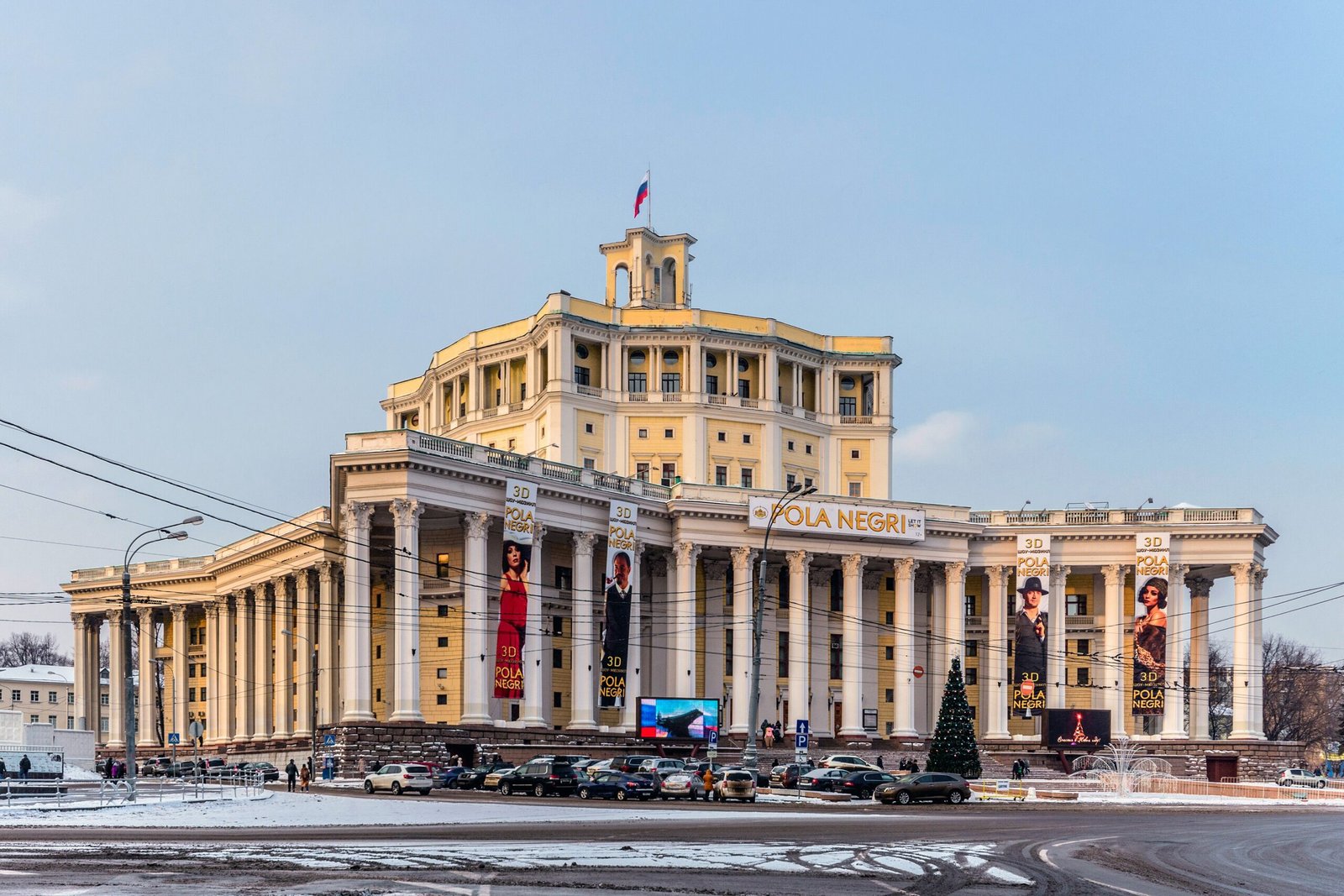
On Suvorov Square stands the largest theatre in Moscow, a Stalinist colossus built in the shape of a five-pointed star and devoted, since its founding, to the drama of war.
At a glance
Founded in 1930 as the Red Army Theatre, the institution was renamed the Soviet Army Theatre in 1951. Its purpose-built home, raised between 1934 and 1940, is a landmark of Stalinist Empire architecture designed by Karo Halabyan and Vasiliy Simbirtsev, with Boris Barkhin also credited among its architects. The building is officially heritage-listed.
History
The company predates its building by four years. Established in February 1930 to serve the Red Army with theatre, it needed a stage worthy of its ambitions. Construction of that stage took the better part of a decade, finishing in 1940 under Stalin’s watch. The 1951 renaming to Soviet Army Theatre reflected the institution’s shifting political identity rather than any change in mission. Aleksey Popov, its first and most celebrated director, shaped the company’s reputation with productions of enormous physical scale. His son Andrei Popov took over direction in 1963, continuing the family’s stewardship of the stage. Generations of Soviet stage stars performed here, among them Lyudmila Kasatkina, Vladimir Zeldin, and Larisa Golubkina.
What you see
The building dominates Suvorov Square by sheer mass. Its plan is scored into the shape of a Soviet red star, a form best appreciated from above but felt even at ground level in the building’s angular, radiating wings. This is Stalinist architecture at full civic scale: monumental, symmetrical, unmistakably built to impress. Inside, the auditorium seats 1,900 people around a stage reputed to be the largest in Europe. That stage was engineered for spectacle beyond ordinary drama. Real tanks have rolled across it. Cavalry have performed there, alongside full-scale models of ships.
Cultural significance
Few theatres anywhere were designed with military hardware in mind. The Russian Army Theatre’s scale reflects a specific Soviet ambition: to fuse state power, military memory, and performing arts into a single civic monument. Its war-themed repertoire was never incidental but foundational, tracing back to its founding brief. Decades of star performers, directors, and monumental productions have kept it central to Moscow’s theatrical life, even as the political language around it shifted from “Red Army” to “Soviet Army” to its current name.
Key facts
- Founded: 6 February 1930, as the Red Army Theatre
- Building constructed: 1934–1940
- Architects: Karo Halabyan, Vasiliy Simbirtsev, Boris Barkhin
- Style: Stalinist Empire style
- Auditorium capacity: 1,900 seats
- Location: Suvorov Square, Moscow
- Heritage status: officially listed
Practical information & getting there
The theatre sits on Suvorov Square in central Moscow, easily reached by metro and a short walk from several central lines. Check the official website before visiting for the current repertoire and ticketing details. As with many working theatres, opening hours depend on the performance schedule rather than a fixed timetable, so plan around a specific show.
Sources & resources
Find it on the map
See this place and what’s around it →📷 Become a Cultural Heritage Online photographer
Share your photos of places: they stay published under your name as the author. The more they're seen, the more you get noticed — and soon a contest will reward the most appreciated photos.
Log in or sign up free to add a photoIs this page about you?
This page is read by travellers and heritage enthusiasts who find it on Google. Tell us how you are connected to this place and we will take it from there.