
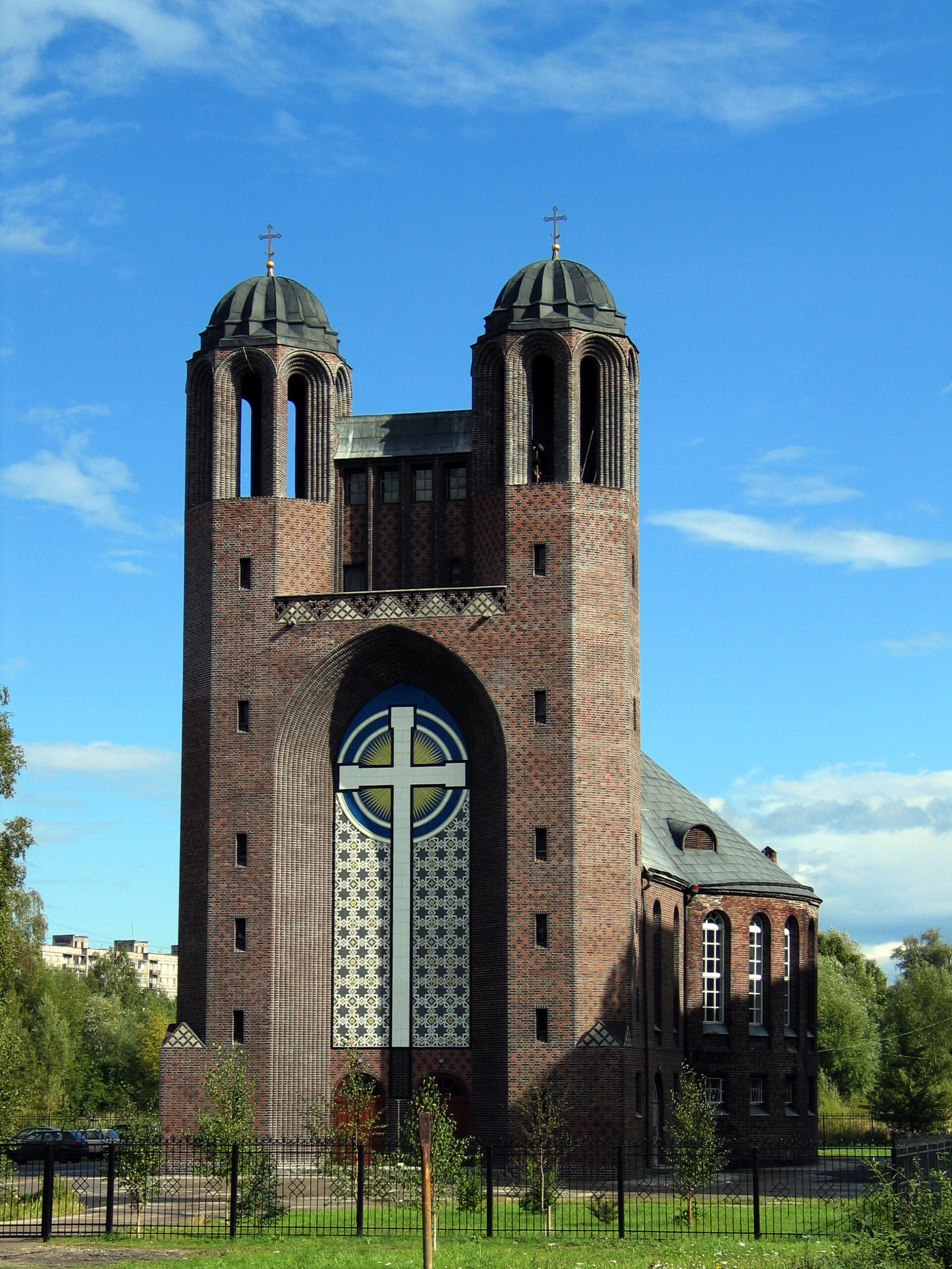
In the former Lomse district of Königsberg stands a brick church raised for a Protestant congregation, converted decades later into an Orthodox parish, its two towers still marked by a maiolica cross.
At a glance
Built between 1930 and 1933 to designs by architect Arthur Kickton, the Kreuzkirche served Königsberg’s evangelical community for barely a decade before war and Soviet rule redirected its purpose. Today it functions as an Orthodox church in Kaliningrad, the city that rose from Königsberg’s ruins.
History
Kickton designed the church for a growing evangelical congregation in Lomse, a working-class quarter east of the old town. Construction ran through the early 1930s, finishing in 1933. World War II left the structure only lightly damaged, a rarity in a city otherwise flattened by bombing and street fighting. Under Soviet administration the building lost its religious function entirely. It became a garage, then a factory producing fishing equipment. A fire in the late 1980s forced a reckoning with the building’s future. In 1988 authorities agreed to hand it to Kaliningrad’s Orthodox community, ending half a century of secular use.
What you see
The church presents a modern silhouette softened by an older device: two flanking towers framing the main volume. Between them sits a monumental cross made of Kadyny maiolica, a glazed ceramic tradition tied to the nearby Kadyny estate. Restoration work following the 1988 transfer altered the building’s internal logic. Both towers, previously distinct from the nave, were physically joined to it. The result reads as a single mass rather than a classic tripartite composition. One original fitting has since traveled elsewhere in the city. The church’s historic clock now hangs on the Church of the Holy Family in Kaliningrad, a quiet link between the two buildings.
Cultural significance
The Kreuzkirche stands as physical evidence of Königsberg’s German Protestant past surviving, however transformed, inside Russian Kaliningrad. Its adaptive reuse mirrors a broader pattern across the region, where former Lutheran churches were repurposed for storage, industry, or Orthodox worship after 1945. The building’s heritage listing recognizes both its 1930s design and its layered later history. Few structures in the city carry so many uses within a single century.
Key facts
- Location: former Lomse district, Königsberg; now Kaliningrad, Russia
- Architect: Arthur Kickton
- Built: 1930–1933
- Style: modern architecture
- Original use: evangelical church
- Interim uses: garage, fishing-equipment factory
- Current use: Orthodox church, since 1988
- Notable feature: monumental cross in Kadyny maiolica
- Heritage status: listed
Practical information & getting there
The church sits within Kaliningrad, reachable by local transport from the city center. As an active Orthodox parish, visiting hours generally follow service times rather than museum schedules. Check the parish’s own site before planning a visit, since access details are not centrally documented elsewhere.
Sources & resources
Find it on the map
See this place and what’s around it →📷 Become a Cultural Heritage Online photographer
Share your photos of places: they stay published under your name as the author. The more they're seen, the more you get noticed — and soon a contest will reward the most appreciated photos.
Log in or sign up free to add a photoIs this page about you?
This page is read by travellers and heritage enthusiasts who find it on Google. Tell us how you are connected to this place and we will take it from there.