
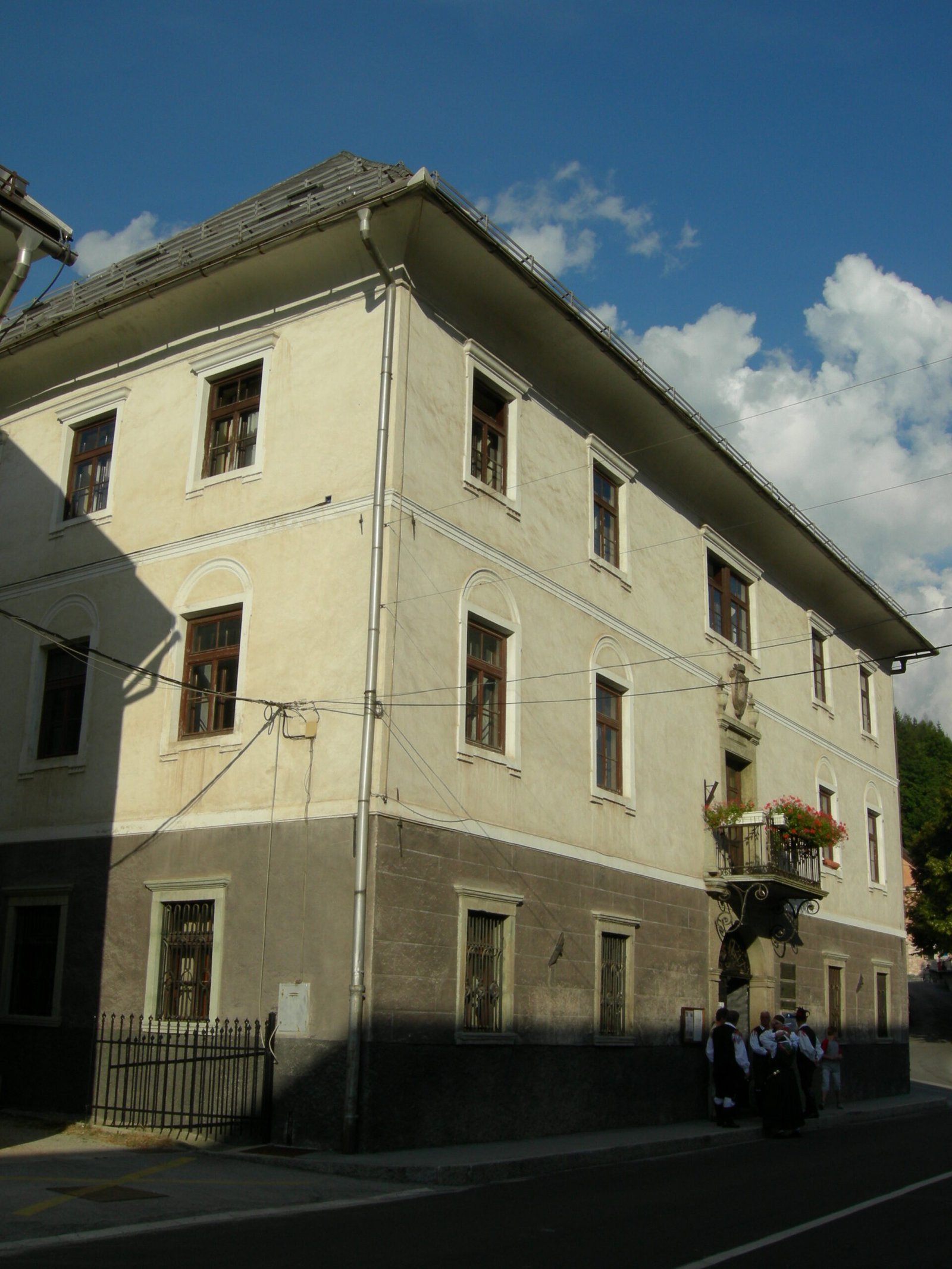
A Renaissance ironworks castle transformed into a cultural institution, bearing witness to four centuries of industrial, political and community history in the Slovenian Alps.
At a glance
Built in 1521 by Sigismund of Dietrichstein for the Bucellini family, the Kos Manor is one of four “ironworks castles” erected in what is now Jesenice during the 16th and early 17th centuries. The Murova neighborhood settlement grew around the iron-mining and processing operations that powered the region’s economy. Today the manor houses a museum, gallery and cultural venue administered by the Upper Sava Museum Jesenice.
History
The manor was constructed in 1521 at the heart of Murova, positioned at the foot of a path leading uphill to the Church of St. Leonard. Early documents referred to it as the “old belopeš castle,” honoring the ancestral seat of the Bucellini family in Bela Peč (“White Furnace”) in present-day Italy. The structure appeared in Johann Weikhard Valvasor’s influential 1689 survey, The Glory of the Duchy of Carniola.
In 1821, the merchant Frančišek Pavel Kos acquired and enlarged the building in neoclassical style, giving it its modern name. The Ruard family later owned it before the KID company—sole operator of local ironworks—purchased it in 1872. The Jesenice municipal government bought the manor in 1882, converting it into a public school from 1883 to 1915. During the interwar period it served as apartments, offices, and a courthouse. The Wehrmacht used it as a transfer prison during World War II.
What you see
The manor blends 16th-century Renaissance stonework with 19th-century neoclassical additions. The early design reflects its origins as a fortified residence for an ironworks proprietor—practical and defensible rather than ornate. Kos’s 1821 renovation introduced neoclassical proportions and detailing while preserving the original structural core. The building’s siting at Murova’s heart, near the Church of St. Leonard, anchors it within the historical settlement pattern.
Cultural significance
The Kos Manor documents the rise of industrial capitalism in the Alpine iron trade. As one of only two surviving “ironworks castles” from its era, it embodies the wealth and influence of merchant families who controlled Slovenia’s most valuable resource. Its later conversion into civic infrastructure—school, courthouse, prison—traces the manor’s passage from private aristocratic seat to public institution. The building’s use as a Gestapo transfer point makes it a sobering reminder of occupation and resistance during World War II.
Key facts
- Built: 1521
- Builder: Sigismund of Dietrichstein
- Location: Cesta maršala Tita 64, Murova, Jesenice, Slovenia
- Coordinates: 46.4389°N, 14.0479°E
- Current use: Museum, gallery, and cultural venue (Upper Sava Museum Jesenice)
Practical information & getting there
The manor is located in the Murova neighborhood of Jesenice, a town in northwestern Slovenia at the foot of the Julian Alps. Currently administered by the Upper Sava Museum Jesenice, it houses rotating art exhibitions, permanent displays on occupation and workers’ movements, and serves as a venue for municipal events and ceremonies. Contact the Upper Sava Museum Jesenice for current hours and admission details.
Sources & resources
Find it on the map
See this place and what’s around it →📷 Become a Cultural Heritage Online photographer
Share your photos of places: they stay published under your name as the author. The more they're seen, the more you get noticed — and soon a contest will reward the most appreciated photos.
Log in or sign up free to add a photoIs this page about you?
This page is read by travellers and heritage enthusiasts who find it on Google. Tell us how you are connected to this place and we will take it from there.