
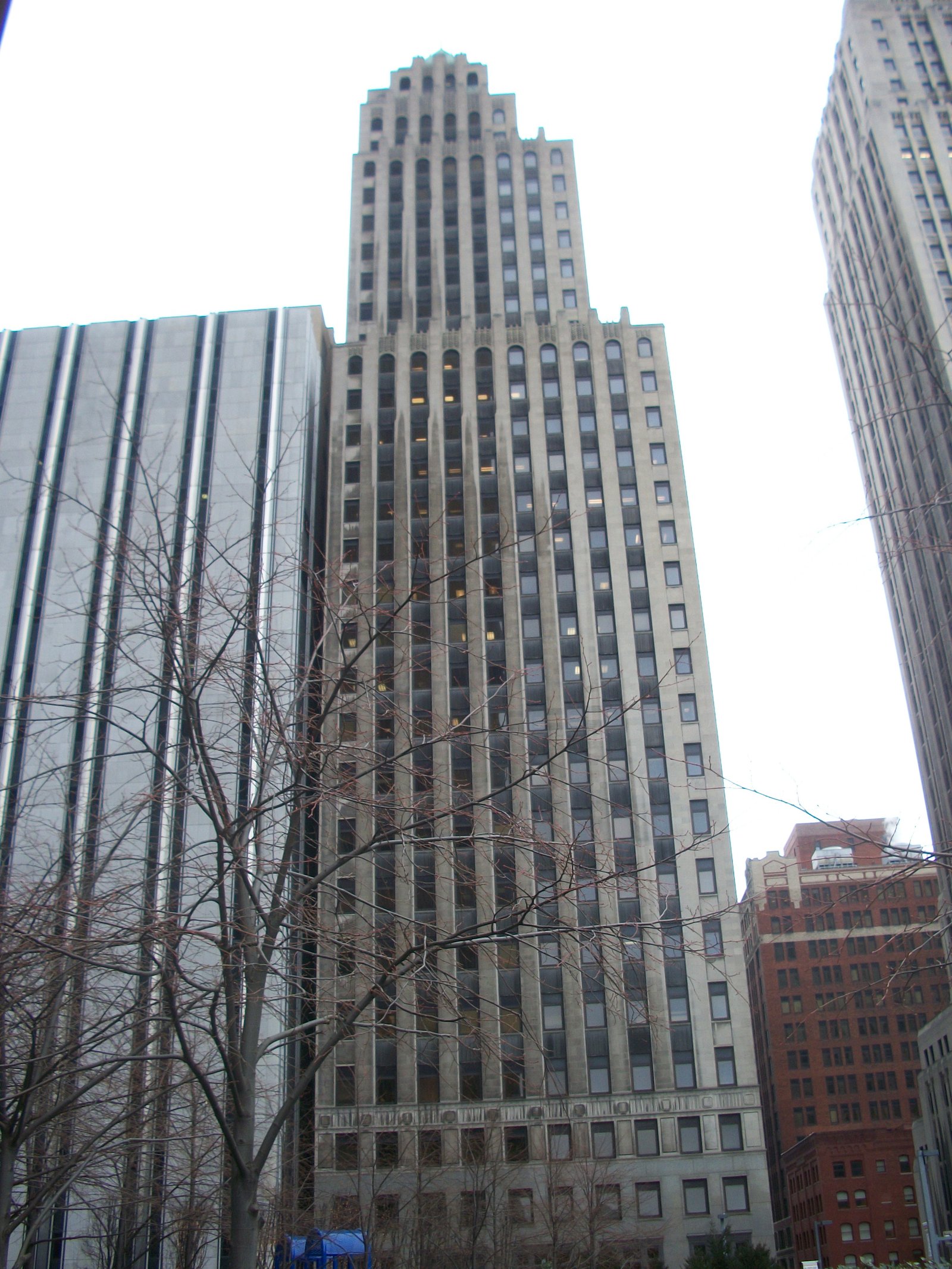

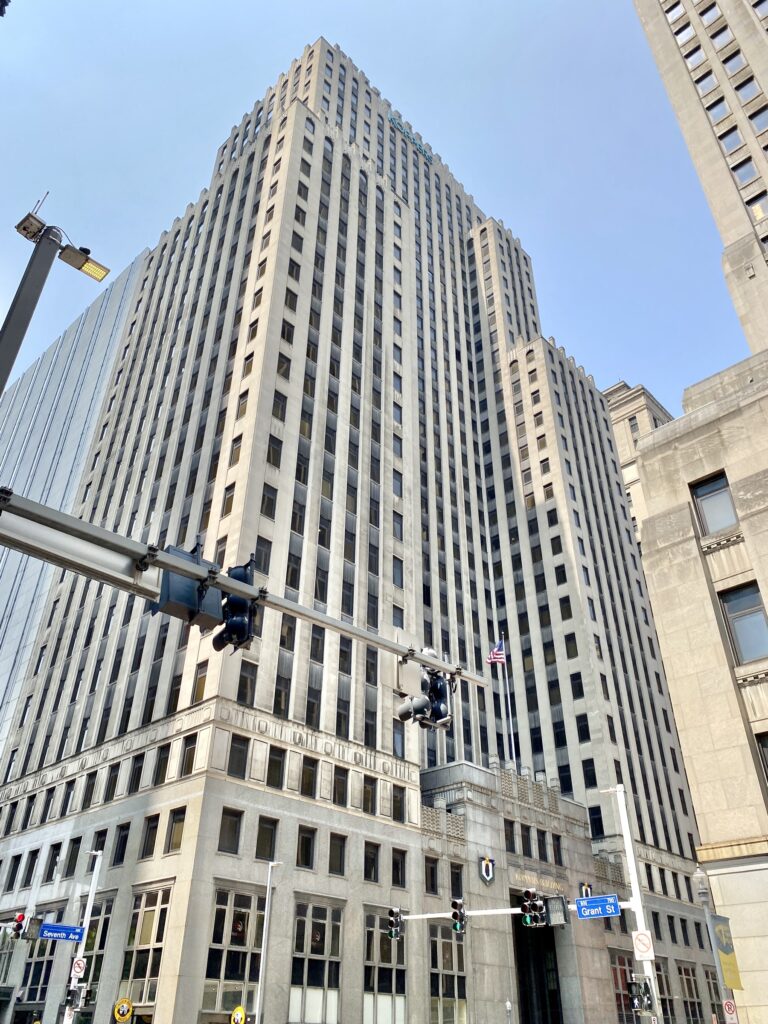
A 34-story limestone shaft capped with an oxidised green copper crown, the Koppers Building is among the most visually distinctive Art Deco towers in the American interior — completed the year of the Crash by one of Chicago’s premier commercial firms.
At a glance
Standing at the corner of 7th Avenue and Grant Street in downtown Pittsburgh, the Koppers Building was completed in 1929 for the Koppers Company, a major coal tar chemicals corporation. Chicago firm Graham, Anderson, Probst & White — also responsible for the Wrigley Building and Chicago Union Station — designed a 34-story tower that combined Deco vertical geometry with a Chateauesque copper crown. The patinated green finials and pinnacles have accumulated their characteristic verdigris over nine decades, giving the building a colour identity unlike any other Pittsburgh tower. Listed on the National Register of Historic Places since 1985, the Koppers Building remains a centrepiece of downtown’s late 1920s architectural ensemble.
Key facts
- Completed: 1929
- Architects: Graham, Anderson, Probst & White
- Height: 34 stories, 475 ft (145 m)
- Style: Art Deco with Chateauesque copper crown
- Address: 436 7th Avenue, Pittsburgh, PA 15219
- NRHP: Contributing property, Pittsburgh Central Downtown Historic District (1985)
- Signature feature: Oxidised green copper crown with Gothic-style pinnacles
History
The Koppers Company commissioned its Pittsburgh headquarters in 1927 as a statement of corporate ambition. Founded by German-born engineer Heinrich Koppers, the firm had built a coal tar and chemical processing empire from the region’s steel and coke industries. Graham, Anderson, Probst & White — then at the height of their Chicago commercial practice following the Wrigley Building (1924) and Union Station (1925) — brought both the technical expertise and the aesthetic ambition the commission demanded.
The building opened in 1929, weeks before the stock market collapse that ended the first American skyscraper era. Despite the economic downturn, the Koppers Company continued to occupy and maintain the tower, and it became a permanent fixture of the downtown commercial district. The copper crown, initially a bright rose-gold, darkened gradually to the characteristic green patina that now identifies the building at a glance across the skyline.
In 1985 the Koppers Building was listed on the National Register of Historic Places, recognising its exceptional architectural quality and its role as a surviving landmark of Pittsburgh’s pre-Depression prosperity. The original lobby — marble walls, ornamental bronze elevator doors, coffered ceiling — remains largely intact, a compressed expression of the corporate grandeur the Koppers Company wanted to project in its peak years.
What you see
The Koppers Building’s facade rises from a stone-carved base through a relatively spare limestone shaft to the crown — the moment where the building’s design logic shifts from Deco to something more decoratively ambiguous. The copper pinnacles and finials are an explicit Gothic quotation, a form of ornamental borrowing that Graham, Anderson, Probst & White employed in several of their commercial towers, treating the Gothic crown as a visually distinctive cap rather than a structural or programmatic element. The verdigris patina makes the contrast with the pale limestone shaft even more pronounced than the architects likely intended, though the colour accident has become the building’s defining characteristic.
At street level the entrance bay on 7th Avenue presents carved limestone pilasters and spandrel panels with stylised Deco foliate ornament. Inside, the lobby’s coffered plaster ceiling and marble revetment represent one of the best-preserved commercial interiors of the period in Pittsburgh. The building is best viewed from the intersection of 7th Avenue and Grant Street, where both the full height and the corner orientation of the entrance bay are visible simultaneously — the green crown floating above pale stone against the sky.
Practical information
- Access: Public lobby open weekdays during business hours; exterior visible at all times
- Best view: Corner of 7th Avenue and Grant Street; or from the upper floors of nearby Grant Building
- Time needed: 20 minutes exterior; lobby visit 10 minutes
- GPS: 40.4419° N, 79.9956° W
- Nearest transit: Steel Plaza T Station, 2-minute walk
Getting there
The Koppers Building stands at the corner of 7th Avenue and Grant Street in downtown Pittsburgh, two minutes from Steel Plaza T station. It is directly adjacent to Gulf Tower and within walking distance of the Cultural District, Market Square, and the David L. Lawrence Convention Center. Pittsburgh International Airport connects by taxi or shuttle in approximately 30 minutes via Interstate 376.
Nearby
- Gulf Tower (1932) — Trowbridge & Livingston’s stepped pyramid tower immediately adjacent on Grant Street
- Grant Building (1929) — Henry Hornbostel’s Art Deco tower at 330 Grant Street, with its rooftop Morse code beacon
- Allegheny County Courthouse (1888) — H.H. Richardson’s Romanesque masterwork on Grant Street
Sources
- National Register of Historic Places, Koppers Building nomination (1985) — National Park Service, nps.gov
- Graham, Anderson, Probst & White firm records — Ryerson & Burnham Archives, Art Institute of Chicago
- Pittsburgh History & Landmarks Foundation, landmark documentation — phlf.org
- Kidney, Walter C. Pittsburgh’s Landmark Architecture: The Historic Survey. Pittsburgh History & Landmarks Foundation, 1997
- Wikidata, Koppers Building Q6431177 — wikidata.org
Gallery
Find it on the map
See this place and what’s around it →📷 Become a Cultural Heritage Online photographer
Share your photos of places: they stay published under your name as the author. The more they're seen, the more you get noticed — and soon a contest will reward the most appreciated photos.
Log in or sign up free to add a photoIs this page about you?
This page is read by travellers and heritage enthusiasts who find it on Google. Tell us how you are connected to this place and we will take it from there.