
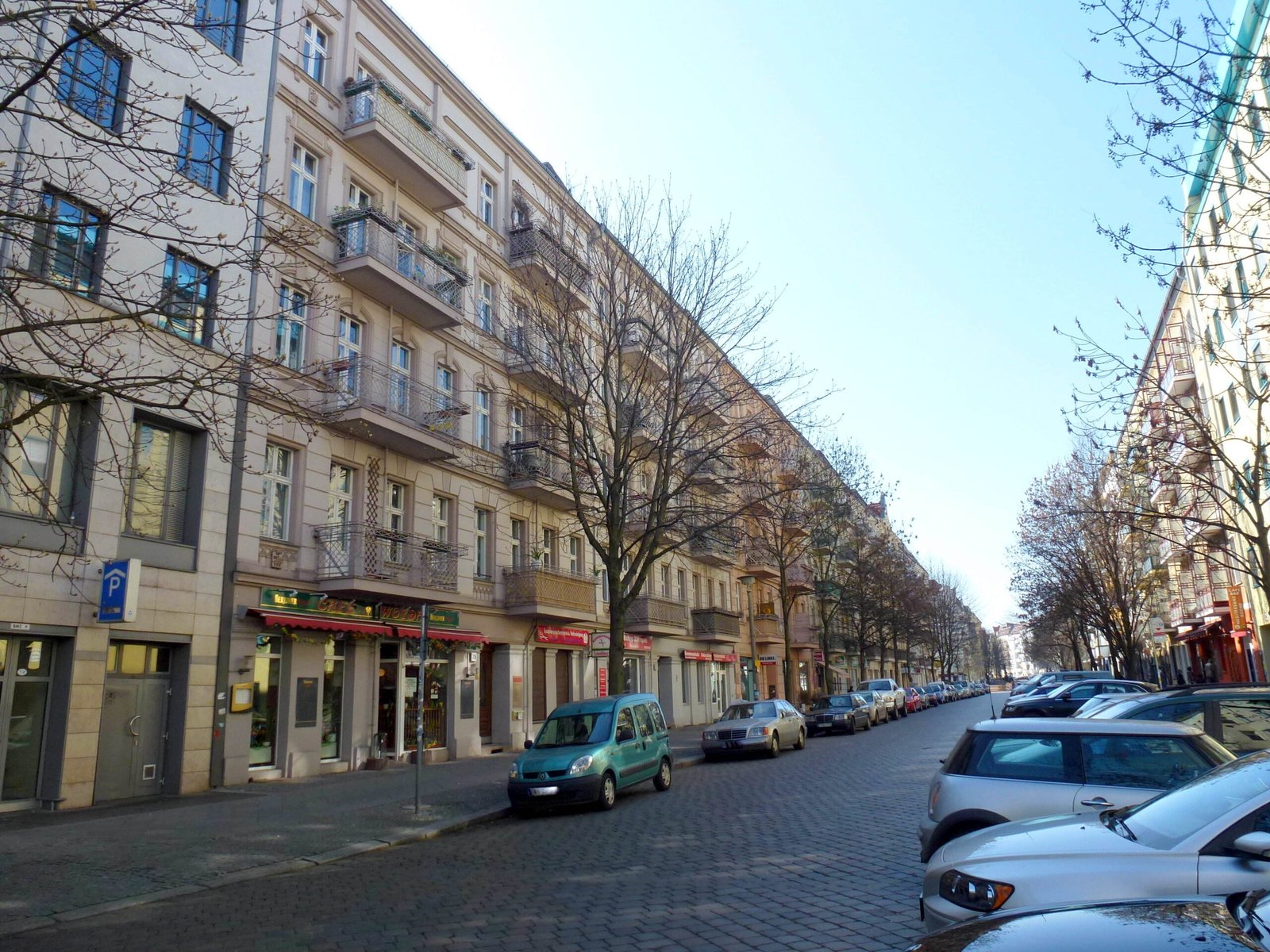
An 800-metre street in Prenzlauer Berg lined with sixty-one Jugendstil apartment buildings, home to Berlin’s most concentrated community of working artists and a living archive of bohemian bohemia from the divided city through reunification.
At a glance
Kopenhagener Straße runs east to west between Schönhauser Allee and Mauerpark, where the Berlin Wall once divided Soviet and French sectors. Named after Copenhagen on 30 April 1899, the cobblestone street preserves the creative character it acquired decades before German reunification in 1989.
History
The street took its Danish name in 1899 and was built up rapidly with Jugendstil residential blocks. During World War II, the Schönfließer Brücke, an iron railway crossing built in 1908 to designs by Alfred Grenander, sustained bomb damage in the Allied raid of 3 February 1945 and was dismantled by the late 1950s. The East German government installed a 60-metre pedestrian bridge nearby in the early 1960s.
Throughout the Cold War, Kopenhagener Straße harboured artists and bohemians, becoming a cultural nerve centre in the divided city. Since 1989, most buildings have been renovated, yet the street has retained its pre-unification atmosphere.
What you see
The street’s dominant visual feature is the row of 61 Jugendstil apartment blocks, interspersed with four modern structures and playgrounds. The most striking landmark is the former Humboldt transformer station at No. 61, designed by renowned industrial architect Hans Heinrich Müller, which anchors the corner of Sonnenburger Straße.
The pedestrian bridge from the early 1960s remains. Moritzhof, an experimental urban children’s farm at the western end, creates an unexpected pastoral scene—horses and goats silhouetted against dense housing and the television tower beyond.
Cultural significance
A study by Humboldt University’s geography department identified 45 resident artists, making Kopenhagener Straße one of Berlin’s most important creative clusters. The street’s aesthetic has attracted filmmakers seeking authentic Cold War settings; it served as location for Der Rote Kakadu and Sommer vorm Balkon, films exploring East German nostalgia.
The street hosts numerous cafés, restaurants, bars, and the Mittwochsclub, a bohemian gathering space in the cellar beneath the Kohlenquelle Café. Approximately half of current residents lived here before 1989; newer inhabitants come largely from former West Germany and across Europe.
Key facts
- Location: Pankow district, Berlin, Germany (52.5489, 13.4089)
- Length: 800 metres (one-half mile)
- Named: 30 April 1899, after Copenhagen
- Architecture: Sixty-one Jugendstil apartment buildings plus four modern structures
- Notable building: Former Humboldt transformer station (No. 61), designed by Hans Heinrich Müller
- Artist population: Forty-five working artists (per Humboldt University study)
Practical information & getting there
Kopenhagener Straße is accessible by public transport in Berlin’s Pankow district; the street runs between Schönhauser Allee station and Mauerpark. Cafés, restaurants and bars line the route. The street remains pedestrian-friendly and retains its original cobblestone surface. Opening hours and admission details for specific venues should be confirmed locally.
Sources & resources
Find it on the map
See this place and what’s around it →📷 Become a Cultural Heritage Online photographer
Share your photos of places: they stay published under your name as the author. The more they're seen, the more you get noticed — and soon a contest will reward the most appreciated photos.
Log in or sign up free to add a photoIs this page about you?
This page is read by travellers and heritage enthusiasts who find it on Google. Tell us how you are connected to this place and we will take it from there.