
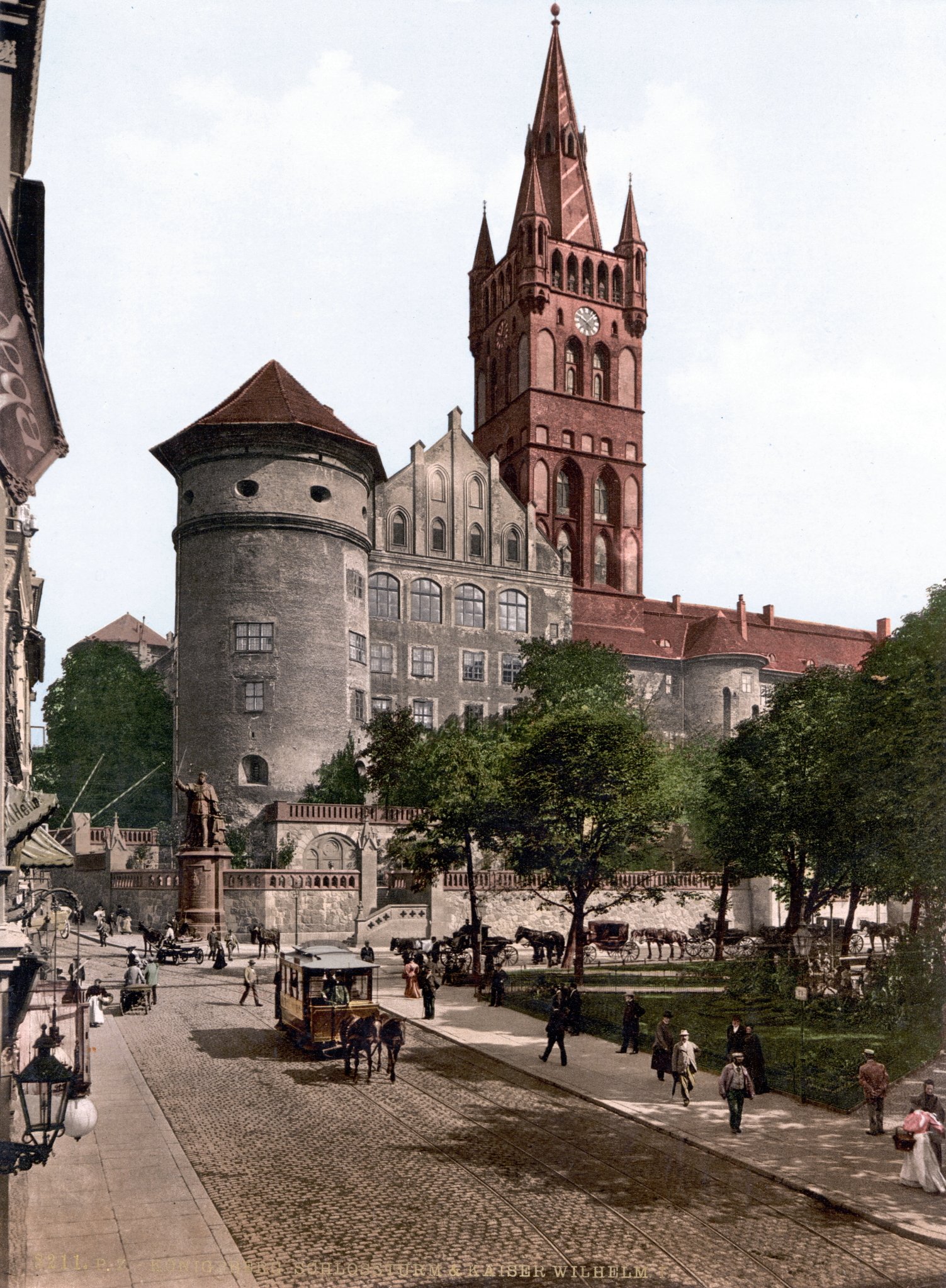
A Teutonic Order stronghold turned royal Prussian residence, reduced to ruins by British bombs and then erased entirely by Soviet order. Only a name and a bare square remain.
At a glance
Founded in 1255 by the Teutonic Knights on a hill above the Pregel river, Königsberg Castle grew over five centuries from a timber fort into a sprawling Gothic quadrangle. It served as seat of the Order’s grand masters and later the dukes and kings of Prussia. Bombed in 1944, its ruins were dynamited by Soviet authorities between the late 1940s and 1968. The site later held the unfinished House of Soviets, demolished in 2024, leaving Kaliningrad’s central square largely empty.
History
The Knights raised a provisional wood-and-earth fort here in 1255, replacing it with stone from 1257. Enlargement continued through the 16th to 18th centuries, as the fortress became a princely residence. Polish king Władysław IV Vasa stayed at the castle in 1635 as suzerain of Ducal Prussia. Stanisław Leszczyński took refuge there in 1734–1736 during the War of the Polish Succession. Two coronations took place in its palace church: Frederick I in 1701 and William I in 1861. By the 20th century the north wing housed the Prussia Museum, with 240,000 exhibits, university library holdings, and paintings by Lovis Corinth. Wartime looted art, possibly including elements of the Amber Room, was reportedly stored inside. British bombing on the night of 29–30 August 1944 gutted the interior, though thick outer walls survived both that raid and the later Soviet siege. Demolition followed steadily until 1968, ordered by regional party chief Nikolai Konovalov.
What you see
Nothing of the castle stands today. Historical accounts describe a Gothic tower some 100 metres tall, climbed by 284 steps, and a pillarless hall 83.5 metres long. Above the palace church rose the Hall of Muscovites, one of Central Europe’s largest rooms. The whole complex formed a large enclosed quadrangle near the city centre, its walls emblazoned with the arms of the Order of the Black Eagle. A tavern called the Blutgericht, or Blood Court, operated within the walls. A weathervane bore the image of Hans von Sagan. Where the castle once stood, Kaliningrad’s cobbled central square now opens onto flat ground, the adjacent House of Soviets removed in 2024 after decades of subsidence caused by collapsed castle tunnels beneath it.
Cultural significance
Königsberg Castle anchored the political identity of the Teutonic Order and, later, the Prussian monarchy for seven centuries. Its destruction is entangled with the fate of the city itself, renamed Kaliningrad after 1946 and absorbed into the Soviet Union. Unlike the nearby cathedral, rebuilt after 1991, the castle was never reconstructed. Excavations funded by Der Spiegel in 2001, and further finds including an occult silver casket in 2005, kept alive hopes of recovering the lost Amber Room. A 2010 proposal for a public referendum on rebuilding the castle stalled over cost, and plans were dropped in favour of paving the square. The site remains a contested memory of vanished Prussia.
Key facts
- Founded: 1255, by the Teutonic Knights
- Style: Gothic architecture
- Location: Kaliningrad (formerly Königsberg), Russia
- Coronation site: Frederick I (1701), William I (1861)
- Severely damaged: RAF bombing, 29–30 August 1944
- Fully demolished: 1968, on Soviet orders
- Successor structure: House of Soviets, demolished 2024
- Heritage status: listed
Practical information & getting there
No castle building remains to visit. The former site sits at Kaliningrad’s central square, easily reached on foot from the reconstructed Königsberg Cathedral across the Pregel. With the House of Soviets gone as of 2024, the open square offers unobstructed views across what was once the castle’s footprint. Excavated cellar sections have periodically been opened for public viewing near the museum; check locally for current access, since arrangements have changed over the years.
Sources & resources
Find it on the map
See this place and what’s around it →📷 Become a Cultural Heritage Online photographer
Share your photos of places: they stay published under your name as the author. The more they're seen, the more you get noticed — and soon a contest will reward the most appreciated photos.
Log in or sign up free to add a photoDo you manage this place?
This page is read by travellers and heritage enthusiasts who find it on Google. Keep it accurate — and make it work for you. Free for non-profit heritage institutions.