

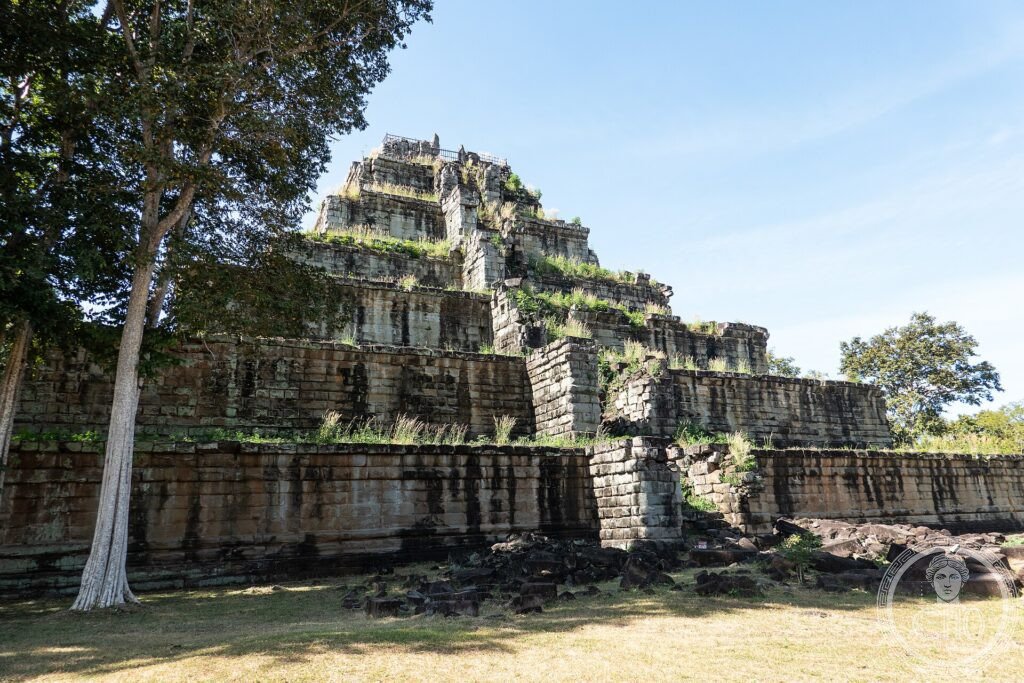
For a few decades of the tenth century, far from Angkor, a Khmer king made Koh Ker his capital and raised there a seven-tier stone pyramid — the “mountain” of his gods. Then the court returned to Angkor and the city was swallowed by the forest, leaving colossal temples and some of the most powerful sculpture in Khmer art.
At a glance
Koh Ker, in northern Cambodia, was for a brief period in the 10th century the capital of the Khmer Empire, when King Jayavarman IV moved his court here from the Angkor region. In barely two decades he built an ambitious city of temples, reservoirs and shrines, crowned by Prasat Thom, a seven-tier stone pyramid representing the cosmic mountain of the gods. After the court returned to Angkor the city was abandoned to the forest, leaving monumental temples and powerful sculpture. Koh Ker was inscribed by UNESCO in 2023.
Key facts
- UNESCO: World Heritage since 2023 (Koh Ker: Archaeological Site of Ancient Lingapura)
- Khmer capital: briefly the imperial capital, 928–944
- King Jayavarman IV: moved the court here from Angkor
- Prasat Thom: a seven-tier stone pyramid, a “temple-mountain”
- Monumental sculpture: some of the most powerful in Khmer art
- Reclaimed by jungle: abandoned after the court returned to Angkor
History
In 928 the Khmer king Jayavarman IV established his capital at Koh Ker, then called Lingapura, away from the usual seat of power near Angkor. In a remarkably short reign he raised an entire royal city: a great temple complex, a vast reservoir, dozens of shrines, and above all the stepped pyramid of Prasat Thom, rising in seven tiers toward a sanctuary at the summit, an image of Mount Meru, home of the gods.
The capital lasted only until 944, when power shifted back to Angkor, and Koh Ker was left to the forest. Its remoteness preserved its monuments and its bold, large-scale sculpture, long known to scholars and, in recent years, the subject of efforts to recover looted statues, before its inscription as World Heritage in 2023.
What you see
Prasat Thom dominates the site, a pyramid of laterite and sandstone climbing in steep tiers from the jungle to a ruined shrine at the top, unlike anything at Angkor. Around it lie the temple enclosures, the lingas and shrines, and the great reservoir, with massive carved figures and reliefs scattered among the trees.
The sense of a vast city briefly raised and then swallowed by the forest is the spirit of Koh Ker.
Practical information
- Site: open to visitors; a ticket is required
- Time needed: half a day
- Note: a more remote and quieter site than Angkor
- Setting: in Preah Vihear province, northern Cambodia
Getting there
Koh Ker is in Preah Vihear province, northern Cambodia, about 120 km north-east of Siem Reap. It is reached by road from Siem Reap. GPS: 13.7847° N, 104.5314° E.
Nearby
- Angkor — the great Khmer capital and temples, to the south-west
- Beng Mealea — a jungle-clad temple on the way
- Preah Vihear — the UNESCO cliff-top temple to the north
Sources
- UNESCO World Heritage Centre — “Koh Ker: Archaeological Site of Ancient Lingapura or Chok Gargyar” (ref. 1667)
- APSARA National Authority — official body
- Encyclopaedia Britannica — Khmer empire
Find it on the map
See this place and what’s around it →📷 Become a Cultural Heritage Online photographer
Share your photos of places: they stay published under your name as the author. The more they're seen, the more you get noticed — and soon a contest will reward the most appreciated photos.
Log in or sign up free to add a photo