
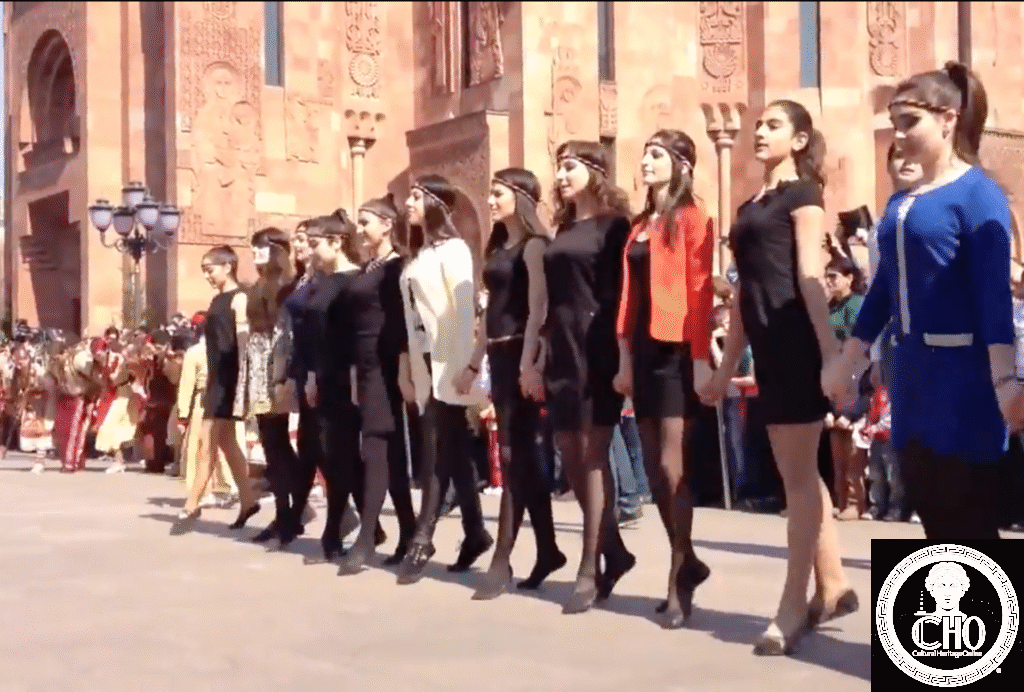
A circle dance rooted in the Armenian Highlands, performed across generations by Armenians and in variant forms by neighboring communities, each region preserving its own choreography and musical traditions.
At a glance
Kochari is a traditional group circle dance that has evolved across the Armenian Highlands into a living practice central to Armenian culture. Performers move in coordinated formations, their steps and gestures varying by region and occasion. The dance carries deep cultural meaning for Armenian communities worldwide and shares structural similarities with circle dances performed by Assyrians, Azerbaijanis, and Pontic Greeks.
Origins & history
Kochari originates in the Armenian Highlands, where diverse regional traditions developed over centuries. Each region in the Armenian Highlands cultivated its own distinct version, with unique choreography and accompanying music. This regional variation reflects the cultural geography of the highlands and the communities who inhabited them.
The practice
Kochari is performed as a circle dance, with participants holding hands or linking arms as they move together. The steps and movements are coordinated and rhythmic, requiring dancers to move in unison. Music accompanies the dance, with melodies and instrumentation varying by regional tradition. The dance can be performed at celebrations, gatherings, and cultural events, bringing communities together in shared movement and rhythm.
Cultural significance
Kochari embodies Armenian cultural identity and community solidarity. The circle formation itself carries symbolic weight—it represents unity and continuity across generations. By performing Kochari, communities transmit cultural knowledge, reinforce social bonds, and maintain connection to their highland heritage. The dance’s persistence across borders demonstrates its importance beyond Armenia itself.
Key facts
- Circle dance originating in the Armenian Highlands
- Performed by Armenians; variants exist among Assyrians, Azerbaijanis, and Pontic Greeks
- Regional variations in choreography and musical accompaniment
- UNESCO Intangible Cultural Heritage reference 01295
- Anchor community: Yerevan, Armenia (40.173°N, 44.509°E)
Where to experience it
Kochari thrives in Yerevan and across Armenia, where it remains central to cultural celebrations and community gatherings. The practice is transmitted through families and cultural organizations in Armenian communities worldwide. Contact local Armenian cultural centers or UNESCO ICH resources for information about performances and learning opportunities in your region.
Sources & resources
- Kochari – Wikipedia
- Kochari: Traditional Group Dance – UNESCO Intangible Cultural Heritage
- Cultural Heritage Online
Find it on the map
See this place and what’s around it →📷 Become a Cultural Heritage Online photographer
Share your photos of places: they stay published under your name as the author. The more they're seen, the more you get noticed — and soon a contest will reward the most appreciated photos.
Log in or sign up free to add a photo