

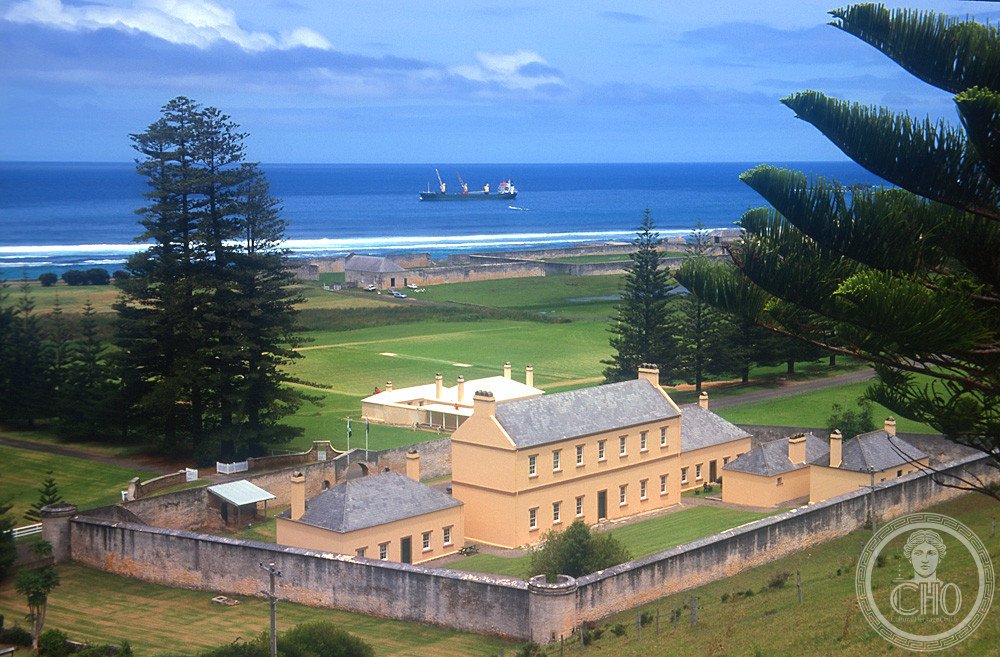
A sprawling convict settlement on Norfolk Island that stands as one of the world’s most significant records of British penal transportation, now inhabited by descendants of the Bounty mutineers.
At a glance
Kingston and Arthur’s Vale Historic Area (KAVHA) occupies the southern coastal plain of Norfolk Island, 1,600 kilometres east-north-east of Sydney. The site preserves dozens of structures—some restored, others ruinous—alongside archaeological remains and dramatic landforms that evoke its convict past. Its picturesque setting and relative lack of modern development enhance its historical atmosphere.
History
Between 1788 and 1855, KAVHA functioned as a place of secondary punishment—a destination for prisoners already convicted in Britain or eastern Australia. The settlement earned a brutal reputation as one of Australia’s harshest penal outposts. Yet it was also a site where humanitarian experiments in penal reform were undertaken, reflecting evolving attitudes toward incarceration.
In 1856, the community transformed entirely when 194 Pitcairn Islanders—descendants of HMS Bounty mutineers and Tahitian women—were resettled here from their remote Pacific homeland. Their descendants continue to inhabit the area today, layering centuries of cultural continuity onto the convict-era fabric.
Before European arrival, Norfolk Island bore evidence of early Polynesian settlement, making KAVHA unique as Australia’s only site displaying such archaeological traces.
What you see
A large cluster of stone buildings and ruins spans the Kingston coastal plain, bounded by protective hills. Structures range from domestic quarters and military barracks to administrative buildings and work facilities. Some retain their original form; others stand as partial ruins that reveal construction techniques and spatial organization. Subsequent modifications during the Pitcairn period reflect adaptation and continuity rather than erasure of the earlier layer.
Cultural significance
KAVHA is inscribed as one of eleven sites comprising the Australian Convict Sites World Heritage serial listing, recognized as “amongst the best surviving examples of large-scale convict transportation and the colonial expansion of European powers.” The site embodies the mechanics, scale and human cost of British imperial punishment.
Its designation reflects UNESCO and Australian recognition of KAVHA’s dual identity: a monument to suffering and state control, and equally, a place of settlement, resilience and cultural continuity across two distinct communities separated by a century.
Key facts
- Country: Australia
- Location: Norfolk Island, southern coastal plain
- Period: 1788–1855 (convict era); 1856–present (Pitcairn Island resettlement)
- Coordinates: −29.05°, 167.96°
- UNESCO World Heritage status: Inscribed 31 July 2010 (Australian Convict Sites serial listing)
- Australian National Heritage List: Inscribed 1 August 2007
Practical information & getting there
KAVHA lies on Norfolk Island, accessible by air from Australia or New Zealand. The site is open to visitors year-round. Detailed practical information, including visiting hours, entry fees, accommodation and transportation options to Norfolk Island, is best confirmed through official Norfolk Island tourism channels before travel.
Sources & resources
Find it on the map
See this place and what’s around it →📷 Become a Cultural Heritage Online photographer
Share your photos of places: they stay published under your name as the author. The more they're seen, the more you get noticed — and soon a contest will reward the most appreciated photos.
Log in or sign up free to add a photoIs this page about you?
This page is read by travellers and heritage enthusiasts who find it on Google. Tell us how you are connected to this place and we will take it from there.