
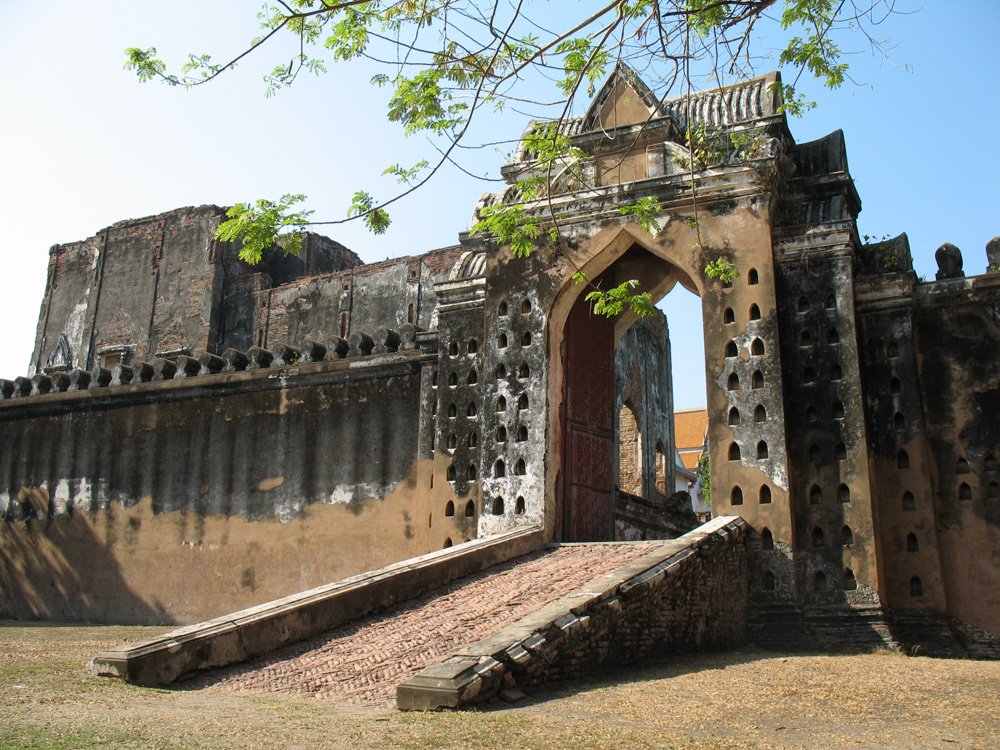
Built as a royal retreat and administrative center by one of Ayutthaya’s greatest monarchs, this sprawling palace complex reveals the refinement and ambitions of 17th-century Siam.
At a glance
King Narai’s Palace stands as a testament to the power and vision of King Narai the Great, who ruled the Ayutthaya Kingdom from 1656 to 1688. Construction began in 1666 on the site of an earlier royal residence. The complex functioned as the king’s seasonal retreat, administrative headquarters, and reception hall for foreign dignitaries—purposes it served for roughly eight to nine months each year. Today it operates as the Somdet Phra Narai National Museum, housing over 1,864 artifacts spanning diverse periods of Thai history.
History
King Narai designated Lopburi as Ayutthaya’s second capital, elevating the palace’s status beyond a mere retreat. The structure accommodated the king’s governance of the realm alongside leisure pursuits, including hunting expeditions. A contemporary account, the Eulogy of King Narai (probably composed around 1680), documents the palace’s sophisticated infrastructure, particularly its innovative piped-water system—a marvel of hydraulic engineering for its time.
Following the king’s death in 1688, Lopburi fell into decline. Centuries later, restoration efforts began under King Mongkut (Rama IV) of the Rattanakosin period. In 1856, he commissioned the Phiman Mongkut Pavilion for his own use. By the reign of King Chulalongkorn (Rama V), portions of the complex had been repurposed as civic infrastructure. The palace’s transformation into a museum commenced on October 11, 1924, when Prince Damrong Rajanubhab and Prince Narisara Nuwattiwong inaugurated the Chantarapisarn Pavilion as the Lopburi Museum. It was renamed the Somdet Phra Narai National Museum in 1961.
What you see
The palace comprises multiple pavilions and structures distributed across a substantial compound. The Phiman Mongkut Pavilion, added during King Mongkut’s restoration, represents 19th-century royal architecture alongside original 17th-century foundations. The Chantarapisarn Pavilion now functions as the primary exhibition space. The site’s layout reflects both practical and ceremonial design: spaces for administration, private quarters, reception areas, and formal gardens demonstrate the complexity of a major royal residence.
Cultural significance
King Narai’s Palace embodies the height of Ayutthaya’s cultural achievement and international influence. Its architectural and engineering innovations—especially the water-management systems—illustrate the kingdom’s technical sophistication. The palace preserves material evidence of trade, diplomacy, and daily life across multiple centuries. As a museum, it serves as a primary repository for Thai cultural artifacts, making it essential for understanding the nation’s pre-modern heritage.
Key facts
- Location: Lopburi, Thailand (14.79972222°N, 100.61°E)
- Founded: 1666, ordered by King Narai the Great
- Original purpose: Royal residence, administrative center, and reception venue
- Museum opening: October 11, 1924 (as Lopburi Museum); renamed 1961
- Collection: Over 1,864 items of ancient Thai artifacts
Practical information & getting there
The palace complex is now open to the public as the Somdet Phra Narai National Museum. Lopburi is approximately 150 kilometers northeast of Bangkok and is accessible by train, bus, or car. The town’s central location makes it a logical stop on routes through Thailand’s northeastern region. For current opening hours, admission fees, and any restrictions, consult the museum’s official resources or contact the local tourism office.
Sources & resources
- King Narai’s Palace – Wikipedia
- Cultural Heritage Online
Find it on the map
See this place and what’s around it →📷 Become a Cultural Heritage Online photographer
Share your photos of places: they stay published under your name as the author. The more they're seen, the more you get noticed — and soon a contest will reward the most appreciated photos.
Log in or sign up free to add a photoIs this page about you?
This page is read by travellers and heritage enthusiasts who find it on Google. Tell us how you are connected to this place and we will take it from there.