

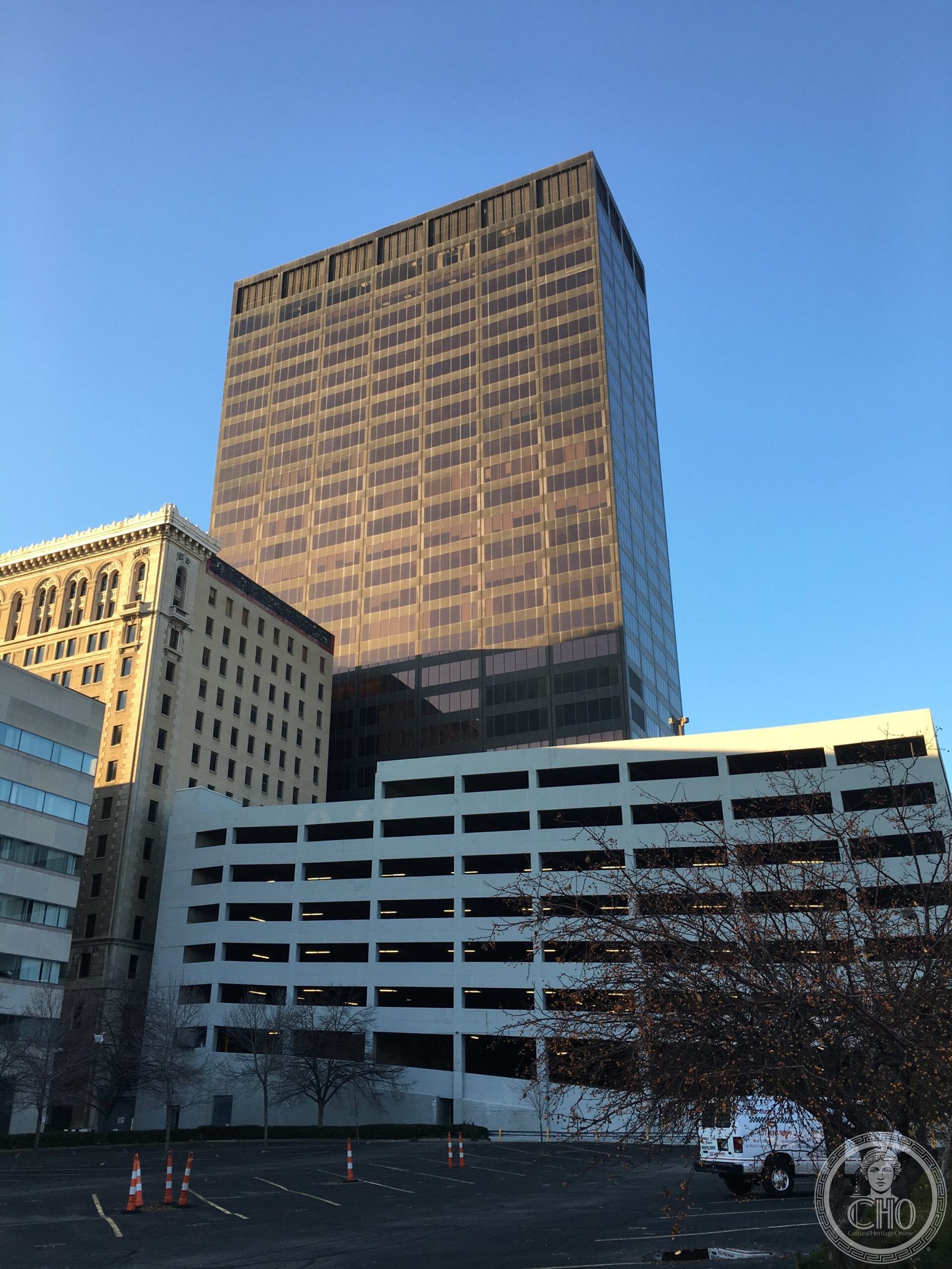
At thirty storeys and 375 feet, the building that opened in 1931 as the First National Bank Building rose above a city that had already given America the aeroplane, the cash register, and the automobile self-starter — three inventions whose logic of mechanical precision the building’s Art Deco ornament quietly reflected.
At a glance
The Kettering Tower at 40 North Main Street, Dayton, Ohio opened in 1931 as the First National Bank Building, the tallest structure in the city and a landmark of the downtown core that remains prominent today. Its thirty-storey Art Deco shaft rises from a base of polished granite, above which alternating bands of Indiana limestone and recessed spandrels climb to a stepped crown whose setbacks produce the characteristic Art Deco silhouette. The building has carried several names over its history — First National Bank Building, Winters Bank Tower, One First National Plaza — and since 1988 has borne the name Kettering Tower in honour of Dayton inventor and engineer Charles F. Kettering, whose career transformed the American automobile industry.
- Completed: 1931
- Height: 375 feet (114 m), 30 floors
- Style: Art Deco — limestone and granite exterior with bronze ornament
- Original name: First National Bank Building
- Current name: Kettering Tower (since 1988)
- National Register of Historic Places
Key facts
- Address: 40 North Main Street, Dayton, OH 45402
- Named for: Charles F. Kettering (1876–1958), inventor and engineer
- Charles Kettering’s contributions: Electric self-starter for automobiles (1911); Freon refrigerant (co-developed with Thomas Midgley Jr.); founding benefactor of the Sloan Kettering cancer research institute
- Construction material: Indiana limestone over steel frame; polished granite base; bronze window surrounds
- Previous names: First National Bank Building (1931), Winters Bank Tower, One First National Plaza
- Use: Commercial office building; ground floor retail
History
The First National Bank of Dayton commissioned the skyscraper at the height of the building boom that preceded the Wall Street Crash of October 1929; the building broke ground before the Crash and was completed in 1931, during the Depression’s first severe phase. Dayton had by then established itself as one of the most significant manufacturing and inventive centres in the American Midwest. The National Cash Register Company, founded by John Henry Patterson in 1884, had made Dayton the world capital of commercial machine manufacturing. The Wright Brothers had designed and flown the first powered aeroplane from nearby Huffman Prairie in 1903. Charles Kettering, working from a Dayton barn in 1911, had invented the electric self-starter for automobiles — the device that made the automobile practical for ordinary drivers by eliminating the dangerous hand-crank.
The thirty-storey bank building rose at the centre of this industrial culture, its Art Deco ornament expressing a civic confidence that was already being tested by economic catastrophe. The First National Bank of Dayton failed during the banking crisis of 1933; the building passed through several owners. Various financial institutions — including Winters National Bank — occupied it over the following decades. In 1988 the building was renamed Kettering Tower in recognition of Charles Kettering’s contributions to Dayton and to American technology. Kettering had spent most of his career in Dayton, co-founded Delco, and subsequently led General Motors Research Corporation; he died in Dayton in 1958.
The tower was listed on the National Register of Historic Places as part of the Dayton Arcade Historic District or in an individual listing reflecting its significance as a representative Art Deco commercial skyscraper.
What you see
The Kettering Tower’s Art Deco language is expressed primarily through the interplay of its vertical limestone shaft and the stepped setbacks that crown it. The base is in polished dark granite, producing a contrast between the heavy stone anchor and the lighter limestone above. The window spandrels at the upper floors are recessed to increase the sense of vertical momentum, while horizontal banding at regular intervals interrupts the climb and gives the building its characteristic layered silhouette. Bronze details — window surrounds, entrance canopy elements, lobby hardware — provide the warmth and precision associated with Art Deco metalwork of the period.
The lobby, designed in the banking-palace tradition of the 1920s and 1930s, has stone floors and a coffered ceiling whose geometry picks up the stepped-crown pattern from the exterior. The interior, which served the First National Bank at ground level, combined the reassurance of heavy stone mass — legible as financial security — with the precision ornament of Art Deco, a language associated with the mechanical industries that had made Dayton prosperous.
Practical information
- Access: Commercial office building; lobby visible during business hours
- Exterior viewing: Best appreciated from the intersection of Main Street and Monument Avenue
- Nearby parking: Paid garages on Second Street and Third Street
- Dayton Aviation Heritage National Historical Park: The Wright Brothers’ bicycle shop and Huffman Prairie Flying Field are accessible from downtown — ask at the visitor centre in Carillon Historical Park
Getting there
Dayton is 55 miles north of Cincinnati and 70 miles west of Columbus via I-70. The Kettering Tower is at the centre of downtown Dayton at the intersection of Main Street and Monument Avenue. The Greater Dayton RTA operates bus routes on Main Street. Dayton International Airport (DAY) is 12 miles north of downtown via I-75.
Nearby
- Dayton Art Institute (1930) — A Palladian-style art museum four blocks west on Forest Avenue, housing an important collection of American and European art from the same era as the Kettering Tower’s construction.
- Dayton Aviation Heritage National Historical Park — Commemorating the Wright Brothers and poet Paul Laurence Dunbar; the Huffman Prairie Flying Field where the Wrights perfected controlled powered flight is 8 miles east.
- Carillon Historical Park — A 65-acre outdoor museum 3 miles south documenting Dayton’s industrial and inventive history, including a Wright Flyer III and early NCR cash registers.
Sources
- National Register of Historic Places documentation, Dayton, Ohio
- Kettering, Thomas A. A Legacy of Innovation: Kettering, General Motors, and the American Automobile. GM Heritage Center archives
- City of Dayton Historic Preservation Office — downtown architectural survey records
- Dayton Daily News historical archives — First National Bank Building construction coverage, 1930–1931
- Ohio History Connection — Dayton commercial architecture records
Find it on the map
See this place and what’s around it →📷 Become a Cultural Heritage Online photographer
Share your photos of places: they stay published under your name as the author. The more they're seen, the more you get noticed — and soon a contest will reward the most appreciated photos.
Log in or sign up free to add a photoIs this page about you?
This page is read by travellers and heritage enthusiasts who find it on Google. Tell us how you are connected to this place and we will take it from there.