

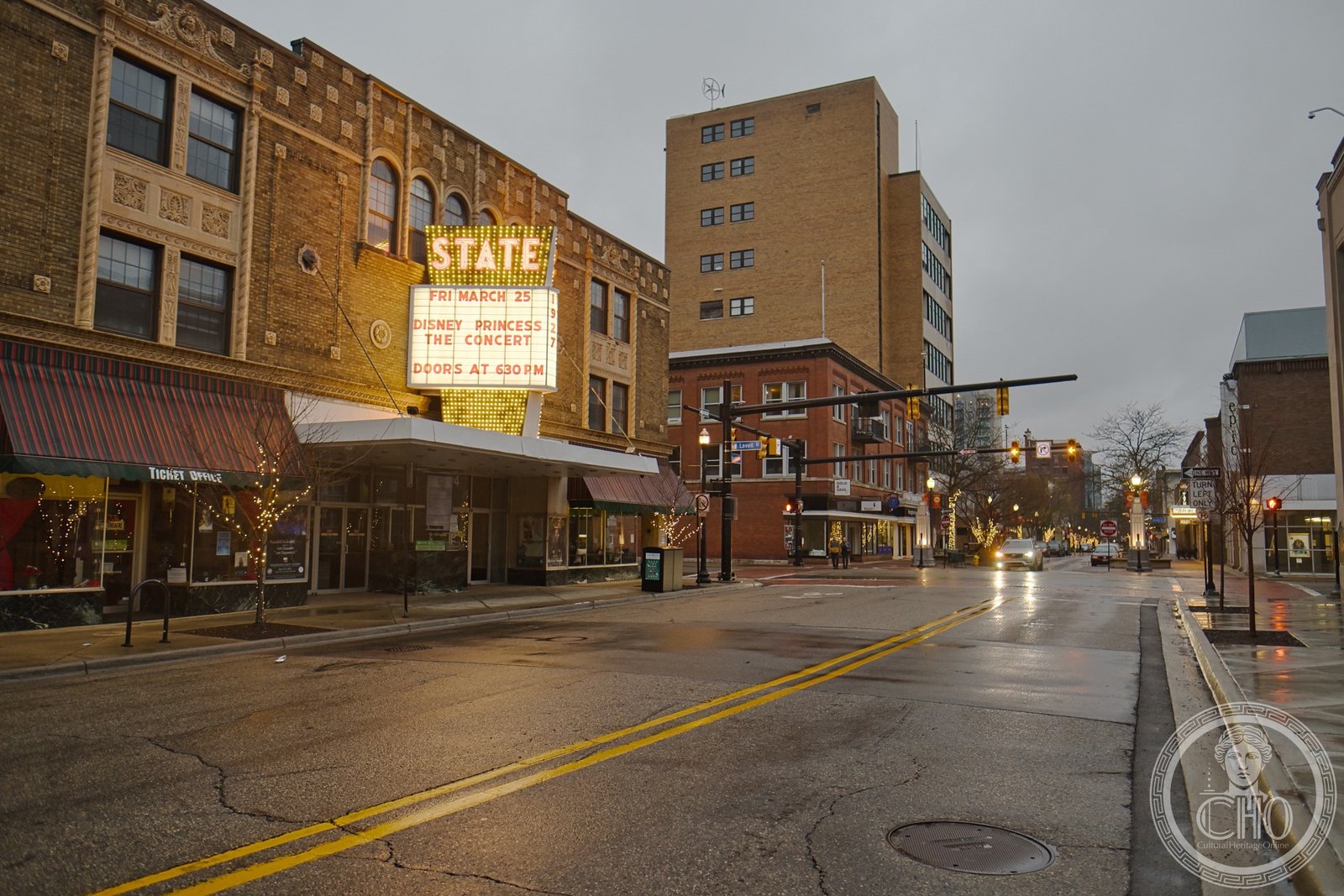
Downtown Kalamazoo’s 1927 State Theatre is one of the finest surviving atmospheric movie palaces in Michigan—its Moorish courtyard interior intact through nearly a century of continuous programming—now operating as the cultural anchor of Kalamazoo’s arts corridor on Burdick Street.
At a glance
The Kalamazoo State Theatre opened in 1927 as a downtown movie palace serving the commercial and cultural center of southwest Michigan. Built in the atmospheric style that John Eberson had popularized through the early 1920s, the State provided its audiences with the experience of an outdoor courtyard under a simulated night sky—plaster walls imitating Moorish architecture, decorative towers and arches, and a ceiling painted to suggest stars and drifting clouds behind the screen. The theater survived the mid-century decline of the downtown cinema and was restored through multiple campaigns; it now serves Kalamazoo as a performing arts center and concert venue, its atmospheric interior intact as one of Michigan’s most significant examples of the picture palace era.
Key facts
- Address: 404 S Burdick Street, Kalamazoo, MI 49007
- GPS: 42.2937° N, 85.5836° W
- Built: 1927
- Style: Atmospheric theater / Moorish Revival
- Capacity: approximately 1,800 seats
- Status: Active performing arts and concert venue
- NRHP: Listed on National Register of Historic Places
History
Kalamazoo in the 1920s was a prosperous manufacturing and commercial center—home to paper mills, pharmaceuticals (Upjohn Pharmaceutical Company was founded here in 1886), and a retail corridor on Burdick Street that anchored downtown activity. The downtown theater district that developed along Burdick Street through the 1910s and 1920s attracted investment in a major picture palace by 1927, when the State Theatre opened at the corner of Burdick and Lovell streets as the largest and most architecturally ambitious cinema in the city.
The atmospheric design placed the audience in a simulated outdoor courtyard environment: the side walls of the auditorium were built to resemble a Moorish palace at dusk, with arched colonnades, ornamental towers, and tile-inset plasterwork suggesting an Andalusian or North African setting. The ceiling was painted and backlit to simulate a clear night sky, with cloud formations that could be moved across the field by a mechanical system. The combined effect created the escapist environment that atmospheric theater advocates claimed produced the ideal receptive state for film viewing.
The State ran first-run Hollywood programming through the studio system era, then transitioned to art-house and concert programming as the downtown cinema landscape changed in the postwar decades. Restoration campaigns through the 1990s and 2000s addressed structural and decorative deterioration and brought the theater into compliance with contemporary accessibility standards. The State today books national touring acts, community events, and film screenings, maintaining the Burdick Street presence it established in 1927.
What you see
The Burdick Street and Lovell Street elevations present a composition of cream-colored brick and terra cotta with Moorish-inflected ornamental detail: arched window openings with geometric tile insets, corniced bays with decorative finials, and the theater marquee spanning the primary street entrance. The facade reads as a ceremonial gateway appropriate to the civic scale of the entertainment it housed.
Inside, the atmospheric auditorium’s plasterwork simulates a Moorish courtyard in reasonable detail: crenellated towers and colonnaded galleries line the side walls, their plaster painted in warm terra cotta and ochre tones that suggest stone and tile. The ceiling carries the simulation formula—a deep blue field painted with stars, backlit at the perimeter to suggest twilight, with sculpted cloud forms overhead. The proscenium arch frames the stage with elaborated Moorish ornament. The overall scale is intimate by movie palace standards, which means the atmospheric detail can be read from almost any seat in the house without the distance that reduces atmospheric effects to general tone in the largest theaters.
Practical information
- The Kalamazoo State Theatre programs a mix of concerts, performing arts events, and film screenings; check kazoostate.com for the current calendar.
- The theater is in the pedestrian-friendly Burdick Street arts corridor of downtown Kalamazoo, surrounded by restaurants and galleries.
- Accessible entrance; ADA seating in the main orchestra.
- Street and structure parking is available on Burdick Street and adjacent blocks; the Burdick Street parking ramp is within one block.
- Arrive early for pre-show atmospheric interior inspection; the decorative program is best studied before the house lights dim.
Getting there
The Kalamazoo State Theatre is at 404 S Burdick Street in downtown Kalamazoo, Michigan, approximately 50 miles south of Grand Rapids and 140 miles west of Detroit via I-94. Kalamazoo/Battle Creek International Airport (AZO) serves the region with connections to Chicago O’Hare and Detroit. Amtrak’s Wolverine and Blue Water services stop at Kalamazoo station (0.5 miles northwest of the theater) en route between Chicago and Detroit/Port Huron. Downtown Kalamazoo is compact and walkable; the theater is within 10 minutes of the Amtrak station on foot.
Nearby
- Kalamazoo Institute of Arts (1 block north): the regional art museum on Rose Street collects American art and hosts rotating exhibitions year-round.
- Western Michigan University (1 mile west): the public university’s 1,200-acre campus includes the Kalamazoo Institute of Technology galleries and the WMU Museum of Fine Arts.
- Gilmore Car Museum (20 miles north): one of the largest automotive museums in the United States, with over 400 vehicles including significant Art Deco-era automobiles.
- Kalamazoo Valley Museum (0.5 miles north): the Kalamazoo County museum covers regional history, science, and the pharmaceutical heritage of the Upjohn company.
Sources
- Kalamazoo State Theatre, kazoostate.com — venue history and programming
- National Register of Historic Places, “Kalamazoo State Theatre” nomination
- Cinema Treasures, “State Theatre, Kalamazoo” database entry
- Michigan Historic Preservation Office records
Find it on the map
See this place and what’s around it →Record researched and written by Luigi De Marchi for Cultural Heritage Online, 2026.
📷 Become a Cultural Heritage Online photographer
Share your photos of places: they stay published under your name as the author. The more they're seen, the more you get noticed — and soon a contest will reward the most appreciated photos.
Log in or sign up free to add a photoIs this page about you?
This page is read by travellers and heritage enthusiasts who find it on Google. Tell us how you are connected to this place and we will take it from there.