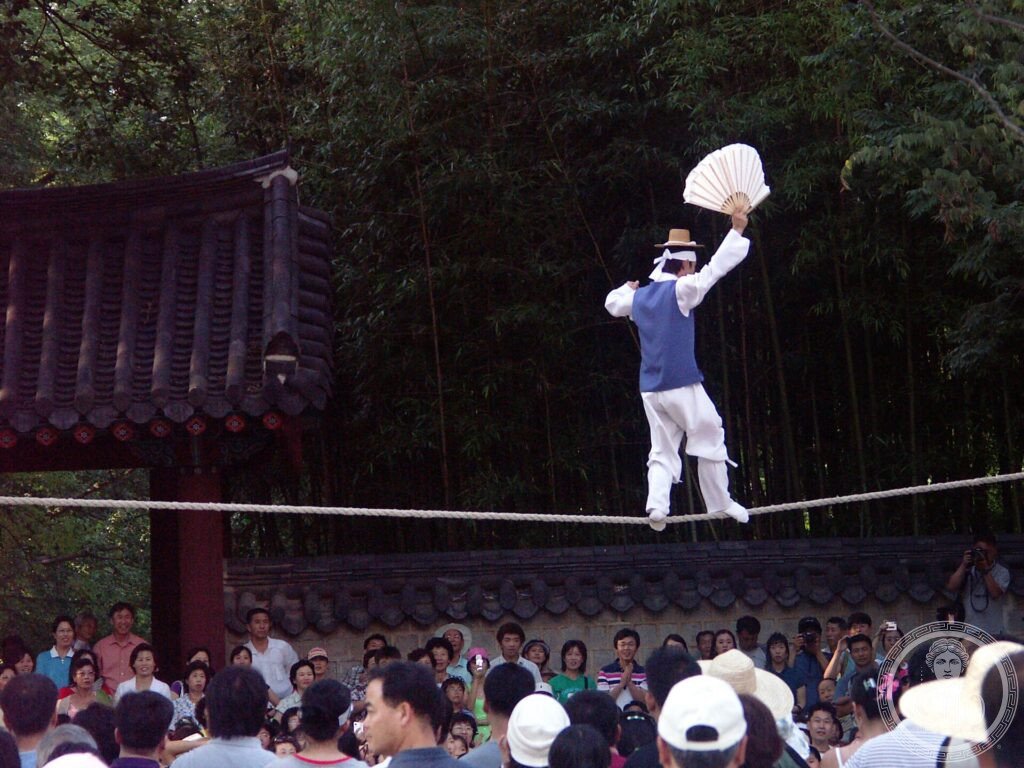
A Korean performance art in which skilled walkers traverse a rope suspended between two points, combining balance, grace, and centuries of accumulated technique.
In UNESCO’s words
Tightrope walking is a widespread form of entertainment that in most countries focuses purely on acrobatic skill. The traditional Korean performing art of Jultagi is distinctive in that it is accompanied by music and witty dialogue between the tightrope walker and an earthbound clown. Jultagi is performed outside. The tightrope walker executes a variety of acrobatic feats on the rope, along with jokes, mimicry, songs and dance, while a clown engages the tightrope walker in joking banter, and a team of musicians plays music to accompany the entertainment. The tightrope walker starts with simpler feats, gradually moving to more difficult acrobatics, displaying some forty different rope techniques in a performance that can last several hours. Today, tightrope walking performers are frequently invited to local festivals that take place throughout the country, particularly in spring and autumn. Currently, transmission of tightrope walking in Korea is centred on the Jultagi Safeguarding Association in Gyeonggi Province. There are two types of training: apprenticeship education where masters educate practitioners and take on students, and public education which takes various forms such as school training, experience classes and summer camps.
Official description, UNESCO Intangible Cultural Heritage List — Jultagi, tightrope walking
At a glance
Jultagi is Korea's traditional form of tightrope walking, distinctive for blending acrobatic skill with music, dialogue and humor. Unlike tightrope walking in most countries, which focuses purely on acrobatics, jultagi pairs the walker's performance with a clown who trades jokes from the ground and musicians who provide accompaniment. The walker executes jokes, mimicry, songs and dance alongside acrobatic feats, while the performance unfolds outdoors.
Origins & history
The roots of jultagi run deep in Korean performance tradition. Over centuries, the practice evolved from street performance into a recognized art form worthy of preservation. Today it carries the weight of that history—each walker inheriting technique and understanding passed down through Korean cultural lineages.
The practice
A jultagi performance features a tightrope walker who starts with simpler feats and progresses to more difficult acrobatics, displaying around forty different rope techniques. The walker performs jokes, mimicry, songs and dance on the rope. A clown stationed on the ground engages the walker in joking banter, while a team of musicians plays music to accompany the entertainment. Performances take place outdoors and can last several hours.
Cultural significance
Today jultagi performers are frequently invited to local festivals throughout the country, particularly in spring and autumn. Transmission of the art is centered on the Jultagi Safeguarding Association in Gyeonggi Province, which oversees both apprenticeship education—where masters educate students directly—and public education through school training, experience classes and summer camps.
Key facts
- Country: Republic of Korea
- Inscribed: 2011
- UNESCO list: Representative List of the Intangible Cultural Heritage of Humanity
- UNESCO reference: 00448
- UNESCO vocabulary: Acrobatics; Performing arts
- Map: Gyeonggi Province — the locality named in UNESCO’s official description of this element
Where to experience it
Jultagi performances take place at local festivals throughout Korea, particularly during spring and autumn celebrations. The Jultagi Safeguarding Association in Gyeonggi Province serves as the centre for transmission of this art form, offering various training opportunities including apprenticeship education, school training, experience classes and summer camps. Visitors interested in witnessing tightrope walking can seek out these seasonal festivals or contact the Association directly to learn about upcoming performances and educational programmes.
Sources & resources
- UNESCO — official element page: Jultagi, tightrope walking
- UNESCO — open data record: Intangible Heritage List, reference 00448
- UNESCO — official photograph: Photograph of this element — Choe Won-jin — Cultural Heritage Administration, 2000
- Reference — Wikipedia (secondary): Jultagi — consulted as a secondary reference, not as confirmation
- Cultural Heritage Online: Our archive and city guides

Find it on the map
See this place and what’s around it →📷 Become a Cultural Heritage Online photographer
Share your photos of places: they stay published under your name as the author. The more they're seen, the more you get noticed — and soon a contest will reward the most appreciated photos.
Log in or sign up free to add a photo