

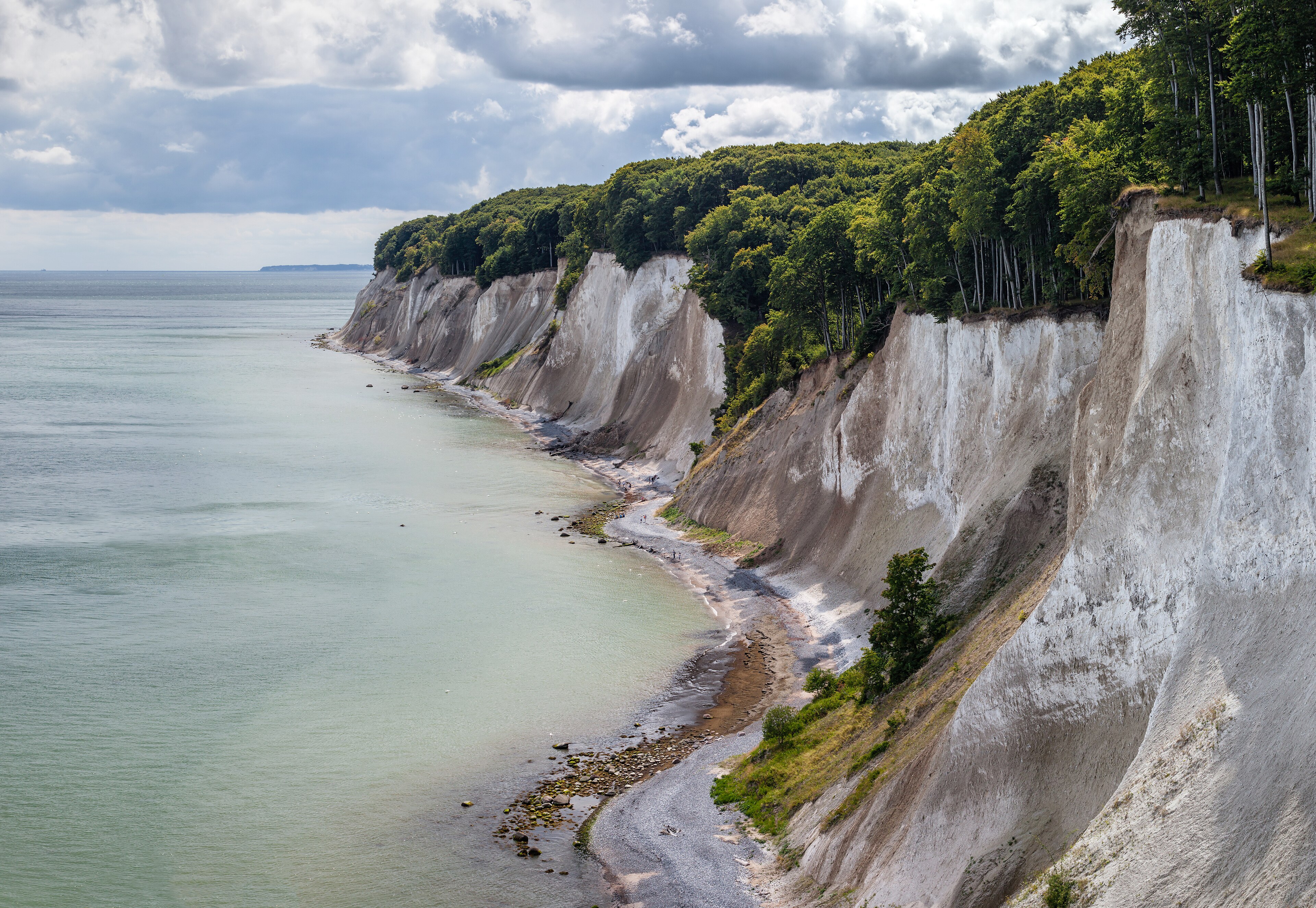
Germany’s smallest national park protects dramatic chalk cliffs and ancient beech forests on the Jasmund peninsula, where the highest sea-cliff face rises 118 metres above the Baltic.
At a glance
Jasmund National Park spans just 30 square kilometres on the northeastern tip of Rügen island in Mecklenburg-Vorpommern. The park’s most iconic feature is Königsstuhl—the “king’s chair”—a towering chalk cliff that reaches 118 metres above sea level. Behind these dramatic white faces lie ancient beech forests that form the park’s ecological heart.
History
The park was established in September 1990 by the last government of East Germany, weeks before German reunification. In 2011, the beech forest was inscribed on the UNESCO World Heritage List as an extension of the Primeval Beech Forests of Europe site, recognizing its undisturbed condition and significance as a record of European ecological history since the last Ice Age.
What you see
Königsstuhl dominates the landscape—a sheer wall of white chalk rising dramatically from the sea. The park’s highest point overall is Piekberg, at 161 metres above sea level. Beyond the cliffs stretch extensive beech forests, their dense canopies and undisturbed understory representing centuries of continuous woodland evolution.
Cultural significance
The park exemplifies the tension between human land use and ecological preservation. Its UNESCO designation reflects the global importance of intact temperate forests and the chalk cliff ecosystem. The landscape has inspired artists and visitors for centuries, representing the Romantic ideal of untamed northern nature.
Key facts
- Location: Jasmund peninsula, northeast Rügen, Mecklenburg-Vorpommern, Germany
- Coordinates: 54.55°N, 13.65°E
- Founded: September 1990
- Area: 30 square kilometres (Germany’s smallest national park)
- Königsstuhl height: 118 metres above sea level
- Piekberg height: 161 metres above sea level
- UNESCO World Heritage status: 2011 (beech forest)
Practical information & getting there
The park is accessible from the town of Sassnitz on Rügen island. A visitor centre and viewing platforms offer safe access to the Königsstuhl cliffs. Hiking trails traverse both cliff-top and forest environments. The chalk cliffs can be hazardous; visitors should remain on marked paths and observe safety barriers.
Sources & resources
Find it on the map
See this place and what’s around it →
📷 Become a Cultural Heritage Online photographer
Share your photos of places: they stay published under your name as the author. The more they're seen, the more you get noticed — and soon a contest will reward the most appreciated photos.
Log in or sign up free to add a photo