
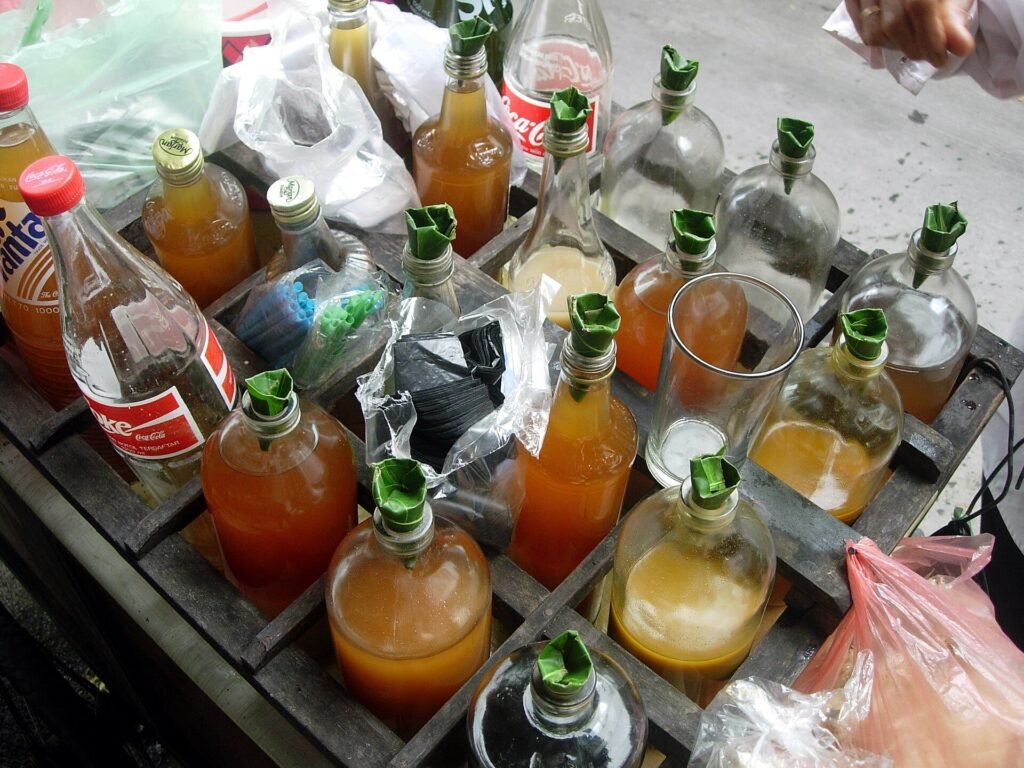
A living tradition of herbal medicine-making rooted in Java, where generations of healers and street vendors prepare remedies from plants, animal products, and ancestral knowledge.
At a glance
Jamu is Indonesia’s traditional herbal medicine practice, spanning from individual preparation in households to commercial production by established companies. The culture thrives on botanical expertise, oral transmission of recipes, and the iconic figure of Mbok Jamu—the traditionally dressed Javanese woman carrying a bamboo basket of bottles through village streets and town alleys, calling out her wares. Today it operates as both grassroots healing practice and a multimillion-dollar industry.
Origins & history
Jamu represents centuries of accumulated botanical and medicinal knowledge within Indonesian communities, particularly in Java. The practice evolved through observation of local plants, animal products, and indigenous healing systems, passed orally through families and vendor networks. In 2019, the Indonesian Ministry of Education and Culture formally recognized jamu as national intangible cultural heritage; in December 2023, UNESCO inscribed jamu wellness culture on its Representative List.
The practice
Jamu preparation combines roots, bark, flowers, seeds, leaves, and fruits—often supplemented with honey, royal jelly, milk, and native chicken eggs. Street vendors dissolve dried herbal sachets in hot water before serving. The iconic bearer is Mbok Jamu, a young to middle-aged Javanese woman in traditional kain kebaya, transporting bottles in a bamboo basket on her back, moving through neighbourhoods with a distinctive call.
Industrial production by companies such as Air Mancur, Djamu Djago, and Sido Muncul has expanded the repertoire to tablets, caplets, and capsules sold in pharmacies and stores. The herbal taste—often bitter—is traditionally balanced with honey or palm sugar. Each preparation reflects regional knowledge and family formulae.
Cultural significance
Jamu embodies Indonesian botanical expertise and preventive healing philosophy. The vendor culture, especially the Mbok Jamu figure, represents continuity of women’s economic agency and community care. Beyond ritual or ceremonial use, jamu is woven into daily wellness practice—a expression of trust in natural materials and inherited wisdom. The practice connects urban and rural communities through both street-level commerce and industrial enterprise.
Key facts
- Countries: Indonesia
- Anchor community: Yogyakarta
- UNESCO Intangible Cultural Heritage reference: 01972
- UNESCO inscription year: 2023
- Primary materials: roots, bark, flowers, seeds, leaves, fruits, honey, royal jelly, milk, eggs
- 2014 sales contribution: Rp 3 trillion (approximately US$73.29 million)
Where to experience it
Jamu wellness culture is most vibrant in Java, especially in Yogyakarta and surrounding regions, where street vendors and traditional Mbok Jamu carriers still move through villages and town alleys. Major Indonesian cities host jamu hawkers and pharmacies stocking both traditional sachets and modern packaged forms. The practice remains accessible daily as a living, working tradition rather than a scheduled performance or staged event.
Sources & resources
- Jamu – Wikipedia
- Jamu wellness culture – UNESCO Intangible Cultural Heritage
- Cultural Heritage Online
Find it on the map
See this place and what’s around it →📷 Become a Cultural Heritage Online photographer
Share your photos of places: they stay published under your name as the author. The more they're seen, the more you get noticed — and soon a contest will reward the most appreciated photos.
Log in or sign up free to add a photo