
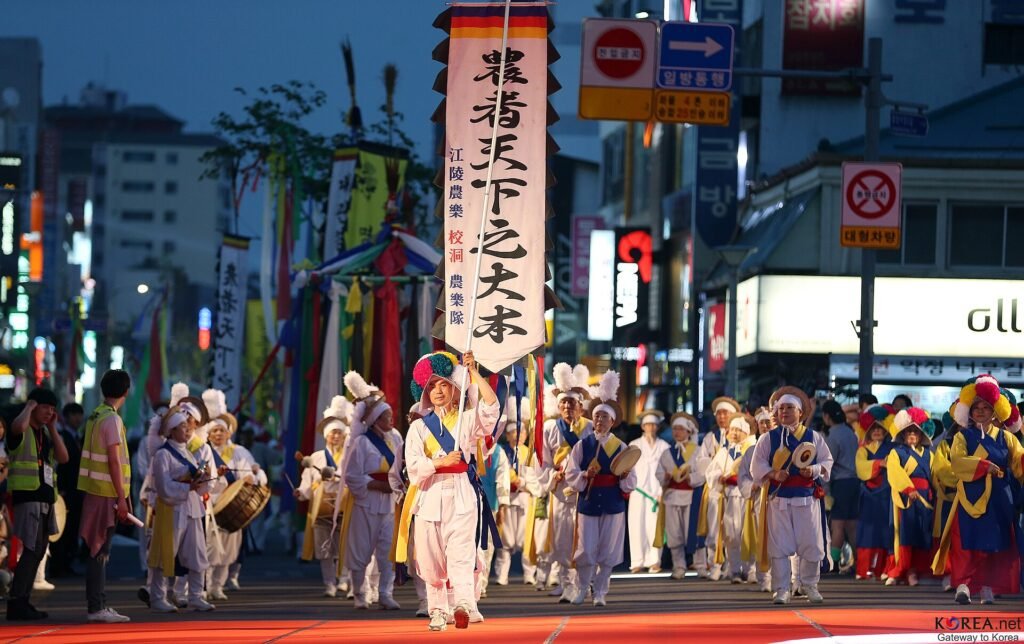
A 47-day spring celebration rooted in ritual appeasement of local gods, Gangneung Danoje blends music, drama, and communal blessing in Korea’s most revered seasonal festival.
At a glance
Gangneung Danoje, known locally as Danogut, is the signature expression of Dano—the Korean seasonal holiday traditionally observed on the fifth lunar month. Held annually over 47 days from the twentieth day of the third month through the seventh day of the fifth month, the festival draws communities together to honor local deities and petition for their protection and favor. Today it anchors Gangneung’s cultural calendar and draws visitors from across South Korea and beyond.
Origins & history
The festival’s precise origins remain opaque; its documented history spans at least 400 years, though the ritual practices underlying it may trace back over 1,000 years. The tradition survived suppression during the 1910–1945 Japanese colonial period, when cultural assimilation policies threatened to erase Korean practices. Beginning in the 1950s, scholars and local bearers undertook systematic research and reconstruction efforts to restore the festival to its authentic form, ensuring its continuity into the modern era.
The practice
Danoje encompasses music, dance, ritual drama, and communal meals organized around sacred and social purposes. The festival features performances of folk music and traditional dance, theatrical enactments, and processions that move through Gangneung. Participants and performers invoke local gods through gesture, song, and symbolic action—swinging on swings, singing songs, playing games—while the broader community gathers to witness, participate, and share food. The festival creates a calendrical pause: time devoted to collective memory and the renewal of social bonds through ritual practice.
Cultural significance
Gangneung Danoje embodies the resilience of Korean intangible heritage. It survived cultural erasure and was consciously revived through community scholarship and commitment. The festival demonstrates how living practices anchor local identity and transmit values—reciprocity with the sacred, seasonal attunement, community interdependence—across generations. Its elevation to National and UNESCO recognition affirms its status as a cornerstone of Korean cultural expression.
Key facts
- Held annually for 47 days in the lunisolar Korean calendar (third month, twentieth day to fifth month, seventh day)
- Designated National Intangible Cultural Heritage of South Korea since 1967
- UNESCO Intangible Cultural Heritage inscription: 2005 (Reference 00114)
- Anchor community: Gangneung, Gangwon Province, South Korea
- Documented history: at least 400 years; possible origins 1,000+ years old
Where to experience it
Gangneung, nestled on South Korea’s east coast, remains the living heartland of Danoje practice. The festival unfolds across the city during the traditional lunar calendar window. Visitors seeking to witness the festival should consult local cultural authorities for specific dates and venues, as the lunar calendar shifts yearly against the Gregorian calendar.
Sources & resources
- Gangneung Danoje — Wikipedia
- Gangneung Danoje Festival — UNESCO Intangible Cultural Heritage
- Cultural Heritage Online
Find it on the map
See this place and what’s around it →📷 Become a Cultural Heritage Online photographer
Share your photos of places: they stay published under your name as the author. The more they're seen, the more you get noticed — and soon a contest will reward the most appreciated photos.
Log in or sign up free to add a photo