
Jaipur is one of the few Indian cities built to a single plan rather than grown over centuries. Its nine-block grid, its terracotta-pink façades and its working astronomical observatory, the Jantar Mantar, together make it a rare case of eighteenth-century town planning still inhabited and still legible on the ground.
At a glance
Jaipur was laid out in 1727 by Maharaja Sawai Jai Singh II on a grid of nine rectangular wards aligned to the cardinal points, following principles drawn from the Shilpa Shastra and Vastu Shastra. The old city still runs on wide, straight streets that were unusually generous for their period. In 1876 the entire old town was painted terracotta pink to welcome the Prince of Wales, later King Edward VII, and by local ordinance the buildings of the old city are still required to keep that colour today.
Key facts
- Founded: 18 November 1727, by Maharaja Sawai Jai Singh II
- UNESCO status: Jaipur City inscribed as a World Heritage Site in 2019; the Jantar Mantar observatory within the city was separately inscribed in 2010
- Jantar Mantar: the largest of five observatories built by Jai Singh II, its Samrat Yantra sundial stands 27 metres tall and can read local solar time to a claimed accuracy of two seconds
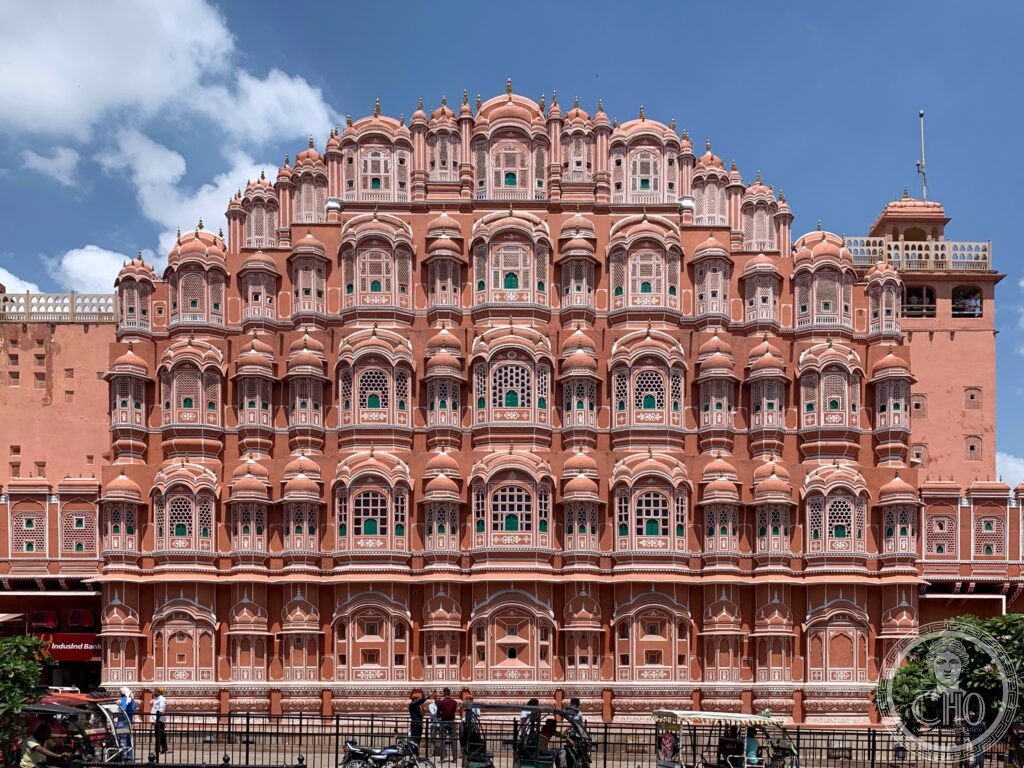
- Hawa Mahal: a five-storey pyramid-shaped screen façade pierced by 953 latticed windows, designed so the women of the royal household could watch the street below unseen; built in 1799 to a design attributed to Lal Chand Ustad
- City Palace: still partly occupied by the descendants of the Jaipur royal family, with a museum housing one of the finest royal armouries in India
- Coordinates: 26.9124° N, 75.7873° E
History
Jaipur was founded in 1727 when Maharaja Sawai Jai Singh II moved his capital from the hill fort of Amber, whose growing population could no longer be sustained there. Jai Singh II, who became Maharaja at the age of eleven, was also an astronomer and mathematician, and the new city reflects his interest in precise planning and observation, most visibly in the Jantar Mantar. Jaipur City was inscribed as a UNESCO World Heritage Site in 2019, joining the Jantar Mantar, which had been separately inscribed in 2010.
What you see
The Hawa Mahal presents its honeycombed sandstone screen to the street, a façade only one room deep behind which the latticework once let cooling air and glimpses of city life reach the women of the royal household. Nearby, the Jantar Mantar’s stone and marble instruments, chief among them the towering Samrat Yantra sundial, still stand as working measuring devices rather than ornamental follies.
The old city’s bazaars are part of the same fabric: Johri Bazaar is one of the best-known jewellery markets in Asia, reflecting Jaipur’s long-standing role as a centre for gem cutting and polishing, while other quarters are given over to hand-block-printed textiles, notably the Sanganeri prints stamped by hand with carved wooden blocks.
Practical information
- Combined tickets: a city pass covering Amber Fort, City Palace, Jantar Mantar, Hawa Mahal and other sites is available; check current validity and cost through Jaipur’s official tourism channels
- Amber Fort access: elephant rides up to the fort are controversial on animal-welfare grounds; a jeep is offered as an alternative
- Golden Triangle: Jaipur is one corner of India’s Delhi–Agra–Jaipur circuit, commonly done by car or train
Getting there
Jaipur is served by its own international airport, with connections from other Indian cities and some direct international links. It is also reachable by train from Delhi, including express services aimed at same-day travel, and sits within the well-trodden Delhi–Agra–Jaipur route.
Nearby
- Amber Fort — around 11 km north of Jaipur; a Rajput fort-palace begun in 1592, with the mirror-lined Sheesh Mahal, the painted Ganesh Pol gateway and views over Maota Lake; counted among the satellite sites of the Jaipur City World Heritage listing
- Ranthambore National Park — roughly 130 km southeast; one of India’s best-known places to see wild Bengal tigers, with the tenth-century Ranthambore Fort standing within the park as part of the separately inscribed Hill Forts of Rajasthan World Heritage Site
- Pushkar — roughly 145 km southwest; home to one of India’s few temples dedicated to Brahma, the sacred Pushkar Lake with its ghats, and the annual camel fair held each November
Sources
- Wikipedia, Jaipur
- Wikipedia, Hawa Mahal
- Wikipedia, Jantar Mantar, Jaipur
- Wikipedia, Sawai Jai Singh II
- UNESCO, Jaipur City, Rajasthan, World Heritage reference 1605
- UNESCO, Jantar Mantar, Jaipur, World Heritage reference 1338
Find it on the map
See this place and what’s around it →📷 Become a Cultural Heritage Online photographer
Share your photos of places: they stay published under your name as the author. The more they're seen, the more you get noticed — and soon a contest will reward the most appreciated photos.
Log in or sign up free to add a photo