

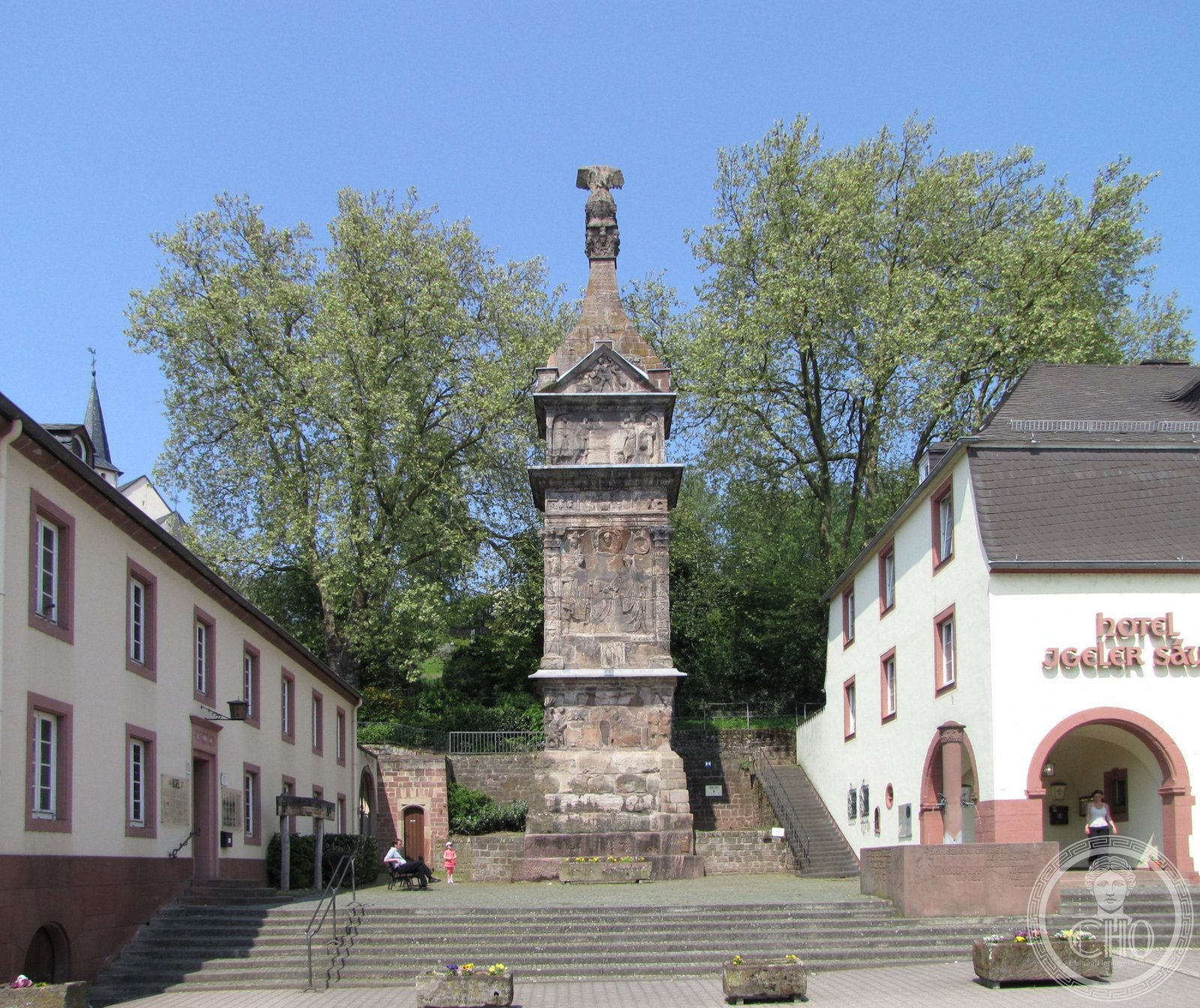
A 23-metre Roman sandstone monument to a prosperous cloth merchant family, crowned with Jupiter and Ganymede and carved with scenes of rural life and devotion.
At a glance
The Igel Column rises from the countryside near Trier as one of the finest surviving funerary monuments of the Roman Empire. Built around 250 AD by two wealthy brothers of the Secundinii family, it stands as testimony to their status and the commercial vitality of Roman Trier. The monument combines architectural grandeur with intimate domestic detail, revealing the world of a provincial elite through carved stone.
History
The column was commissioned by Lucius Secundinius Aventinus and Lucius Secundinus Securus as a burial monument for their cloth merchant family. Built in the mid-third century, it marks a period when Trier was among the wealthiest and most important cities in the western Roman world. The monument’s survival through the centuries—remarkably intact—makes it an exceptional document of Roman provincial life and funerary practice.
What you see
The column rises 23 metres on a four-stepped base and relatively low podium, topped by a projecting cornice. Its main shaft features flat Corinthian pilasters with decorated shafts, supporting an architrave, sculptured frieze and heavy cornice. The crowning element depicts Jupiter and Ganymede in sculptural form.
The bas-reliefs encircling the monument show a procession of six farm workers (coloni) approaching the master’s house with offerings: a hare, two fish, a kid, an eel, a rooster and a basket of fruit. They are shown being received at the entrance to the atrium. Originally painted in bright colours, the monument is now carved from red and red-grey sandstone, its pigments largely vanished.
Cultural significance
The Igel Column testifies to Trier’s prominence as a major economic and administrative centre under Roman rule. Its detailed reliefs provide rare visual evidence of daily life, labour relations and domestic architecture in the Roman provinces. The monument has inspired artists for centuries; a polychromed replica now stands in the Rheinisches Landesmuseum Trier, allowing visitors to glimpse its original painted splendour.
Key facts
- Country: Germany
- City: Igel, near Trier
- Coordinates: 49.7092° N, 6.5494° E
- Designated UNESCO World Heritage Site (Roman Monuments, Cathedral of St. Peter and Church of Our Lady in Trier) in 1986
- Height: 23 metres (75 feet)
- Date: c. 250 AD
Practical information & getting there
The column stands in the municipality of Igel, near Trier in western Germany, close to the Luxembourg border. It remains in its original location in the open air. The nearby Rheinisches Landesmuseum Trier houses a polychromed replica and provides context for understanding the monument’s original appearance and significance.
Sources & resources
Find it on the map
See this place and what’s around it →📷 Become a Cultural Heritage Online photographer
Share your photos of places: they stay published under your name as the author. The more they're seen, the more you get noticed — and soon a contest will reward the most appreciated photos.
Log in or sign up free to add a photoIs this page about you?
This page is read by travellers and heritage enthusiasts who find it on Google. Tell us how you are connected to this place and we will take it from there.