

Helsinki once bought its irons and coffeepots here. The building that sold the city electricity is now the building where the city sleeps.
At a glance
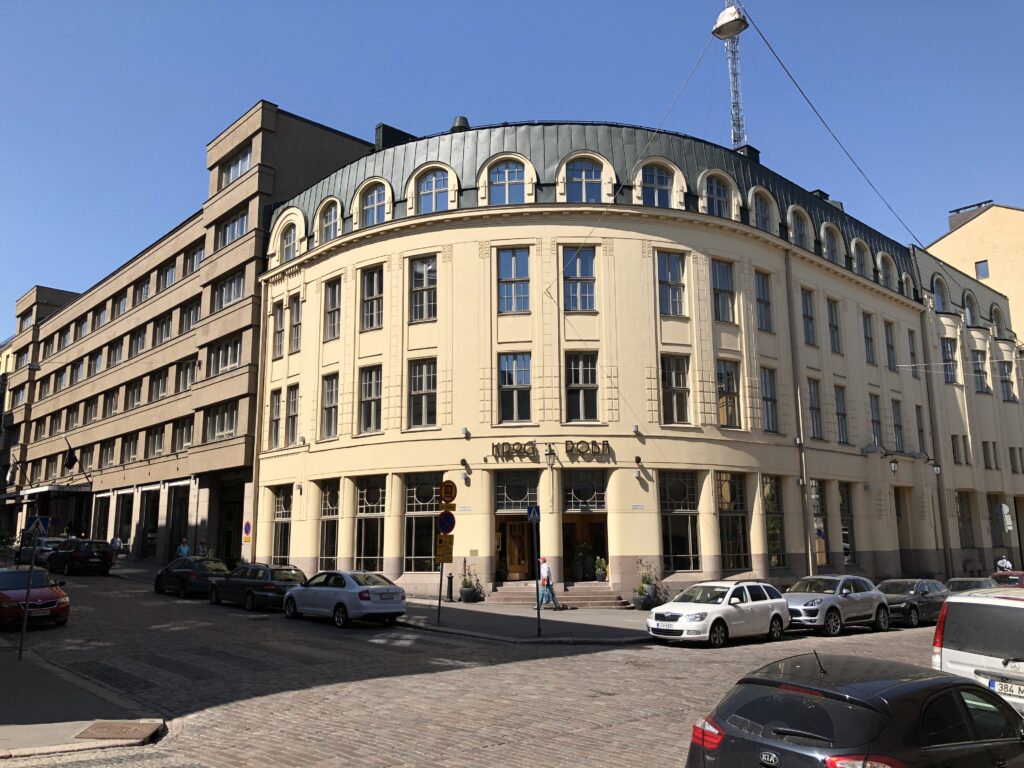
On the corner where Pieni Roobertinkatu meets Kasarmikatu stands a pale cream block with a rounded shoulder and a dark metal roof. It is one of the few buildings in central Helsinki whose original purpose was to sell electricity to people who had never owned any. The city electricity works opened an administration building here in 1909 and put an exhibition inside it: foot warmers, heat radiators, irons, coffeepots, lamps. A substation worked in the same complex, feeding the grid of the city centre. The machinery is long gone and the rooms are now a hotel, but the curve of the corner and the arched dormers cut into the roof are the ones the electricity works built.
Key facts
- Address: Pieni Roobertinkatu 1–3 / Kasarmikatu 30–32, Kaartinkaupunki, 00130 Helsinki
- Built: administration building of the Helsinki city electricity works, opened 1909
- Architect: attributed to Selim A. Lindqvist (1867–1939)
- Original use: offices and showroom of the municipal electricity works; the Kasarmitori substation stood in the same complex
- Current use: Hotel Lilla Roberts
- Coordinates: 60.164572, 24.947027 · open in Google Maps
History
Helsinki municipalised its electricity supply in the first years of the twentieth century, and the new utility faced a problem that had nothing to do with engineering: almost nobody owned anything that ran on current. The answer was a shop. In 1909 the electricity works opened an exhibition in its new administration building at the corner of Pieni Roobertinkatu and Kasarmikatu, and filled it with the appliances a household might be persuaded to want — foot warmers and other heat radiators, irons, coffeepots, lamps.
The building worked as three things at once: an office for the utility, a showroom for its customers, and part of the technical plant that made the supply possible. The Kasarmitori substation, recorded under this address in the Helsinki City Museum photographic archive, sat inside the same complex and fed the centre of the city. Offices and machinery shared a wall, which was normal for municipal utilities of that generation and is rare to find standing now.
The complex did not arrive all at once. Walk the two street fronts and the joins are visible: the rounded corner block, and beyond it a plainer, greyer mass of a different date and temper. The electricity works left in the end, the rooms were converted, and the hotel that opened here took its name from the street — Lilla Robertsgatan, the Swedish name for Pieni Roobertinkatu.
What you see
The corner is the whole argument. Instead of meeting at a right angle the two facades bend into a single curved face, and the roof follows: a broad band of dark seamed metal, swung round the curve, with a row of arched dormer windows cut into it one after another. Below, the wall is rendered in a flat warm cream, scored into shallow bays, with small square motifs ranged along the top of the window zone — geometric, repeated, restrained. This is the Helsinki of 1909 stepping away from the heavy carved stone of the National Romantic years and towards something smoother, before classicism arrived in full.
At street level the building still behaves like a shop. The ground floor opens in tall glazed bays set between plain piers, with round oculi punched above them, all of it standing on a plinth of pink-grey granite that runs unbroken round the corner. The entrance sits in the middle of the curve under lettering in a soft geometric alphabet. On a clear day the granite holds the light at the bottom of the wall while the render goes almost white above it, and the dark roof reads as a single drawn line against the sky.
Practical information
- The building is a working hotel. The exterior can be seen from the street at any hour; the interior is accessible to guests and to customers of the ground-floor bar and restaurant.
- Best light on the curved corner is late morning to early afternoon, when the sun reaches the Pieni Roobertinkatu face.
- Ten minutes on foot covers the block and the two street fronts.
- Kaartinkaupunki is flat and paved; the surrounding streets are cobbled in places.
Getting there
The corner is in Kaartinkaupunki, in the southern grid of central Helsinki, about fifteen minutes on foot from Helsinki Central Station and five from Esplanadi. Trams serve Kasarmikatu and the nearby Erottaja and Kasarmitori stops. From Helsinki Airport the Ring Rail line reaches the Central Station in roughly thirty minutes, and the walk south from there runs through the Esplanadi gardens.
Nearby
- Kasarmitori, the former parade square that gives the substation its name, one block north-east.
- The Design District shops and studios, which fill the streets immediately west.
- Esplanadi and the harbour market, a short walk north.
Sources
- Helen Ltd, company history — the 1909 opening of the electricity works exhibition in the new administration building at the corner of Pieni Roobertinkatu and Kasarmikatu, and the appliances shown there. Helen is the successor of the Helsinki city electricity works.
- Helsingin kaupunginmuseo (Helsinki City Museum), photographic record Helsingin kaupungin sähkölaitos, Kasarmitorin sähköasema, Pieni Roobertinkatu 1 – Kasarmikatu 30, Finna.fi.
- Museum of Finnish Architecture, Selim A. Lindqvist (1867–1939) — the architect’s dates and principal works. The Museum’s list does not include this building, and the attribution here is therefore given as an attribution.
- OpenStreetMap / Nominatim — address and coordinates, verified against the building footprint at Pieni Roobertinkatu 1–3.
Find it on the map
See this place and what’s around it →📷 Become a Cultural Heritage Online photographer
Share your photos of places: they stay published under your name as the author. The more they're seen, the more you get noticed — and soon a contest will reward the most appreciated photos.
Log in or sign up free to add a photoIs this page about you?
This page is read by travellers and heritage enthusiasts who find it on Google. Tell us how you are connected to this place and we will take it from there.