
The railway needed the ground that Santa Lucia stood on. Her church was pulled down, and in 1863 her body was carried here — which is why a station, a church and a saint in Venice all carry the same name.
At a glance
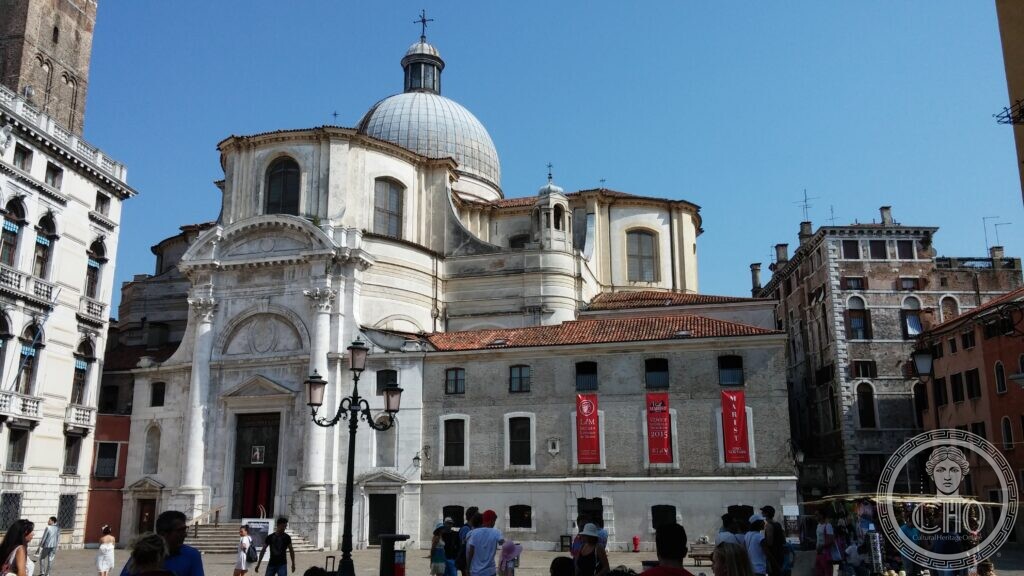
San Geremia stands where the Cannaregio canal meets the Grand Canal, its flank on the campo and its dome visible from the water on both sides. The church is old in foundation and eighteenth century in what you see: Carlo Corbellini designed the present building in 1753 and the first mass was said in it on 27 April 1760. The brick bell tower beside it is far older, probably of the twelfth century. Since 1863 the church has held the body of Saint Lucy of Syracuse, and it is a place of pilgrimage on that account.
Key facts
- Architect of the present church: Carlo Corbellini, 1753
- First mass: 27 April 1760
- Fronts on the campo and the Cannaregio canal: finished in 1861
- Bell tower: brick, two narrow Romanesque two-light windows at the base, probably 12th century
- Saint Lucy: her body was brought from Constantinople during the Fourth Crusade in 1204; here since 11 July 1863, when the church of Santa Lucia was demolished for the railway station
- Inside: marble statues of Saint Peter and the prophet Jeremiah by Giovanni Ferrari, 1798; works by Palma il Giovane; sculpture by Giovanni Maria Morlaiter and Giovanni Marchiori
- GPS: 45.44263, 12.32520 · Open in Google Maps
History
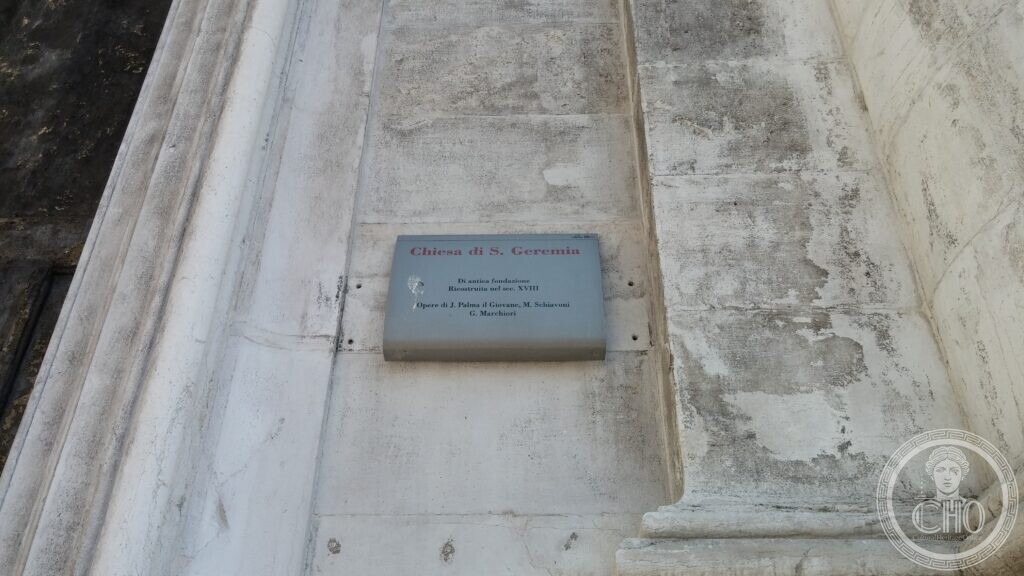
The church is of ancient foundation, rebuilt more than once; the plaque on its own wall says only di antica fondazione, ricostruita nel sec. XVIII. That rebuilding is the one that counts for what stands here: Corbellini’s design of 1753, a Greek cross under a dome, with the first mass celebrated in the spring of 1760. The two fronts, towards the campo and towards the Cannaregio canal, were not finished until 1861, a century after the church opened.
What made it a destination came two years after that. The body of Saint Lucy had been in Venice since 1204, carried off from Constantinople in the Fourth Crusade, and kept in a church of her own near the western end of the city. In the 1860s that church was demolished to clear ground for the railway station — which is why the station is called Santa Lucia and the saint is not in it. On 11 July 1863 her body was moved to San Geremia, where it lies under the high altar. An inscription cut where the boats pass asks, in the voice of the saint, for light and peace for Italy and for the world.
What you see
From the campo the church reads as a plain stone box carrying a lead dome and a lantern, with a second, smaller dome behind. The wall is undecorated to the point of severity, and the effect is that the dome does all the work. The bell tower stands apart at the left, in bare brick, with the two slim Romanesque openings near its foot: six centuries older than the building it now serves, and the only part of the site that looks its age.
Nearby
- The War Memorial of the San Geremia Parishioners — on the outside wall of this church
- Palazzo Flangini — forty metres away on the Grand Canal
Sources
- Wikipedia (Italian), Chiesa di San Geremia: Corbellini’s design of 1753, the first mass of 27 April 1760, the fronts finished in 1861, the twelfth-century bell tower, the arrival of Saint Lucy’s body on 11 July 1863 after the demolition of her own church for the station, the inscription on the Grand Canal, and the works inside
- The plaque on the church wall, read from the contributed photograph: Chiesa di S. Geremia — di antica fondazione, ricostruita nel sec. XVIII
Gallery
Find it on the map
See this place and what’s around it →📷 Become a Cultural Heritage Online photographer
Share your photos of places: they stay published under your name as the author. The more they're seen, the more you get noticed — and soon a contest will reward the most appreciated photos.
Log in or sign up free to add a photoIs this page about you?
This page is read by travellers and heritage enthusiasts who find it on Google. Tell us how you are connected to this place and we will take it from there.