

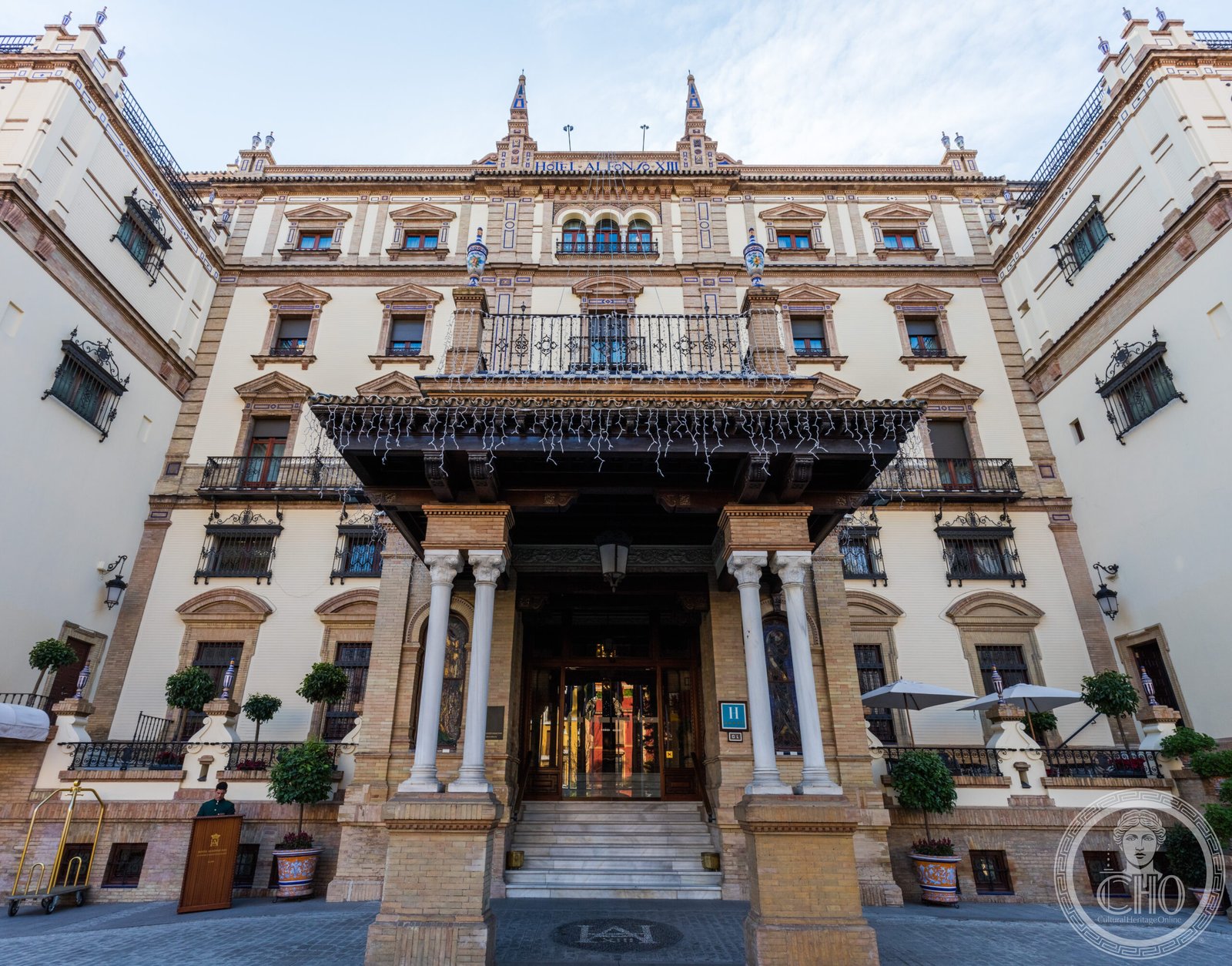
Commissioned as a royal showpiece for the 1929 Ibero-American Exhibition, this palace hotel fuses Moorish geometry, Baroque ironwork, and hand-painted azulejo into one of Spain’s most decorated interiors.
At a glance
José Espiau y Muñoz (1879–1938) designed the Alfonso XIII as a landmark civic gesture: a luxury hotel that would represent Andalusia to the world at an international exposition. The building draws on Neo-Mudéjar tradition — arched colonnades, polychrome ceramic panels, carved plasterwork — while packaging it all within a formally symmetrical block fit for a European grand hotel. Today the property operates as a Marriott Luxury Collection hotel with 151 rooms, and it remains one of the most significant examples of early-twentieth-century Spanish regionalist architecture still in active hotel use.
Key facts
- Built: 1916–1928 by José Espiau y Muñoz (1879–1938)
- Style: Neo-Mudéjar / Andalusian Regionalism
- Status: Operating luxury hotel (Marriott Luxury Collection, 151 rooms)
- Address: Calle San Fernando, 2, 41004 Seville, Spain
- GPS: 37.38222, -5.99222 — Open in Google Maps
- UNESCO/Listed: No national monument listing confirmed; within Seville’s historic centre (UNESCO World Heritage buffer zone)
History
Construction began in 1916, twelve years before the hotel opened its doors. The project was driven by the city’s ambition to host the Ibero-American Exposition of 1929, and the municipality needed lodging commensurate with the event’s diplomatic scale. Espiau y Muñoz — Seville’s leading regionalist architect — was chosen to produce a building that would read as quintessentially Andalusian while meeting the comfort standards expected of a grand international hotel.
The hotel opened on 28 April 1929 and was inaugurated by King Alfonso XIII and Queen Victoria Eugenie, lending it its permanent name. When the Second Spanish Republic was proclaimed in 1931 the hotel was briefly renamed Hotel Andalucia Palace, a politically safer designation. The monarchy fell, but the building’s ornamental identity proved more durable than its royal patron: after the Civil War the original name was quietly restored.
The City of Seville retains ownership of the property. Day-to-day management passed through several international hotel groups across the twentieth century before Marriott International took over under its Luxury Collection brand, a position it holds today. The building has been subject to periodic restoration campaigns preserving its ceramic and plasterwork surfaces.
What you see
The exterior rises across a formally composed façade of warm brick punctuated by horseshoe-arched windows, elaborately carved alfiz frames, and bands of polychrome azulejo tile. Wrought-iron balconies trace each upper floor in a rhythm characteristic of Sevillian regionalist work. The corner towers and the central entrance portal concentrate the ornamental programme, drawing the eye upward toward carved stone cresting along the roofline. The building sits on Calle San Fernando directly adjacent to the University of Seville, making its silhouette inseparable from the civic promenade linking the cathedral quarter to the María Luisa Park.
Inside, the building organises itself around a large Andalusian courtyard — a glazed patio whose arched galleries rise on two storeys of marble columns. Bohemian crystal chandeliers hang above marble and wood floors. Six banqueting halls carry distinct decorative programmes: Castilian, Baroque, and Mozarabic schemes coexist within the same building. Hand-painted tile dados run throughout the ground-floor corridors, and the Royal Suite preserves original furnishings consistent with the hotel’s 1929 inaugural character.
Practical information
- Open to hotel guests; the lobby, courtyard, and bar are accessible to non-residents during hotel hours
- Best visited in spring (March–May) or autumn (September–October) to avoid Seville’s intense summer heat
- Guided architectural tours are not offered as a standard programme; concierge can assist with bespoke arrangements
- Estimated visit time for non-guests exploring public areas: 30–45 minutes
Getting there
Seville–San Pablo Airport (SVQ) lies approximately 10 km north-east of the hotel; taxi or airport bus to the city centre takes 20–30 minutes. From Santa Justa railway station, a taxi takes under 10 minutes. On foot from the Seville Cathedral, the hotel is a five-minute walk south along Calle San Fernando, past the university building.
Nearby
- Real Alcázar of Seville — Royal palace complex begun in the tenth century, one of the oldest royal residences in Europe still in use; a five-minute walk.
- Seville Cathedral and Giralda Tower — The world’s largest Gothic cathedral, with a Moorish minaret converted into a bell tower; five minutes on foot.
- Plaza de España — A sweeping semi-circular pavilion built for the same 1929 Exposition, designed by Aníbal González; ten minutes south through the María Luisa Park.
- Barrio Santa Cruz — The former Jewish quarter, a dense network of whitewashed lanes immediately east of the Alcázar.
Sources
Find it on the map
See this place and what’s around it →📷 Become a Cultural Heritage Online photographer
Share your photos of places: they stay published under your name as the author. The more they're seen, the more you get noticed — and soon a contest will reward the most appreciated photos.
Log in or sign up free to add a photoIs this page about you?
This page is read by travellers and heritage enthusiasts who find it on Google. Tell us how you are connected to this place and we will take it from there.