

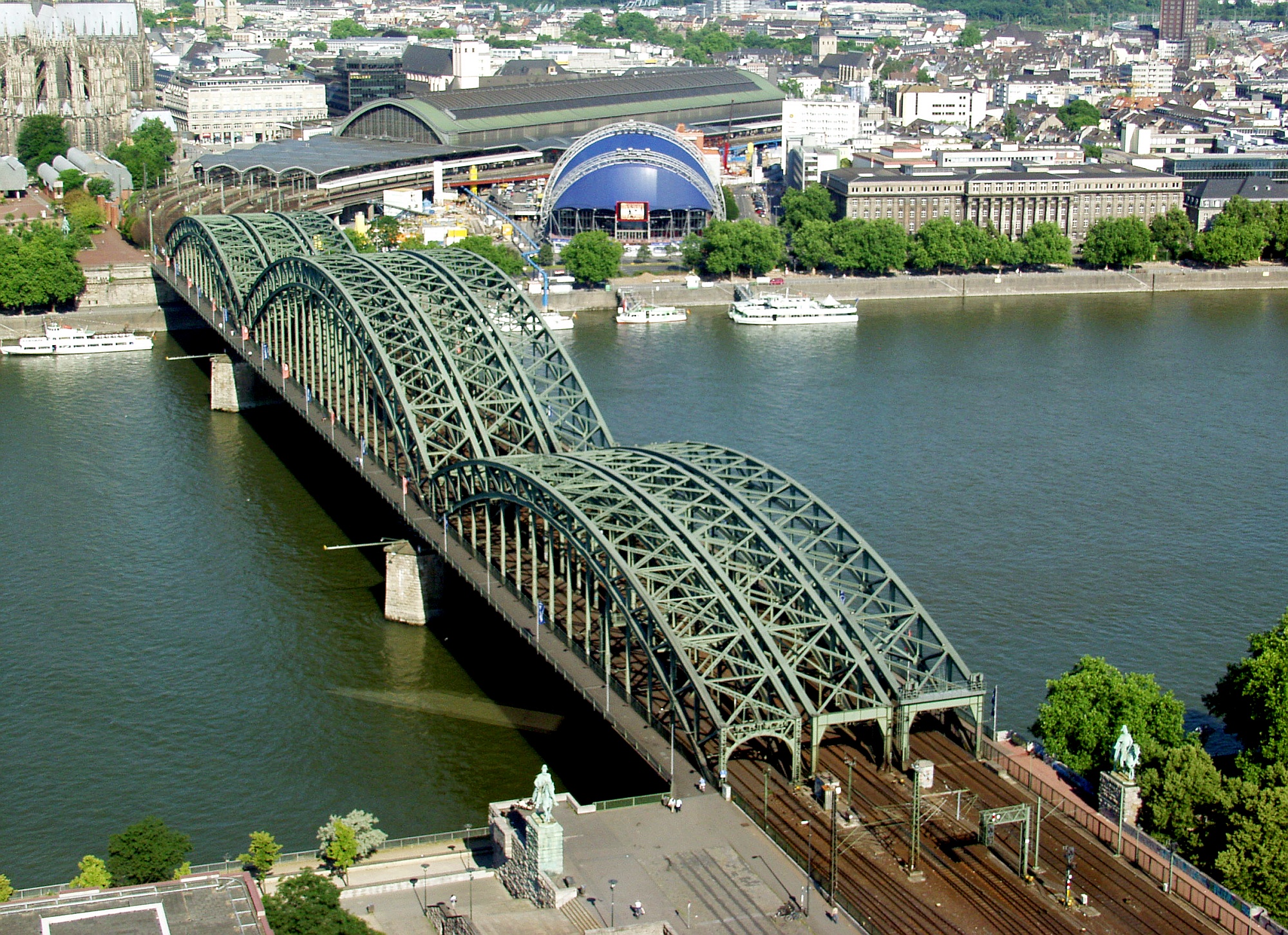
Germany’s busiest railway bridge spans the Rhine with over 1,200 trains daily, connecting Cologne’s central stations and serving both commuters and pedestrians since its postwar reconstruction.
At a glance
The Hohenzollernbrücke crosses the Rhine at kilometre 688.5, functioning as the vital artery linking Köln Hauptbahnhof and Köln Messe/Deutz stations. Rail and pedestrian traffic flow continuously across this engineering landmark.
History
Originally constructed as a combined railway and road bridge, the structure served multiple transportation modes until its destruction in 1945. Following World War II, it was reconstructed with a modified design: rail and pedestrian access only, eliminating vehicular traffic that once crossed it.
What you see
The bridge’s steel framework spans the broad Rhine, engineered to support the intensive daily traffic of regional and long-distance trains. Its postwar reconstruction reflects mid-twentieth-century bridge design adapted to pedestrian and railway use.
Cultural significance
The Hohenzollern Bridge serves as a critical transport infrastructure that defines modern Cologne’s connectivity. Its resilience through destruction and rebuilding symbolizes the city’s reconstruction era, while its status as Germany’s most heavily used railway bridge underscores its ongoing importance to the nation’s rail network.
Key facts
- Country: Germany
- City: Cologne (Köln)
- Coordinates: 50.9414, 6.9656
- Over 1,200 trains cross daily
- Destroyed in 1945; reconstructed postwar
- Current function: rail and pedestrian bridge only
Practical information & getting there
The bridge connects Köln Hauptbahnhof (the main railway station) with Köln Messe/Deutz on the Rhine’s eastern bank. You can cross on foot or by train during regular service hours. Access is available via both terminus stations.
Sources & resources
Find it on the map
See this place and what’s around it →📷 Become a Cultural Heritage Online photographer
Share your photos of places: they stay published under your name as the author. The more they're seen, the more you get noticed — and soon a contest will reward the most appreciated photos.
Log in or sign up free to add a photoIs this page about you?
This page is read by travellers and heritage enthusiasts who find it on Google. Tell us how you are connected to this place and we will take it from there.