
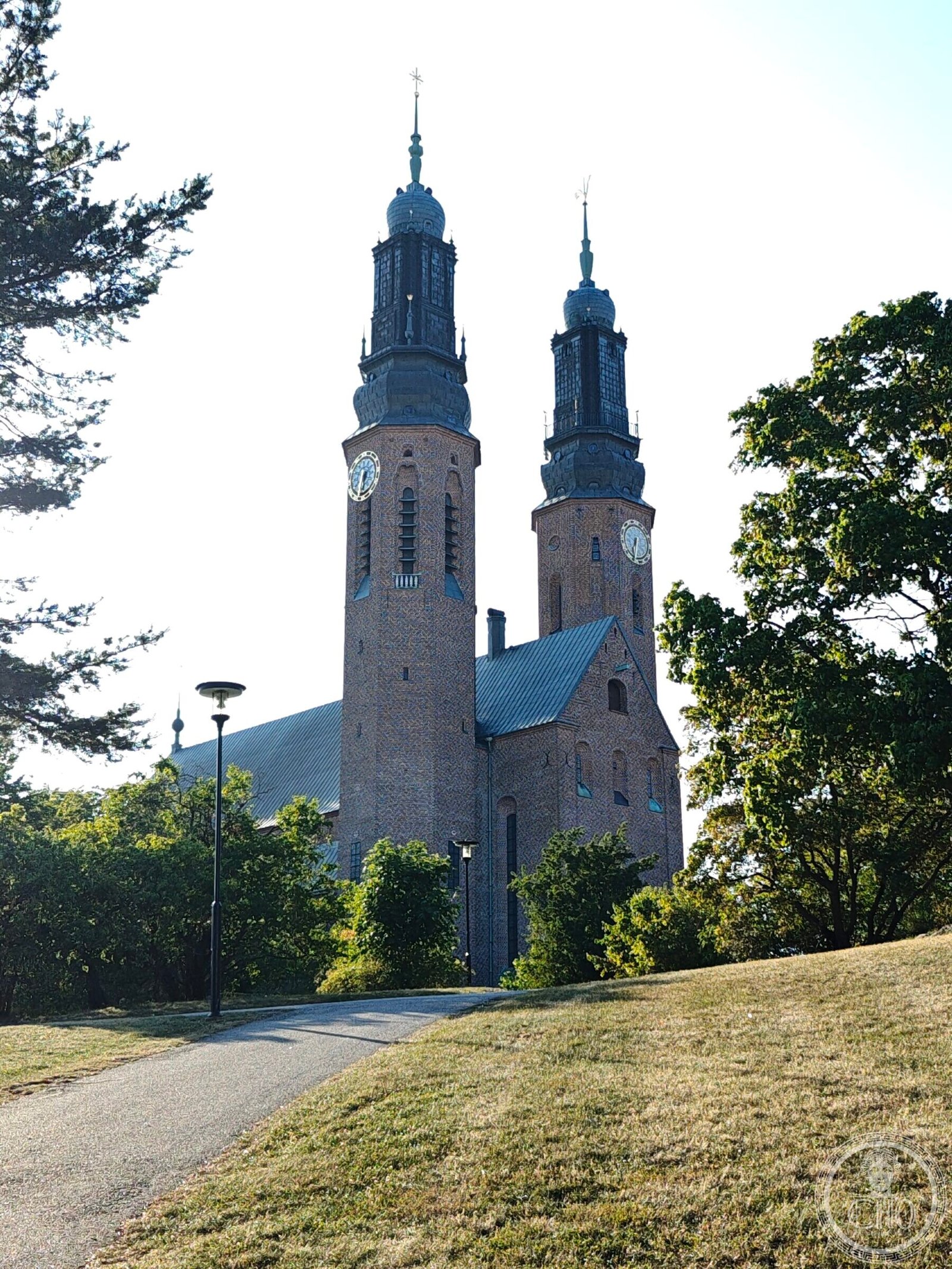
On a hill above Hornstull, Ivar Tengbom raised a parish church with two towers that are deliberately not a pair. It was consecrated a fortnight before the tower across the water opened.
At a glance
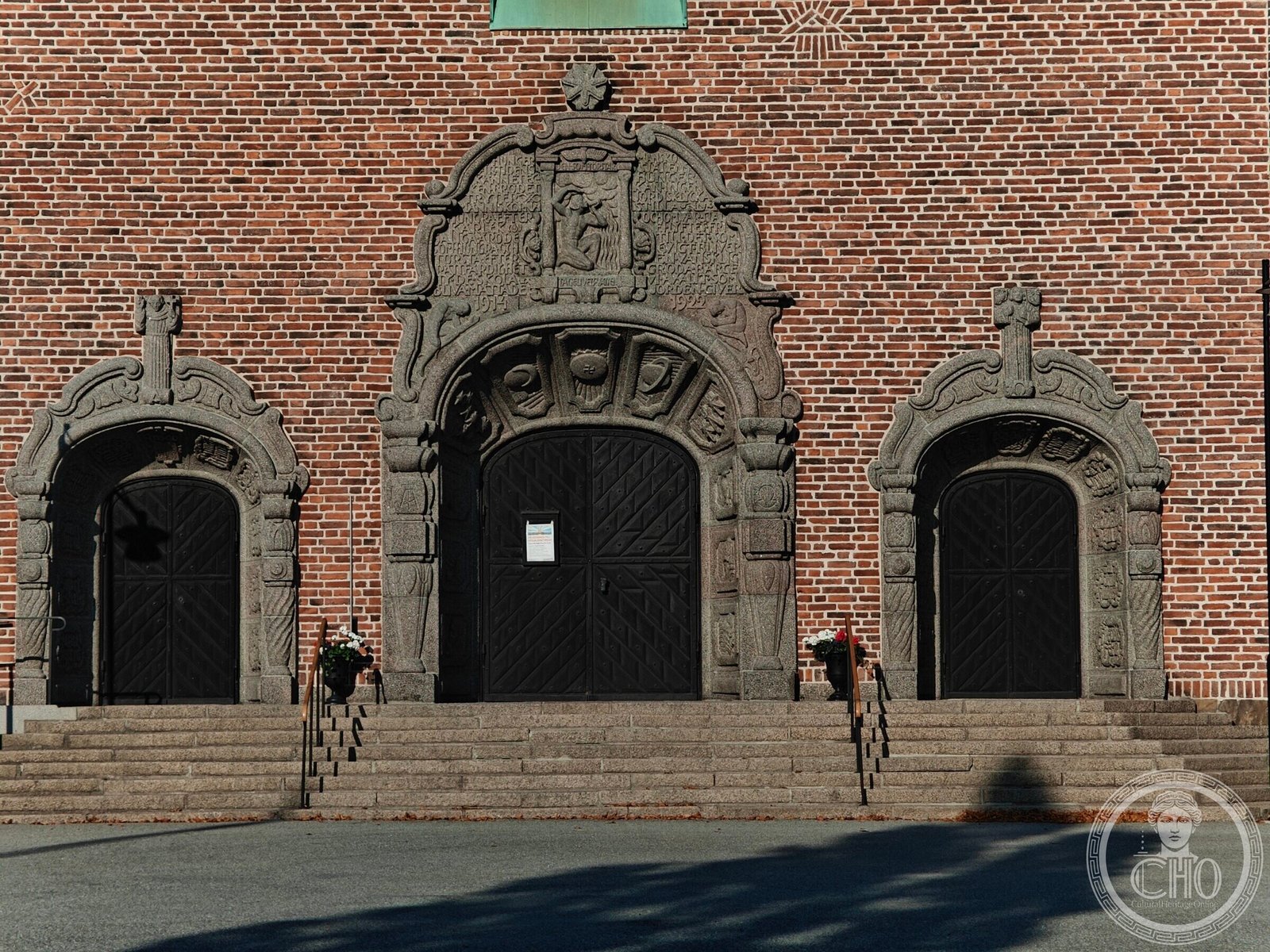
Högalidskyrkan crowns Högalidsberget, a low hill at the western tip of Södermalm known as Hornstull. Ivar Tengbom (1878–1968) won the design in an open competition in 1913. Construction ran from 1916, and Archbishop Nathan Söderblom consecrated the finished church on 10 June 1923 — two weeks before Ragnar Östberg’s Stockholm City Hall opened directly across the water. Built of dark red brick from the Mälardalen with a carved granite portal, it is counted among the finest works of Swedish National Romanticism, and its two towers, reaching roughly 100 metres above Lake Mälaren, are visible across much of the city.
Key facts
- What it is: an active parish church of the Church of Sweden (Högalids församling)
- Where: Högalids Kyrkväg 13, 117 30 Stockholm, on Högalidsberget above Hornstull
- Built: 1916–1923; foundation stone laid 1917; consecrated 10 June 1923
- Architect: Ivar Tengbom (1878–1968), winner of the 1913 design competition
- Style: National Romanticism, drawing on medieval church building
- Materials: dark red hand-moulded brick, carved granite portal
- Towers: two, unequal — Ansgar to the north (77.88 m) and Olaus Petri to the south (78.92 m)
History
By the end of the 19th century the growing western end of Södermalm had outgrown its parish churches. In 1905 the Maria Magdalena congregation acquired the hilltop site on Högalidsberget, first for a chapel. In 1913 Tengbom won the competition to design something larger: a full parish church for the district. Work began in 1916, the foundation stone was laid in 1917, and just over six years later, on 10 June 1923, Archbishop Nathan Söderblom consecrated Högalidskyrkan — a fortnight before Östberg’s City Hall opened on the opposite shore.
Tengbom, one of the architects who defined Swedish building in the 1910s and 1920s, is buried inside the church he designed, in a pillar of the nave’s south arcade.
What you see
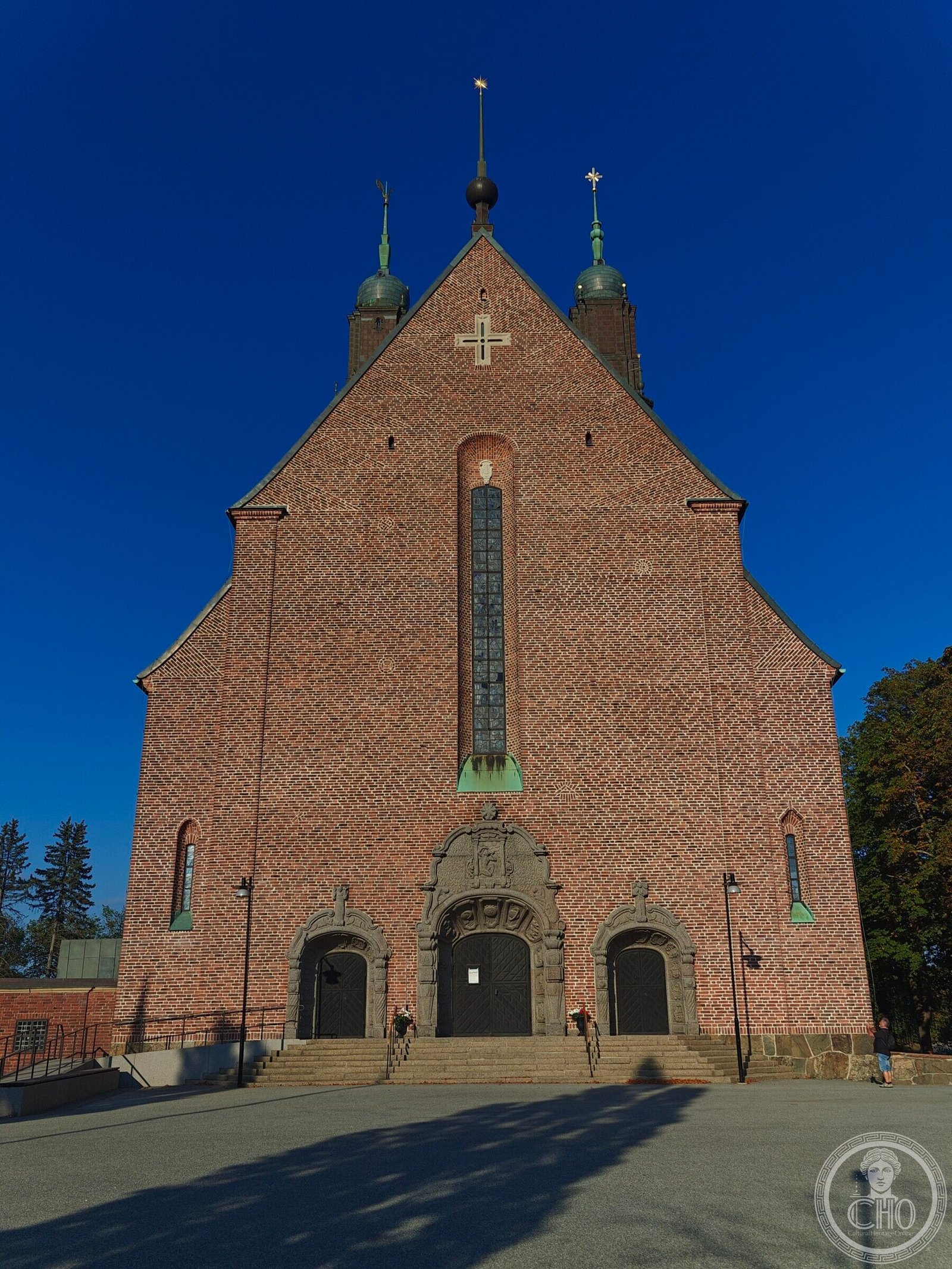
The two towers are the building’s signature, and they were designed not to match. Ansgar, the northern tower, is topped by a weathervane and read as an image of divine law. Olaus Petri, the southern tower — named for the Swedish reformer — carries a golden cross instead. Parish tradition describes it as “more open and luminous in character,” standing for the Gospel that the church’s bells carry over the city. Between the towers, the brick gable climbs to a stone cross above a tall stained-glass window.
Inside, the church holds what is described as the largest crucifix in Scandinavia, carved by Gunnar Torhamn, alongside stained glass by Oskar Brandtberg, a fresco of Veronica by Olle Hjortzberg, and ceiling and mosaic work by Einar Forseth. A 16th-century baptismal font and 18th-century altar candelabra, both older than the building, were brought in when it opened.
Why it matters
Högalidskyrkan and Stockholm City Hall went up in the same years and were finished a fortnight apart. Tengbom’s brick towers on their hill still answer Östberg’s tower across the Riddarfjärden, one religious and one civic, a pairing the Stockholm skyline has kept ever since. The church closed for a full restoration between March 2021 and June 2023, reopening in time for its own centenary.
Practical information
- Open daily, 9:00–17:00; admission is free
- Sunday services at 11:00 and 18:30; a shorter Wednesday service at 12:00 in the adjoining St Ansgar chapel
- The parish community hall and parsonage beside the church, and a 1939 columbarium and mosaic-decorated chapel in the graveyard, are also Tengbom’s work
Getting there
Högalidskyrkan stands on its own hill above Hornstull, at the western end of Södermalm. The Stockholm metro’s red and green lines both stop nearby, at Zinkensdamm and Hornstull, with several bus routes serving Hornstull as well. On foot, a path climbs the hill from Högalidsgatan to the church.
Sources
- Högalids församling, Church of Sweden, “Om Högalidskyrkan” and “Öppettider”: address, tower names, heights and symbolism, materials, interior artists, opening hours.
- Tengbom (Ivar Tengbom’s architecture studio), “Högalidskyrkan by Ivar Tengbom”: construction period, height above Lake Mälaren, 2021–2023 restoration.
- Wikipedia, “Högalid Church”: overview and National Romantic classification.
- Photographs supplied to Cultural Heritage Online by Andrea Manzo, September 2026.
Find it on the map
See this place and what’s around it →Record researched and written by Andrea Manzo for Cultural Heritage Online, 2026.
📷 Become a Cultural Heritage Online photographer
Share your photos of places: they stay published under your name as the author. The more they're seen, the more you get noticed — and soon a contest will reward the most appreciated photos.
Log in or sign up free to add a photoIs this page about you?
This page is read by travellers and heritage enthusiasts who find it on Google. Tell us how you are connected to this place and we will take it from there.